
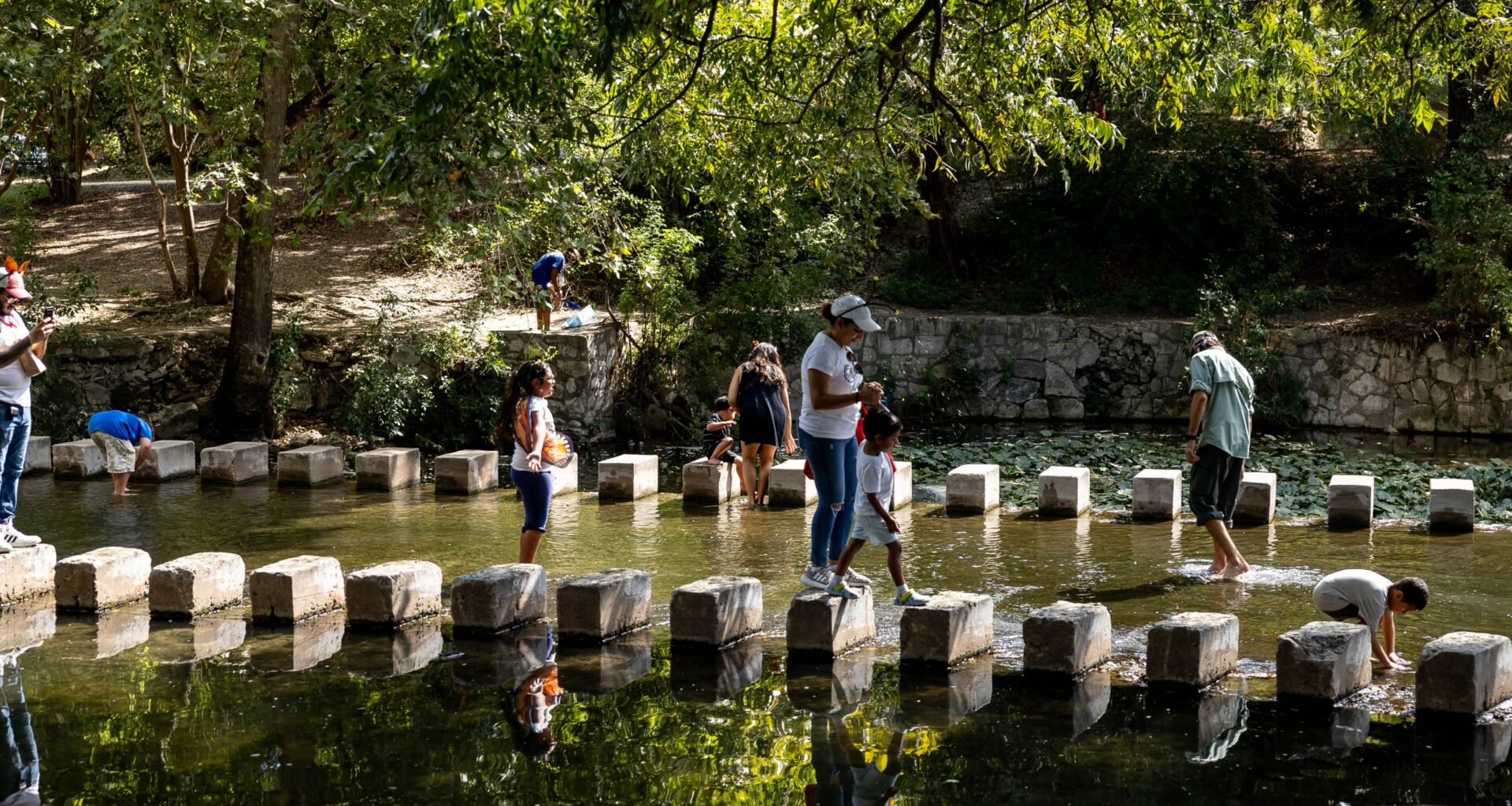
Before becoming one of San Antonio’s oldest parks, the area known as Brackenridge Park was treasured for its many water springs. The springs provided water to missions in the area, such as Mission San Antonio Valero — now known as the Alamo.
Brackenridge Park has served as a gathering place for 12,000 years with Native American artifacts found in the area dating back as far back as 9,200 B.C.
This year, the park celebrates 126 years since its founding with its second Brack Bash from noon to 4 p.m. on Saturday, Nov. 15 at the Sunken Garden Theater.
The Brackenridge Park Conservancy, a nonprofit organization dedicated to preserving and improving the park, is throwing the free, family-friendly event.
“Brack Bash is a love letter to the park,” said Britta Ramirez, the Brackenridge Park Conservancy’s director of events and programs. “We want to make it bigger and better every year.”
Brack Bash will include a classic car show with the Viejitos San Anto car club, a petting zoo and performances from The Dirty River Jazz Band, The Jed Craddock Band and DJ A-Rod.
“We wanted the event to showcase the different things that happen at the park,” Ramirez said. “That’s why we have Los Viejitos and some great musicians coming out for Brack Bash.”
Who was George W. Brackenridge?
The park was founded in 1899 when philanthropist George W. Brackenridge donated 199 acres of his land holdings. He also donated land for the San Antonio Japanese Tea Garden, gave the Alamo Heights neighborhood its name, and lived in Fernridge estate, a museum on what is now the University of the Incarnate Word’s campus.
 A statue of George Brackenridge along Broadway Street in 2018. Credit: Scott Ball / San Antonio Report
Brackenridge was involved with the development of the San Antonio Water Works Company, a privately-owned company that would later become the public utility San Antonio Water System.
It was through San Antonio Water Works that he would come to own and later donate the stretch of land surrounding current Brackenridge Park and part of the San Antonio Botanical Garden.
The philanthropist came into wealth through war profiteering during the Civil War. After being forced to flee Texas, he lived in Washington, D.C., where President Abraham Lincoln appointed him as an agent of the United States Treasury. He did similar work at the Treasury Department in New Orleans before being sent to Mexico as Lincoln’s representative to persuade former President of Mexico Benito Juárez to stop trading cotton with the Confederacy.
Brackenridge served on the University of Texas’ Board of Regents for 25 consecutive years from 1886 through 1911 and an additional three years from 1917 through 1920.
During his time as the first president of the San Antonio Independent School District’s Board of Trustees starting in 1899, Brackenridge funded scholarships for women studying medicine at Columbia University and supervised the opening of several schools for Mexican American and Black students. He provided funding for four schools dedicated to educating Black students and oversaw the construction of the Douglass School, the first free, public high school in San Antonio for Black students.
Brackenridge would never marry and never have children, so a majority of his estate was left to a trust to be used for educational purposes. The Brackenridge Foundation was started with this trust and has funded the education of hundreds of college students in San Antonio.
Now 400 acres, Brackenridge Park is home to two miles of the San Antonio River, three pavilions, and two trails. The park is listed on the National Register of Historic Places and is designated as a National Antiquities Landmark.
The Brackenridge Park Conservancy was established in 2008 by the City of San Antonio and San Antonio Conservation Society. It hosts events around the park, including weekly yoga and fitness classes.
More information is available on the park’s website.