
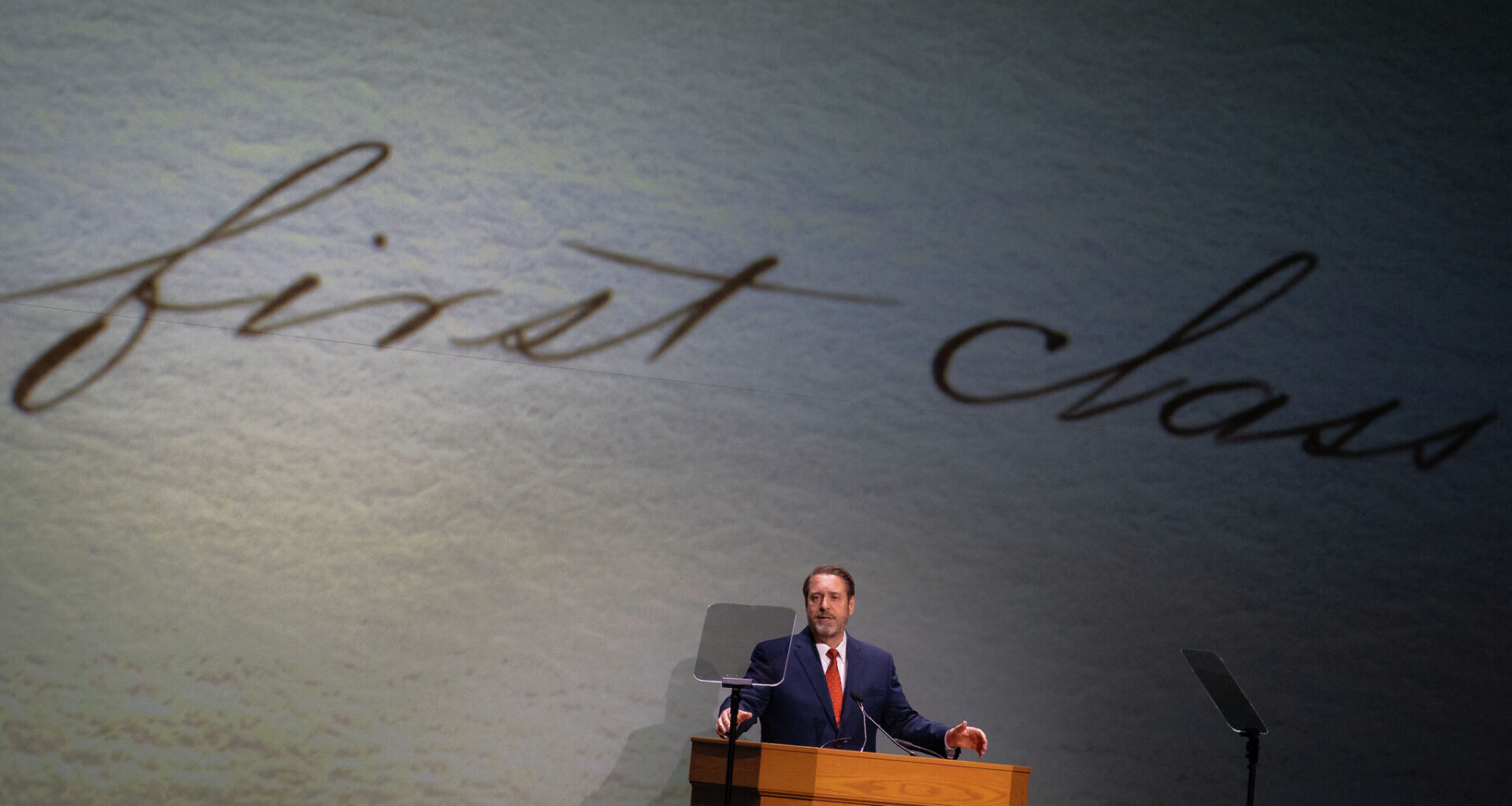
University of Texas President Jim Davis gives the annual State of the University Address to an audience seated in Hogg Auditorium, Oct. 21, 2026. At the address, Davis announced the creation of the new University College.
Sara Diggins/Austin American-Statesman
The University of Texas promised its new core curriculum will prepare 10,000 Longhorns a year for civic and professional success in place of the current “grab bag” system of requirements. On Wednesday, President Jim Davis announced a new college to protect those new standards.

Devin Stauffer, a longtime government and philosophy professor at the University of Texas who has authored books on Plato and Thomas Hobbes, will become the dean of UT’s new University College this January.
Article continues below this ad
Stauffer served as the chair of the task force that designed UT’s new core curriculum, which is set to roll out in fall 2028.
On Thursday, he said the new college will approve all courses that count toward UT’s new core; fundraise to support the courses, research and professors; and house the Center for Humanities, which had been set up under the provost’s office. The center had initially been billed as a home for new hires teaching core humanities courses.
Unlike UT’s other 17 colleges, University College will not offer majors. Instead, it will work as a “nexus for the whole university,” approving and overseeing undergraduate requirements to ensure UT’s core standards stay specific and rigorous, Stauffer said.
Article continues below this ad
“It’s very to be determined how large this college will be, how much it will do, its own hiring, and how much it will just facilitate what’s being done in other units,” Stauffer said. “As the dean of this new college, I’m going to cooperate with people all over the university. We’re going to need each other.”
Davis announced the new college during his state of the university address last week. He said it will oversee and act as a guardian of UT’s new core curriculum, which Stauffer said will be piloted next year and launch as soon as 2028. The new core reworks what all undergraduate students must learn across three categories: arts and humanities, STEM and social sciences.
The reform has been a hallmark of Davis’ presidency, driven by his goal of graduating students with an essential, shared foundation of knowledge. Davis has spoken about the need to balance and broaden courses and degree programs to restore public trust in UT, improve civil discourse and student values.
The new college — which does not yet have a known budget or physical home — will have three committees to review core courses to see if they meet the requirements. The college will also establish guidelines for what classes the core topic areas should include, such as lessons related to a list of 100 “great thinkers” throughout time.
Article continues below this ad
When asked to lead the core curriculum task force a year ago, Stauffer did not imagine the work would lead to a new college. Now, he believes it is necessary to guide, enact and preserve the new core.
Because Davis’s core model is a ground-up rebuild from the university’s prior core, faculty must submit course proposals to count toward one of the 12 new course requirements. UT will need hundreds of course sections to serve 10,000 students a year — a “math problem” the college will be in charge of solving, Stauffer said.
It won’t just be the University College that teaches the new classes. Stauffer, who currently works in the College of Liberal Arts, said he wants to “build as much connective tissue between COLA and this new unit” as possible, through joint hires and recruiting liberal arts professors to design and teach requirements.
Have an education question? Submit it below, and one of our reporters will get back to you.
Article continues below this ad
Controversy with the new core
After Davis announced the college’s creation, UT’s chapter of the American Association of University Professors condemned it as a “yet another example of a decision of enormous consequence for students’ education being made quickly, from the top, and without meaningful faculty governance or student consultation.” The AAUP is a national professor’s union with 2,600 Texas members.
To prepare for the new core, UT’s provost office cut dozens of Department of Social and Cultural Analysis courses from counting toward the requirements. The department was created when the university consolidated existing ethnic and gender studies departments this fall.
Article continues below this ad
AAUP chapter officials said losing the core designation and majors will gut enrollment in the department’s classes, starving the fields at the state’s flagship institution.
But the new core is meant to be focused and foundational, not reflective of professors’ research interests, Stauffer said. The strict guidelines are not meant to exclude perspectives or push a political agenda, he said.
“We’re not trying to create liberal students. We’re not trying to create conservative students,” Stauffer said. “We’re trying to create better educated students.”
The Center for Humanities — which opened this summer with little explanation or public promotion from UT — had 14 hires, about half of whom were also appointed in the Civitas Institute, a conservative think tank funded by the Texas Legislature in 2022 to increase the intellectual diversity of campus.
Article continues below this ad
Five Center for Humanities hires came from Provost William Inboden’s former institution, the University of Florida. That center will now operate under the new college.
Stauffer said the hiring process for staff who will teach the core is still being decided, but it will likely involve co-appointments with the University College and other relevant schools.
He wants to talk to faculty and students across the university to get them excited about the new core and hear ideas on how to improve it.
Article continues below this ad