
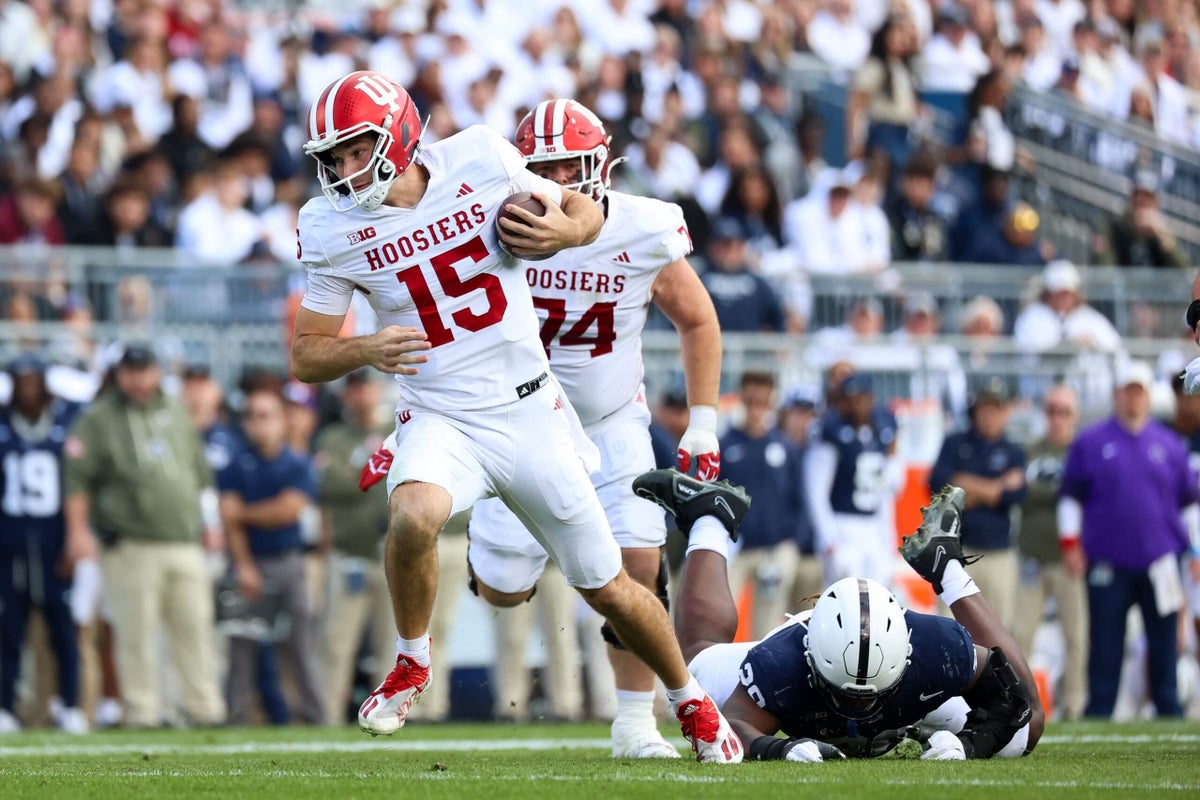
After two sets of College Football Playoff rankings, I’m struggling to find any juicy controversies to get mad about. But that’s probably because I’m not a fan of one of the contenders, where, unless your team is No. 1, there’s always a slight to be found.
I understand as an A&M fan that I might have some bias in this question, but at this point, what can you look at to actually make an argument that Indiana should be No. 2 over Texas A&M? — Garrett R.
I’d turn it around and say, what argument does Texas A&M have to be higher than Indiana?
The Hoosiers are ranked above the Aggies in pretty much every power rating. And they’re ranked higher statistically on both sides of the ball — Indiana has the No. 10 offense and No. 13 defense in yards per play; A&M is No. 19 and No. 39, respectively.
Their resumes are fairly similar, but even there, I’d give IU a slight edge. Its three best wins are 30-20 at No. 8 Oregon, 20-15 at No. 21 Iowa and 63-10 at home over 6-3, unranked Illinois. The Aggies won 41-40 at No. 9 Notre Dame, 38-17 at 6-3 and now-unranked Missouri (with its third-string QB) and 49-25 at 5-4 LSU.
In my unbiased opinion, the teams are ranked correctly for now.
As a side note, while we’re on the subject of Texas A&M, has anyone taken a close look at its conference schedule? Seth Emerson wrote a story earlier this week about SEC tiebreaker scenarios, and I was stunned by a stat in there: The Aggies’ eight league opponents currently have a combined conference record of 13-34. That includes Texas, who they haven’t played yet. Their six foes to date are a combined 8-27.
Indiana’s conference foes to date are slightly more respectable at 16-26, but the Hoosiers’ slate will end up looking much like A&M’s because they finish against 1-5 Wisconsin and 0-7 Purdue.
Unbalanced schedules for the win.
Stew: One of my favorite parts of the 12-team Playoff is how many teams have a realistic path to make the field well into November. But as a fun thought exercise, what kind of four-team debates would we be having today? Currently, we could enter conference title week with nine teams at 11-1 or better. — Nicholas R.
It’s a good thing the 12-team playoff format hit just as Big Ten and SEC expansion took hold, because chances are those leagues would have combined for at least three of the four berths every year under the old format.
The top two seeds are easy: the Ohio State-Indiana winner (presumably 13-0 or 12-1) and the SEC champion (presumably 13-0 or 12-1)
And if the Ohio State-Indiana loser is 12-1, that team gets the No. 3 seed.
Then the pecking order after that would likely be:
• A 12-1 Texas A&M team that loses in the SEC championship game.
• Alabama, Georgia or Texas A&M if any of them finish 11-1 but miss the title game.
• A 12-1 Big 12 champion Texas Tech
• An 11-1 Oregon team
• An 11-1 Ole Miss team, unless Georgia (who beat them) is 11-2
The most obvious difference between four and 12 is that Notre Dame would have been long-since eliminated. But also: No ACC or G5 team has a shot, and if Texas Tech loses at any point, the Big 12 is done.
Which is exactly why it had to expand. It would be an unhealthy sport if 102 teams (everyone outside of the SEC and Big Ten) go into the season knowing they’ve got almost no path to the CFP.
Hey Stew: Love your Sunday morning recap columns. I noticed in the comment section this week that people had a hard time understanding that Indiana’s win over Penn State, despite Penn State being 3-6, is still a tough task. People like to group all 3-6 teams as just “bad” and struggle to find nuance. Winning at Penn State or Florida, who each have future NFL players across the roster, is not easy! Can you speak to this at all from your perspective? — Andy J.
Yeah, that was lame. Winning on the road, against almost anyone, is hard. But to your point, labeling any team below .500 as “bad” is just lazy.
Case in point, Penn State and Wisconsin are both 3-6. Yet the two are ranked 70 spots apart in this week’s SP+ ratings at ESPN. Penn State, which has lost five of its conference games (all but Ohio State) by a combined 16 points and took top-10 Oregon to overtime, is ranked 20th. Wisconsin, which prior to last week’s upset of Washington, had lost six straight games by an average of 23.3 points, is 90th.
By no means am I saying that a last-minute win at 3-6 Penn State is exactly the same as a last-minute win at 6-3 Iowa, just that the degree of difficulty is closer than one might think.
People often suggest that the CFP should bring back the old BCS formula, which was two-thirds human polls and one-third computer ratings. But that approach involved nonsense math. For one thing, they neutered those computers by capping the margin of victory component, but also, power ratings aren’t designed to measure teams’ resumes; they measure how well they’ve performed regardless of record. They’re meant to be predictive, not retrospective.
The NCAA basketball committee does it right. It doesn’t use the NET rankings to assess the teams themselves; it uses them to assess the strength of the resumes — Quad 1 wins, Quad 2 wins, etc. I’d love to see football do something similar.
The LSU drama with Brian Kelly, Scott Woodward and Jeff Landry seems unprecedented. Given that Kelly just sued LSU, how does that impact Kelly’s chances at other schools as well as his compensation structure? — Vikas M.
I’m reticent to ever say anything in the SEC is “unprecedented,” and especially at LSU, where one former governor, Huey Long, got the state legislature to fund Tiger Stadium expansion by putting some dorm rooms inside of it, and another, Bobby Jindal, pressured LSU into keeping Les Miles for another season. What’s striking about this story, though, is that the people who didn’t trust Woodward to do his job have made it so much harder for the next athletic director to do his.
The governor went on record demanding the next coach’s contract include far less guaranteed money, which, while admirable, may scare off the most sought-after coaches.
The newly appointed president, Wade Rousse, named interim athletic director Verge Ausberry permanent AD almost the moment he got the job, then did an interview the next day where he referred to him as the “acting AD” and suggested he’ll reassess once he has more time on the job, which will surely leave candidates wondering whether Ausberry is going to be replaced once the coach is hired.
And now we have Kelly’s lawsuit, which paints a picture of comical dysfunction. The school is allegedly trying to get out of paying his full $53 million buyout by claiming Woodward lacked the authority to fire him without cause and that it could still fire Kelly for cause at some future date. This might make the potential next coach think twice about signing a contract that the school may later try not to honor.
If I’m Kelly, I’m not settling for a dollar less. If LSU had some incriminating evidence of wrongdoing, it would have already gone public with it. Kelly will need to be extra diligent about honoring the “duty to mitigate” clause in his contract. He has to make an earnest attempt to seek “qualifying employment,” by which his new salary would reduce the amount LSU owes him. He should formally apply for all the top jobs — Penn State, Florida, etc. — even though they are extremely unlikely to hire him. If he ends up landing an FCS job that pays him $350,000 a year, oh well. That’s LSU’s problem.
And here’s some delicious irony: By threatening to fire him for cause, it’s possible LSU scares away other schools from hiring him entirely. In which case, it could wind up owing him the full amount rather than a number reduced by offset.
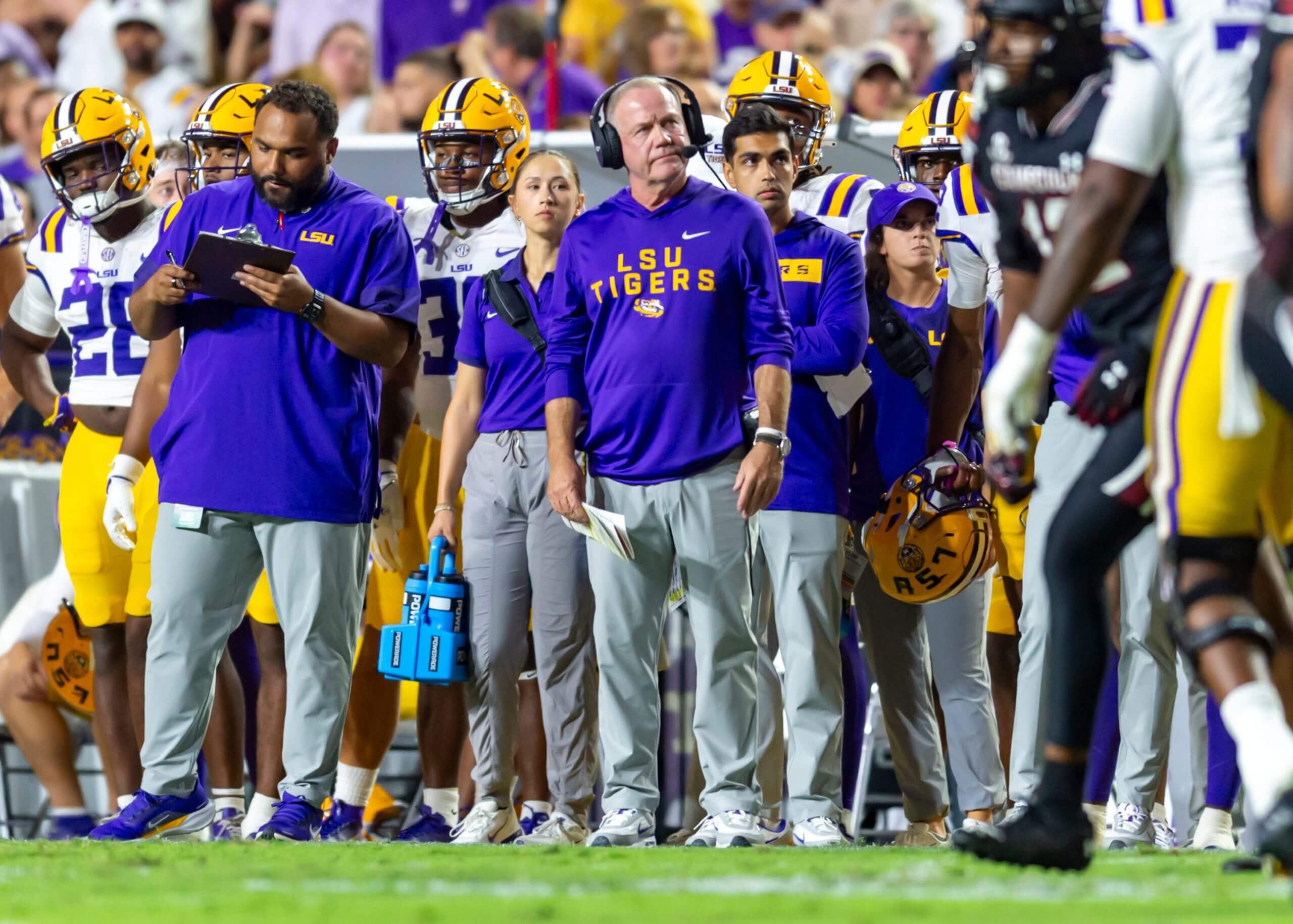
LSU fired Brian Kelly after a 5-3 start to his fourth season. (Scott Clause / USA Today Network via Imagn Images)
At this point, is LSU intentionally trying to hurt its chances of getting a big-name coach so it doesn’t have to worry about giving him a large buyout? — Faith G.
Wow. Hadn’t thought of that. Maybe the governor is smarter than I realized.
What are the chances the ACC is a zero-bid league in the CFP? Do the American, Sun Belt, and Mountain West have enough quality teams to surpass a 3-4 loss ACC champ? — Stephen O.
It’s a fun game to play, but no, that’s not happening. USF, 7-2, is currently the committee’s only G5 team, and at No. 24, the Bulls are ranked lower than No. 15 Miami, No. 16 Georgia Tech, No. 19 Virginia, No. 20 Louisville and No. 22 Pitt. Even if they win out, chances are they will still finish behind the ACC champ, unless …
… unless that champ is unranked Duke, which despite being 5-4 (with three non-conference losses) still controls its ACC fate. If the Blue Devils beat Virginia, UNC and Wake Forest, they will win any tiebreaker needed to get into the conference championship game. I’m still not sure it’s a guarantee American champ USF (or 8-1 North Texas, 7-2 Tulane or 7-2 Navy) finishes higher, given Duke could add two more Top 25 wins between now and then, but it’s a strong possibility.
The problem is, you’re not going to find another G5 champ to be the fifth AQ. I realize AP voters ranked 8-1 James Madison this week, but I’d be surprised if the Dukes enter the committee’s rankings at all. Their schedule strength is well into the 100s. The highest-ranked team they’ve beaten, according to SP+, is No. 66 Old Dominion. And, conveniently, they did play one of the ACC’s ranked teams, Louisville, and lost by two touchdowns.
Your only other possibility might be if 7-2 San Diego State or 7-2 UNLV finishes as an 11-2 Mountain West champ. The Aztecs at least have a 34-0 non-conference win over Cal. But unless the Bears win out and enter the rankings, SDSU will likely finish with no Top 25 wins. Ditto UNLV, with its best win coming against 3-6 Big Ten foe UCLA.
So, the ACC champ will be in. Period. And despite how dire those rankings look, don’t yet rule out the possibility of two bids. If Georgia Tech beats Georgia, gets to 11-1 but misses the ACC title game, the Yellow Jackets are in. And it’s not a stretch to think Miami can move up five spots over the next three weeks if it finishes 10-2. In fact, if the Canes close the gap with Notre Dame, and there’s only room for one of them, I’d bet the committee would invoke the head-to-head and flip them.
You mentioned Texas Tech and its “$25 million” roster. Seems like nearly every sportswriter, analyst or announcer always has to say something to this effect. It’s a lazy narrative. Why don’t you media people ever lead with Ohio State, Texas A&M or Texas and their multimillion-dollar rosters? — Bryan L.
Did you by chance read any article about Ohio State’s national title run last year? Because I’m pretty sure 95 percent (at least) mentioned the Buckeyes’ $20 million roster after AD Ross Bjork put that out there.
But also, Texas Tech is the only program I know of that openly advertises how much NIL money it spends on its athletes, including giving exact figures to the media, even for specific position groups. (Bjork stayed quiet this year.) It seems to me they want us to write the lazy narrative.
I remember a preseason article about winners and losers of the transfer portal that listed Georgia as a loser because it didn’t sign a quarterback. I think Gunner Stockton has convinced his doubters. Does this validate Kirby Smart’s roster/culture-building philosophy — Al
I, for one, severely underestimated Stockton, who was outstanding in wins against Tennessee, Ole Miss and, most recently, Mississippi State, and very good in several others. I also need to apologize to offensive coordinator Mike Bobo for my lack of confidence in him as well. While Smart is known primarily for defense, Smart deserves credit for developing Stockton, not to mention turning Stetson Bennett into a Heisman finalist and somehow getting Carson Beck to throw only six interceptions during the entire 2023 season. (Kidding. Beck was very good that year.)
I’d like to hold off making any grand statements about Smart’s philosophy until we see how Georgia fares in the Playoff this season. Because I assume Dawgs fans will not be thrilled if they lose their first game again. Mind you, that’s a first-world problem to have. Smart is not Dabo Swinney, who ran his program into the ground with his stubbornness. Georgia remains an annual top 5-to-10 program.
But Smart did set the bar at national championships. If he falls well short of one for a third straight season, he’ll need to consider making at least some small adjustments. But quarterback evaluation does not appear to be one of them.
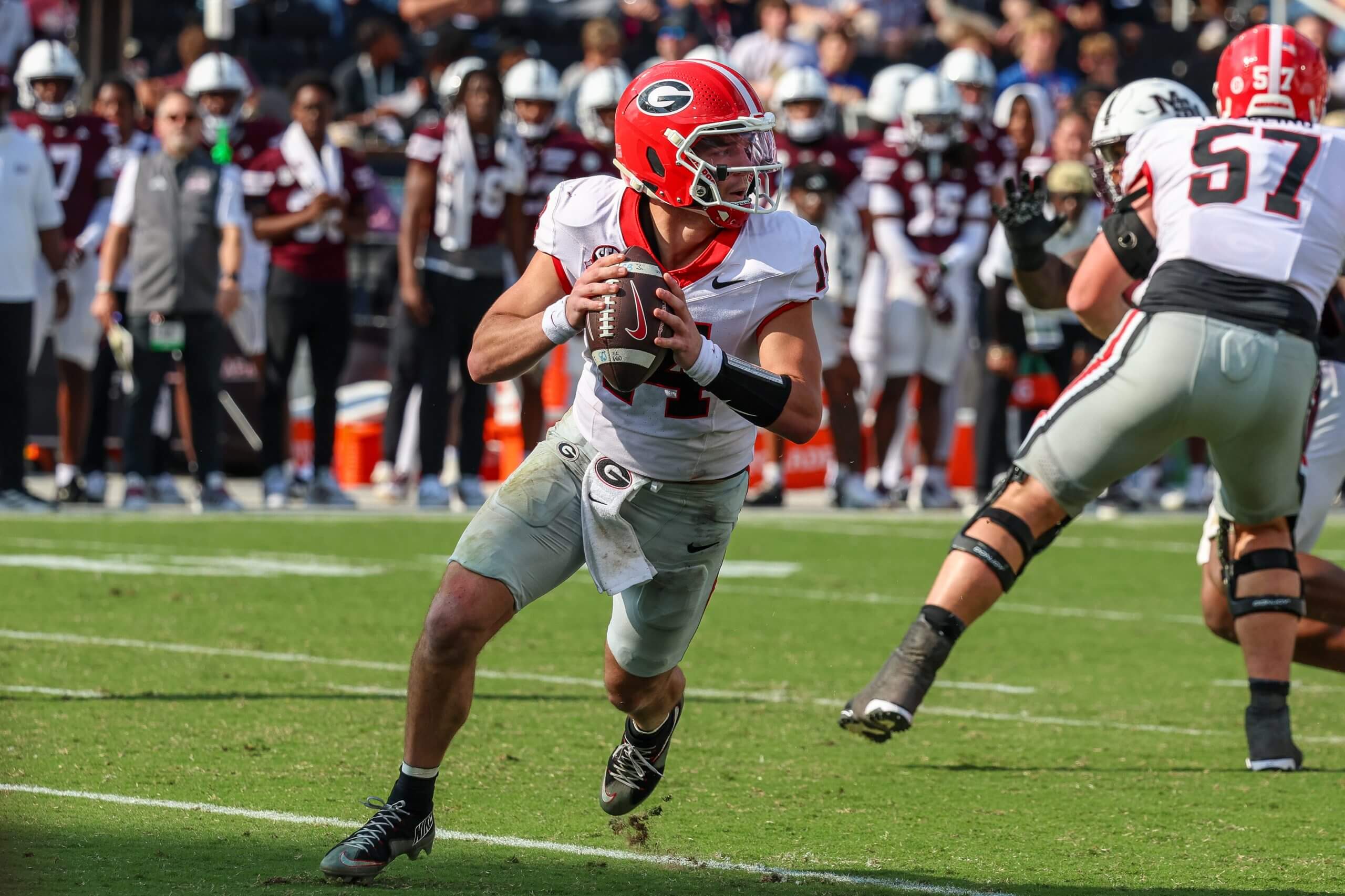
Gunner Stockton has accounted for 22 total touchdowns with just two interceptions. (Wesley Hale / Imagn Images)
Serious question: Considering how many openings there are going to be for coaches this year, and the desire of so many schools to have a “name” coach, do you think there is any chance someone will (please) hire Bill Belichick away from UNC? — Mike C.
C’mon, Mike, your team is on a two-game winning streak and now in Gasparilla Bowl contention. Two more wins and he might get an extension.
Stew — What needs to happen for the bottom half of the Big Ten to be more competitive? Looking at SP+, the lowest-ranked SEC team is South Carolina at No. 59. Eight Big Ten teams rank lower than that, so nearly half the conference is abysmal. I know most of those schools aren’t in great recruiting areas, but with NIL, it seems like they could do better. They’re holding back the whole conference’s reputation. — Brian D.
The SEC has been deeper than the Big Ten for decades, but the gap has become more pronounced with each wave of realignment. Since 2012, the SEC has added Texas A&M, Missouri, Oklahoma and Texas, all good-to-great programs that recruit at a high level. The Big Ten brought in Oregon, USC and Washington, all of them value-adds, but also, Maryland, Rutgers and UCLA, all of them minuses on the field, all of them hampered by various degrees of financial straits and athletic department dysfunction. Which also holds back the conference’s reputation.
This happens to be a particularly stark year for the Big Ten’s imbalance, what with three top-10 teams/national championship contenders, but also more deadweight than at any time I can recall. I don’t think it will always be this way. Michigan State and Wisconsin were winning conference championships not that long ago and can work their way out of their ruts with the right coaches. Purdue had it going with Jeff Brohm, then made a terrible hire in Ryan Walters that it is still trying to recover from. But there are no easy answers for the schools I mentioned above.
But remember, Indiana was considered similarly hopeless not that long ago, and now it’s a national championship contender. Curt Cignetti deserves most of the credit, but so does Indiana, which upped its investment in football by more than 150 percent from 2019-24, according to Knight Foundation data. It takes both to get out of the cellar.
Do you feel like you are writing about college football or NFL-lite? — Ce S.
Last weekend, I watched fans of a 3-6 Wisconsin team storm the field in a monsoon, a player for 0-8 Sam Houston hold up a fake bag of cash after forcing a turnover, an SEC head coach run on to the field during a marriage proposal and a Hawaii kicker who taught himself how to kick on YouTube improve to 22-of-22 on field goals.
Definitely college football.