
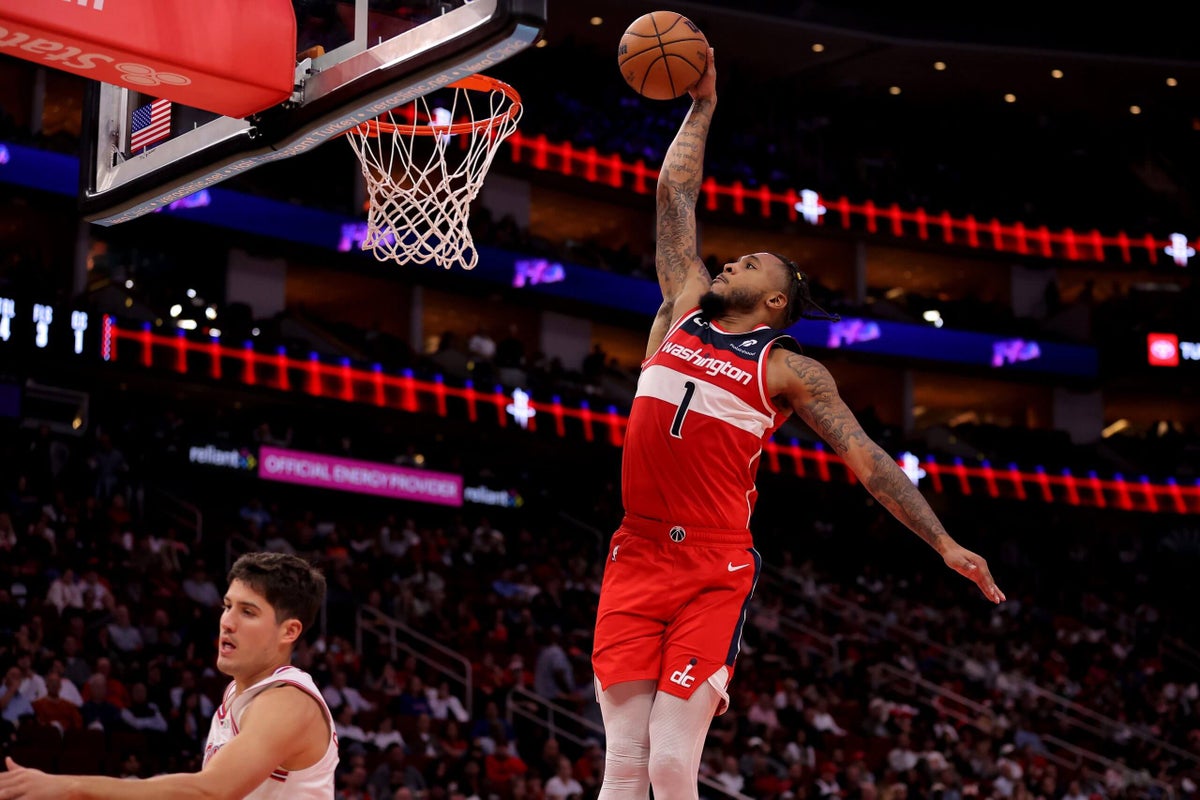
HOUSTON — Cam Whitmore returned Wednesday night to face the team that drafted him and, after two frustrating seasons trying to develop him, moved him off its deep roster and its crowded cap sheet.
As the Houston Rockets crushed the Washington Wizards, 135-112, Whitmore occasionally reminded the Rockets why they traded him for next to nothing. But he also illustrated why the Wizards have embraced him as an intriguing reclamation project.
Whitmore’s flaws — his tunnel vision with the ball in his hands and his off-ball defense — are plain to see. His gifts — scoring ability, athleticism and power — are undeniable.
Whether he will minimize his weaknesses and maximize his abilities is one of the most intriguing storylines of the Wizards’ 2025-26 season. He has shown promising glimpses, including a 19-point performance in a narrow defeat Saturday to the Dallas Mavericks and a 20-point game, including a poster dunk against Jalen Duren, in an overtime loss Monday to the Detroit Pistons.
“I haven’t really showed anything yet,” Whitmore said before he tallied 11 points and corralled three rebounds off the bench against the Rockets.
“I’m still trying to get used to the chemistry and the role I’m playing in. But (as) I said before, it’s just the beginning, just the start of something special. So I didn’t really do anything yet, to be honest.”
He and his new team have time, and the incentive, to endure any growing pains. Whitmore is only 21 years old.
The Wizards can afford to give heavy minutes to the many youngsters they have on their roster. Playing so many inexperienced guys ensures the team will finish at or near the bottom of the league standings. As long as that happens, the Wizards will keep the protected first-round pick they owe to the New York Knicks for the 2026 NBA Draft.
In the process, one or two or three of those young players might make significant individual strides. That’s the hope, anyway. Big man Alex Sarr has shown improvement already. Kyshawn George has also taken a step.
Could Whitmore be next?
“He’s really acclimated well to our culture and our environment,” Wizards coach Brian Keefe said. “I’ve really enjoyed getting to know him as a person and, obviously, as a player. You can see the stuff that he does well: attacking the rim. You’ve seen the defensive progress guarding individual players, his ability to get in the paint and the shooting ability.”
Bilal Coulibaly might be the only player on the Wizards’ roster who is a more explosive athlete than Whitmore, and that evaluation is up for debate. With his 6-foot-7, 250-pound frame, Whitmore resembles a middle linebacker or ball-hawking strong safety more than he resembles a typical NBA wing.
On Monday in Detroit, Whitmore provided the best example yet of his unique gifts. Stationed in the right corner, he received a pass from CJ McCollum. Whitmore jab-stepped to his left, faking out defender Ron Holland II, and dribbled along the baseline. Whitmore elevated toward the basket just before Duren, the Pistons center, jumped to challenge a dunk attempt, but Whitmore drove with such force that Duren reeled sideways when they collided. The result: an emphatic poster dunk that almost certainly will turn out as one of the Wizards’ best highlight-reel plays of the season.
“I just saw a lot of space when I got Ron off the baseline,” Whitmore said. “I saw a lot of space, and I just knew I was gonna dunk it, to be honest. Now (that) I look back at it, it was kind of crazy. It didn’t look wild at the time when I was doing it, but I did jump pretty high. I’m not going to lie. It was crazy.”
Khris Middleton, the wily Wizards veteran, said defenders face a difficult choice when they close out to Whitmore on the perimeter. If defenders attempt to prevent a jumper, they risk seeing Whitmore speed past them and attack the basket. If they hedge against a potential drive, they risk seeing Whitmore elevate for a clean jumper. Neither scenario is particularly appealing.
“You don’t know what poison to take,” Middleton said.
“He’s an extremely talented player. Once he gets downhill with momentum, he’s a bowling ball. You can’t stop him. He’s so athletic. He’s got great touch, great athleticism. I think everybody sees it.”
Houston executives saw that potential, and that’s why they drafted him at No. 20 in 2023.
But Whitmore struggled to earn consistent playing time on a team that also included Amen Thompson, Dillon Brooks, Jalen Green and Tari Eason. With Houston challenging for a top-four seed in the West, coach Ime Udoka didn’t want to allocate heavy minutes to an inexperienced player who was prone to mistakes on defense and could derail the offense with his lack of passing.
“We’ve always had depth since I’ve been here, and (he) kind of got caught in that shuffle,” Udoka said. “And then just some of the things we stressed offensively and defensively for improvement, I wanted to see (from) him, and he’d be a little up-and-down with that. But I’m happy for the opportunity he’s getting now and hopefully (he) takes advantage of that.”
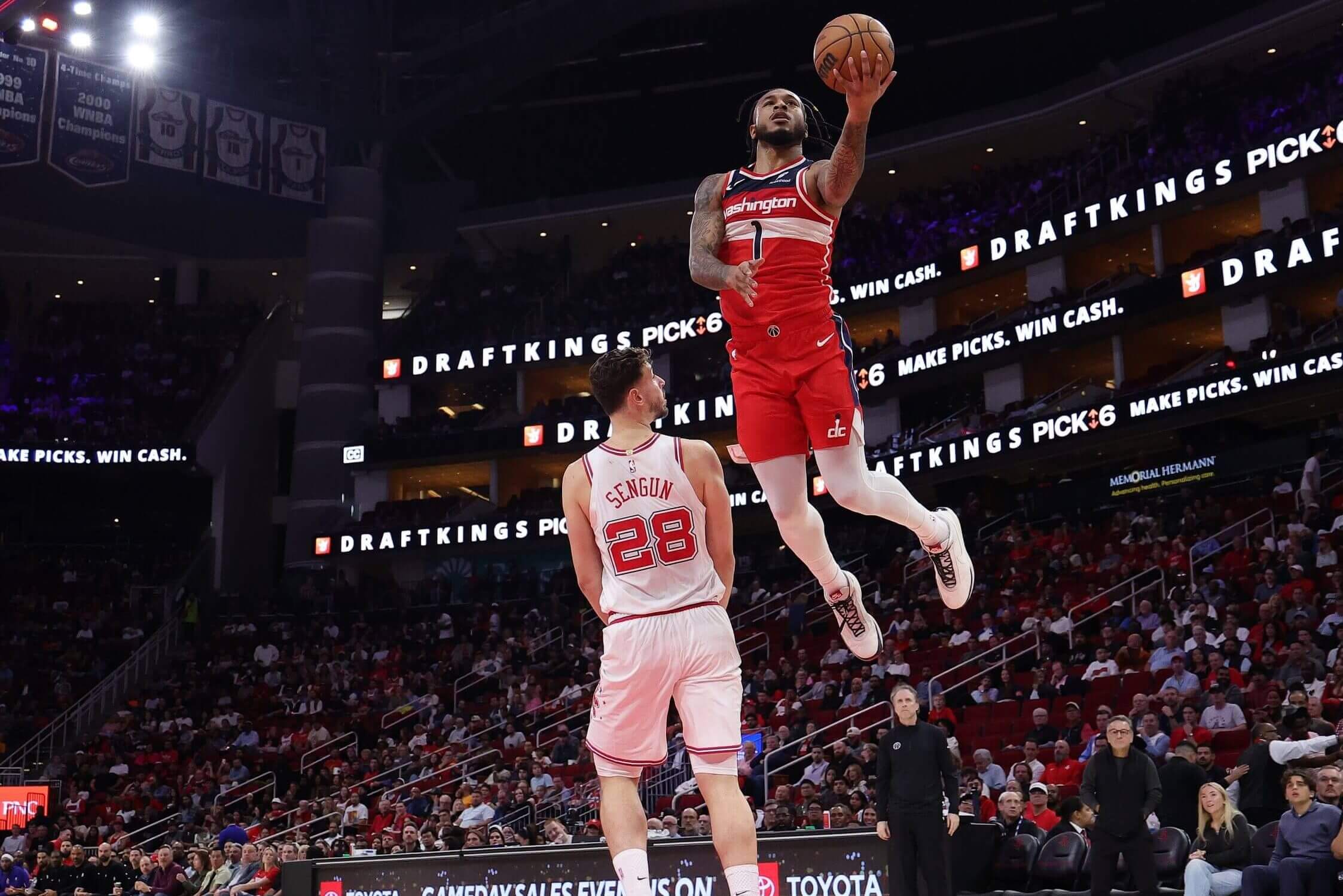
Cam Whitmore skied past the Rockets’ Alperen Şengün Wednesday night in his return to Houston. (Alex Slitz / Getty Images)
The Wizards-Rockets deal eventually included a third team, the New Orleans Pelicans. In essence, however, Houston agreed to trade Whitmore to Washington for a 2026 second-round pick and a 2029 second-round pick. The deal gave the Rockets a little bit more financial wiggle room to maneuver under the first apron.
This season is still early, and as Whitmore said, he’s adjusting to new teammates, new expectations and new offensive and defensive schemes. It takes time, even for veteran players.
So far, though, his tunnel vision has remained. Through Tuesday, he had assisted on only 5.1 percent of his teammates’ made baskets, ranking 118th among the 126 forwards and wings who had played at least 100 minutes this season, according to Cleaning the Glass, an advanced analytics database that filters out garbage-time statistics.
Through Tuesday, Whitmore ranked last among all Wizards players this season in passes made per minute, averaging just 0.63, according to the NBA’s player-tracking database.
A sequence during Wednesday’s first quarter demonstrated his tendency to hunt shots. Bub Carrington passed Whitmore the ball, and Corey Kispert set a pick on Jae’Sean Tate to force Reed Sheppard to switch onto Whitmore. So far, so good.
Whitmore caught the ball with 19 seconds remaining on the shot clock and kept it for seven seconds, taking eight dribbles before he settled for a stepback jumper from the top of the key that Sheppard contested.
To be clear, isolating Whitmore against Sheppard was a smart move that created a mismatch in Washington’s favor. But 12 seconds remained on the shot clock when Whitmore released his jumper, and Washington had lots of time to run an additional action to try to produce a better shot. Whitmore’s attempt clanged off the rim.
Whitmore had a productive individual night, making five of his nine attempts overall. He again demonstrated his ability to generate instant offense, especially in the open court.
Still, one of his challenges is to fit in more seamlessly into an offense predicated on ball and player movement. Players are expected to pass up OK shots when good ones are available and pass up good shots when great ones are available. No one expects that development to occur overnight.
Whitmore said his dad sometimes teases him, urging him to pass more often.
“My mentality is really just to score first, and if the score is not there, then kick the ball out and just find my teammates,” Whitmore said. “But that’s something I’ve kind of been dialing down on, actually trying to fully focus on this year.”