
In our college football writers’ roundtable, beat writers Lia Assimakopoulos and Shawn McFarland and columnist Kevin Sherrington tackle trending issues surrounding the sport. You can follow them on X at @Lassimak, @McFarland_Shawn and @KSherringtonDMN.
This week, our writers discuss dominance from Texas A&M and Texas Tech, Sonny Dykes’ challenges at TCU and more.
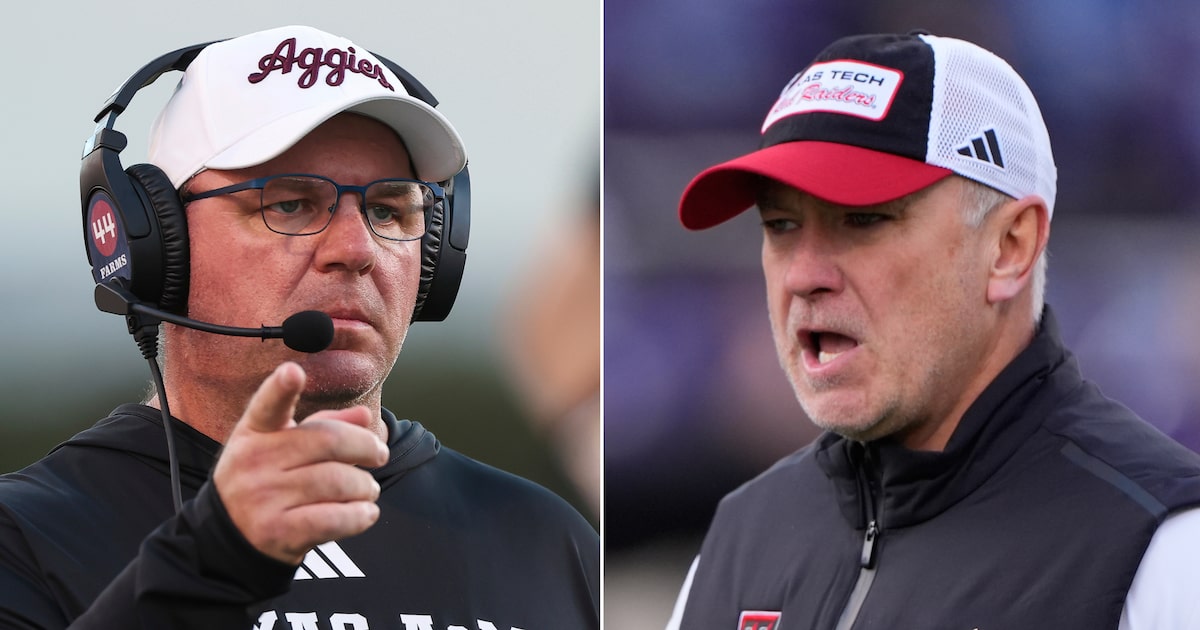
Who has had the more impressive season thus far: Texas A&M or Texas Tech?
Assimakopoulos: Texas Tech is amid a historic season, but after the program’s big spend, it was expected the Red Raiders would contend for a Big 12 title. No knock on their success, which has been incredibly impressive given where the program has been in recent years, but Texas A&M, on the other hand, is one of just three teams in the nation without a loss and one of just two without a loss in SEC play. It’s off to its best start this century. The Aggies have also managed so with wins over Notre Dame, LSU and Missouri. A 12-0 record seems within reach for Texas A&M, and to accomplish that in the SEC is the ultimate success.
Sports Roundup
McFarland: How’s this for impressive? Texas Tech — a program historically synonymous with offense and shootouts — may have the single best defense in the country. The grades over at Pro Football Focus says they do, at least, and it follows a decade in which they were the 89th-best defense nationally on average. Yes, the Aggies are undefeated in a tougher conference, but the Red Raiders have built a defensive unit that few teams in the country want to face come playoff time. They get my nod.
Sherrington: The Aggies are No. 1 in ESPN’s strength of record and the Red Raiders ninth, which sounds about right. A&M has big-time road wins at Notre Dame and LSU. Tech’s strength of schedule is only 47th, but, save for the Arizona State game, the Red Raiders have dominated their games. And they’ve come further than the Aggies. The last time Tech was ranked in the top 10 was 2013. Love to see them play each other in the CFP.
No primary defensive player has won the Heisman since Charles Woodson in 1997. Fans in Lubbock are trying to start a Heisman campaign for Texas Tech linebacker Jacob Rodriguez, but does he actually have a legitimate shot?
Assimakopoulos: Rodriguez deserves to be in the conversation, but I’d say it’s unlikely. Heisman has become a quarterback award, outside of a few wide receivers, running backs and two-way Travis Hunter, who were just too convincing to pass up. This year’s pool has too many quarterbacks deserving of the award. Even though Tech is climbing in the rankings, it still might not have the respect of voters to choose its linebacker over an SEC or Big Ten quarterback.
McFarland: Unless Texas Tech plans to use him as a two-way player (which, hey, his high school did to some success), then, no. It’s a quarterback’s award, save for the rare seasons when a Travis Hunter or DeVonta Smith sneaks in, and it isn’t equipped to reward inside linebackers. The fact that Rodriguez has played himself into a position where we need to have this conversation is remarkable in and of itself and should reflect favorably on his journey and Texas Tech’s wholesale defensive turnaround. I’ll echo Texas Tech coach Joey McGuire, though, and ask how many players favored to win the award above Rodriguez can impact a game as much as he can.
Sherrington: None of the Vegas odds list Rodriguez among their Top 10s, so I’d say chances are slim to none. Except for unicorns like Travis Hunter, it’s a quarterback award, and it’s easy to see why. Voters don’t get to see every player, every week, so they rely on stats, wins and highlight-reel plays. Rodriguez certainly has the numbers. PFF ranks him second among all defenders with a 93.5 grade. But tackles rarely make highlights. He’ll have to take solace in the fact that he’s the mustachioed face of one of the best teams in the nation.
After losing to Iowa State, TCU is 3-3 in its last six games and appears to be out of the running for the Big 12 championship. TCU fans on social media are calling for Sonny Dykes to be fired. Is Dykes on the hot seat?
Assimakopoulos: His seat is certainly heating up, but I’m not sure TCU would want to add its name to an already long list of top programs looking for a head coach this year. It’s understandable why the Horned Frogs fans would call for a change. Since the College Football Playoff, TCU has underwhelmed in a conference that’s more winnable than most. They may have beaten SMU in this year’s Iron Skillet, but Rhett Lashlee and the Mustangs are becoming more nationally relevant and recruiting D-FW better. Two of TCU’s last three opponents are ranked, so Dykes should be able to buy himself some time if he wins at least one.
McFarland: The final month of the regular season will determine this. A potential 9-3 record with signs of late-season improvement would suggest it’s at least worth another go next year. But a .500 or near-.500 finish with more questions than answers about the stability of this program may raise flags and signal change. It’d at least secure another season in which the Horned Frogs did not capitalize on that playoff run in any marginal way. That, to me, is the largest concern. You can stomach one or two steps back after a national championship game appearance. It feels as though they’ve taken more than that.
Sherrington: Barring a complete fallout, I don’t see him getting fired this year even if the Frogs have been all over the map. The wild card is Mike Buddie, who didn’t hire Sonny, so he’s got no incentive to stand by his man. The sentiment running among the critics is that he went to the national title game with Gary Patterson’s players, and it’s been downhill ever since. But that’s not the case. He won nine games last year, has a shot at nine again, and, even if he got blown out by Georgia, he took TCU to the summit and he’s 2-0 in bowl games. TCU isn’t LSU. Those numbers are good enough.
It’s a big week for Texas and Oklahoma. The Longhorns travel to Athens to face Georgia and the Sooners are facing Alabama in Tuscaloosa. Who has a better chance of winning and keeping their College Football Playoff hopes alive?
Assimakopoulos: I’d take Georgia and Alabama this weekend, but I think the Sooners have a better chance. Texas’ postseason hopes have been hanging on by a thread for weeks, and it’s felt like Georgia has been patiently waiting to end the Longhorns’ while closing out its SEC schedule with a resume-building win that would all but secure its spot in the CFP, barring a collapse to Charlotte or Georgia Tech in the final two weeks. The Sooners built some momentum in the win over Tennessee and should be motivated in what is their toughest test left of the regular season.
McFarland: I think Texas is better than Oklahoma. I think Alabama is better than Georgia. I don’t think the gap between either is particularly massive, though, but I’ll follow my own logic here and pick the Longhorns for success over the Sooners this weekend. That doesn’t mean I think Texas will march into Athens (where the Bulldogs are 51-2 in their last 53 home games) and win. But the Longhorns are on an upward trajectory and may have a shot to keep things competitive if the growth their offensive line showed vs. Vanderbilt is real. Alabama (somehow) may currently be the most under-appreciated premier team in the nation right now and I think they’ll reiterate that vs. the Sooners.
Sherrington: I don’t like either’s chances, mostly because of the venues and quarterbacks. John Mateer’s thumb has improved to the point where he’s throwing better, which showed in the win over Tennessee. But both Ty Simpson and Gunner Stockton are playing at a higher level than Mateer and Arch Manning. You’d think Texas was due after losing twice to the Bulldogs last year, but Kirby Smart is the best defensive mind in CFB. He’ll be ready for Arch. OU has the better odds this week.
It’s November and a bunch of area teams are still alive in the CFP hunt. Is this a positive effect from realignment or is this year an anomaly?
Assimakopoulos: Realignment sought to give more teams a chance, and it certainly has. But it’s also created absolute chaos in certain conferences. Take the ACC, for example, where five teams are tied with one loss. One of those teams, SMU, does not play any of the others head-to-head. A three-loss SMU team never would’ve had a chance to make the CFP in its old format, so the Mustangs should be grateful, but the lack of divisions makes this time of year confusing and leaves the power with complicated tiebreakers.
McFarland: Save for North Texas and SMU, which may only be alive in the CFP hunt because of the conference-champion-requirement, this season may say as much about college football’s other two major changes (the transfer portal and name, image and likeness deals) than anything else. Texas Tech spent big and spent it well to build a contender. Texas A&M hit the portal to find the perfect weapons to pair with quarterback Marcel Reed. Texas has been able to attract and develop high school classes that rival few in the nation. Realignment, no doubt, has opened a window of opportunity for these in-state teams to compete sans logjam. The other tools at their disposal have allowed them to capitalize on it.
Sherrington: It’s certainly one of the effects of realignment. Back in the day, one of the reasons so few of the SWC’s teams were ranked was because everybody in the state played each other, and the big schools generally prevailed. Voters nationwide had an easy choice. Realignment means Texas Tech, SMU, TCU and Baylor don’t have to butt heads with Texas and Texas A&M every year. On the football side, that’s probably a plus. But there’s a bigger reason for the area schools showing up now. Most of them usually weren’t good enough in the old SWC days, and that’s because of the financial gap between the haves and have-nots. Neither Tech nor SMU is a have-not anymore, and we’re seeing the results. It’s no anomaly.
Find more college sports coverage from The Dallas Morning News here.