
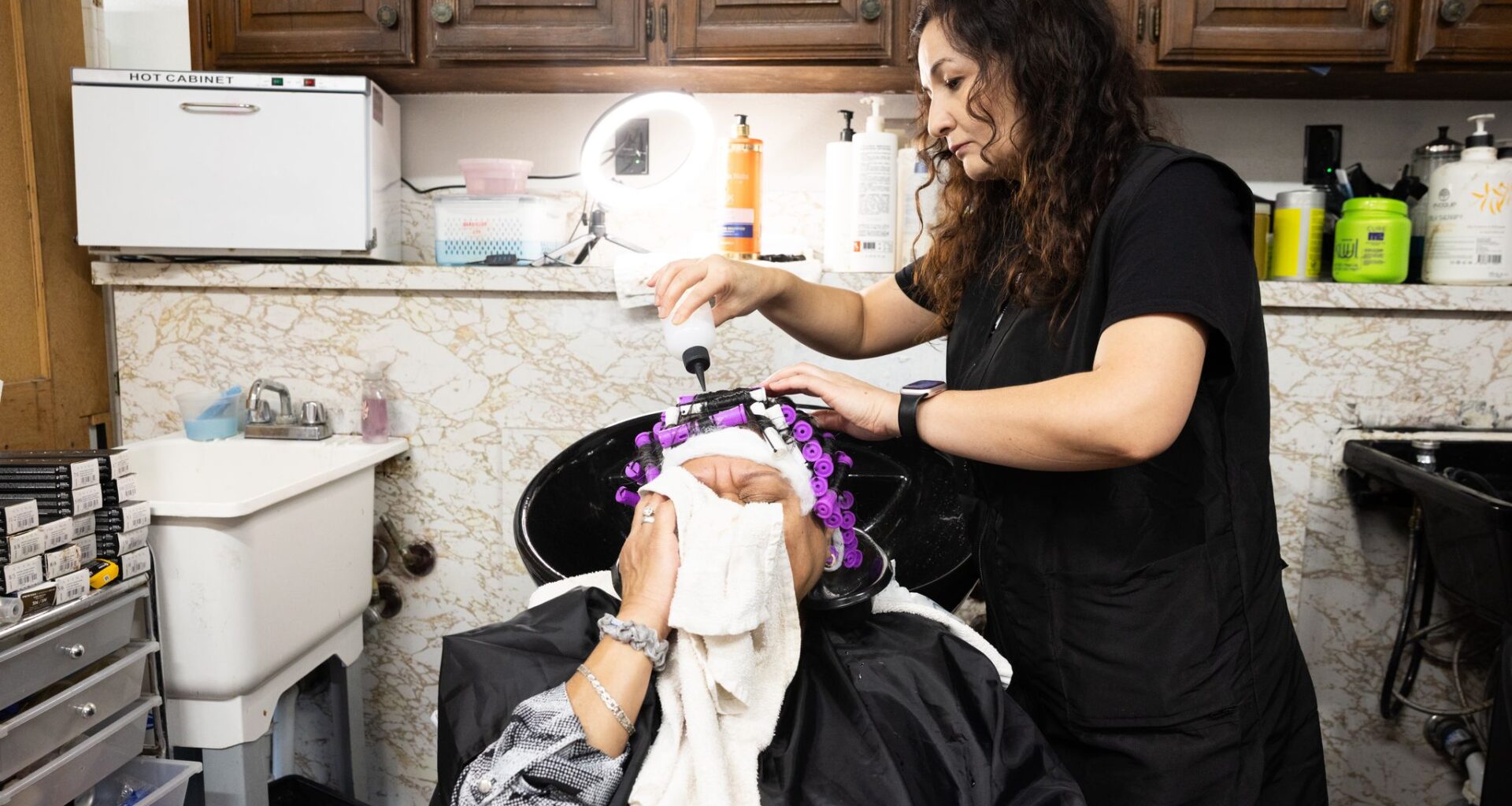
Maria Retana perms Maria Elena Martinez’s hair at her salon in Garland, Friday, Oct. 23, 2026.
Juan Figueroa/The Dallas Morning News
GARLAND — Travis Gilbert, a Baptist pastor, is guided at the polling place by what he calls his one true authority: the Bible. If Democrats gain a foothold in Texas politics, he worries his traditional biblical values will face attack.

At a hair salon across the street from Gilbert’s church, Maria Retana fears the chaos two more years of an unchecked Trump presidency could bring. Immigration crackdowns and a sluggish economy have already slashed her business.
These divisions are not unusual in Precinct 1734, home of the most striking political divide in Dallas County. In 2024, President Donald Trump and former Vice President Kamala Harris finished in a tie, 473 votes apiece.
Article continues below this ad
As the midterm elections near, divisions in this diverse suburban precinct in Garland appear to linger. Interviews with nearly two dozen voters and residents at home, work and while shopping provide a snapshot of a deeply divided America, one both splintered by and weary of embittered politics.
Neighbors in Precinct 1734 agree on a host of issues, from inflation and rising costs to immigration and international strife. Yet they disagree on which party to address them.
Campaign signs for both parties were visible around the precinct this month for top races, including governor and Senate, but also for a tight downballot contest between state Rep. Angie Chen Button, the Republican incumbent, and Democratic challenger Zach Herbert, a Marine veteran and personal injury lawyer, who have clashed on private school vouchers passed last year by Republicans.
Still, some voters said they were undecided on numerous races as Election Day approaches Tuesday.
“There used to be a thriving middle class,” said Edgar Marquez, a 45-year-old independent voter, who was playing basketball with his son on a recent Saturday and is among the undecided. “Now we’re just told to work harder and harder. We need better policies. I don’t hear real solutions from either party.”
Article continues below this ad
A suburban battleground
Like much of Garland, Precinct 1734 is dotted with low-slung ranch homes, tidy front lawns and a smattering of auto shops, hair salons and churches. It is home to Buckingham North, a quiet, leafy neighborhood where it’s still possible to buy a home under $400,000.
The first-ring suburb northeast of Dallas boomed after World War II, bolstered by blue-collar manufacturing jobs.
As Garland grew more diverse, so did the Buckingham North area. Precinct boundaries shift over time, so it’s impossible to pinpoint how its exact makeup has changed, but of the precinct’s roughly 2,200 residents, about 45% are white, 26% Black and 26% are Hispanic.
But its political diversity is what sets it apart.
Article continues below this ad
Most Americans live in geographic polarization, areas where people share the same political beliefs. A 2021 Harvard University study found 98% to 99% of Americans live in neighborhoods segregated by partisanship.
Related: Early voting is underway in North Texas. Here’s where to cast your ballot
Political signs for Republican candidates at a home on Wakefield Drive in Garland, Friday, Oct. 23, 2026.
Juan Figueroa/The Dallas Morning News
Urban voters largely align with the Democratic Party, and voters in rural counties have moved to the right in recent years, according to the Pew Research Center.
“Political polarization has gotten so deep into our groundwater that people have sorted themselves geographically,” said Mark Strama, a former Texas state representative and director of the Annette Strauss Institute for Civic Life at the University of Texas at Austin. “People seem to feel more comfortable around neighbors who share their political beliefs.”
Article continues below this ad
Suburbs are the prized battlegrounds.
Political divisions have exploded in some Dallas-area suburbs, including McKinney and Frisco, where contentious mayoral elections, plans for mosques and recall elections divided voters. Garland, however, has managed to escape that sort of public fighting.
Neighbors in 1734 said they stake their political signs in their front yards but rarely talk politics with one another to maintain civility.
“We may disagree at the ballot box, but on Friday night we’re all cheering together at Williams Stadium,” said Garland Mayor Dylan Hedrick, who lives outside this precinct, referring to the school district’s 72-year-old athletic stadium. “When there’s a disaster, say a tornado hits, you don’t care about your neighbor’s political party.”
A Garland water tower in Garland, Texas, on Thursday, June 18, 2020. (Lynda M. Gonzalez/The Dallas Morning News)
Lynda M. Gonzalez/Staff Photographer
Affordability weighs on voters
Christina Reyes, 44, who works in customer service and has lived in Garland for a decade, said she voted for Trump in the last election because she thought he would bring down high costs and focus on affordability.
Article continues below this ad
The Iran war and stubborn inflation have instead sent costs soaring, leaving her frustrated. She said she will vote for Democrat Gina Hinojosa over incumbent Gov. Greg Abbott.
“What the Republicans are doing isn’t working,” she said, gesturing to her cart full of plastic shopping bags as she left Walmart. “We can’t afford to keep doing this.”
Loretha Bowden, 67, a retired Montessori school teacher, said she and her daughter moved in together to divide household expenses. Even now, they struggle to afford groceries, electricity and medical bills, she said, but she thinks Republicans spend more time targeting transgender children than discussing how to help people.
“Republicans don’t care about the working class,” Bowden said. “They stopped caring about regular people.”
Bowden’s daughter, 41-year-old-old Ruby Gossett, said she does not trust Ken Paxton, a Republican, who is running for U.S. Senate against Democrat James Talarico. Paxton, elected attorney general in 2014, has survived securities fraud charges and an impeachment brought by fellow Republicans on 20 articles, including allegations of bribery and abuse of office. He was impeached by the GOP-led Texas House and acquitted by the Senate.
Article continues below this ad
“I was always taught to do the right thing growing up,” said Gossett, a mother of three young children. “It feels like everything is backwards now. This doesn’t set a good example for my kids.”
Political signs for Democratic candidates at homes on Wakefield Drive in Garland, Friday, Oct. 23, 2026.
Juan Figueroa/The Dallas Morning News
A few blocks away, Carolyn Davidson, who is in her 70s, said she, too, worries about rising costs, which is why she supports Republicans who promise to lower property taxes.
Until a few decades ago, Davidson was a Democrat, but she said the party began to care more about social issues than pocketbook ones. Davidson has voted for Republicans since.
Driving around lately, she said she has noticed fewer yard signs for Republicans than in 2024, but she has no plans to change her vote.
“I trusted the Republicans before to do what was right,” she said, “and I still trust them to do what’s right.”
A divide in theology
For Gilbert, 53, the conservative senior pastor of Rodgers Baptist Church in Garland, the decision of who to vote for is rooted in scripture. He believes life begins at conception and unborn children must be protected, and that men and women are created separately in God’s image.
Paxton — whose estranged wife, state Sen. Angela Paxton, cited allegations of adultery in her divorce filing — is not his ideal Republican Senate candidate, Gilbert said on a recent Friday at his quiet sanctuary.
Still, he said, it’s better than the alternative, Talarico, a Presbyterian seminarian, whose interpretation of scripture contradicts his own.
Pastor Travis Gilbert poses for a photo at Rodgers Baptist Church in Garland, Friday, Oct. 23, 2026.
Juan Figueroa/The Dallas Morning News
In 2021, Talarico said that “God is non-binary” during a speech on the Texas House floor. He later said “you can’t use human categories to define God,” and that he was being intentionally provocative.
Some conservatives say that statement is proof Talarico is out of touch with Texans.
“I vote the way I vote because I believe what I believe,” Gilbert said. “I vote for policies, not people, and I cannot vote in a way that offends my conscience.”
Across the street at Lupita’s Master Cuts, Retana, 45, the salon owner, was perming the hair of a longtime client, the pungent smell of chemicals in the air. She fretted about her business’ slowdown since Trump launched a sweeping mass deportation plan.
In the past several months, Retana said immigration arrests mean clients are afraid to leave their homes, unable to make regular hair appointments or go to the grocery store. With rising costs for supplies, the salon she has owned for seven years is struggling. At the same time, she supports her two daughters in college.
Discouraged, Retana said she hopes for change. Voting, she said, is the only answer. She shook her head and spoke softly to her client in Spanish, then kept working.