
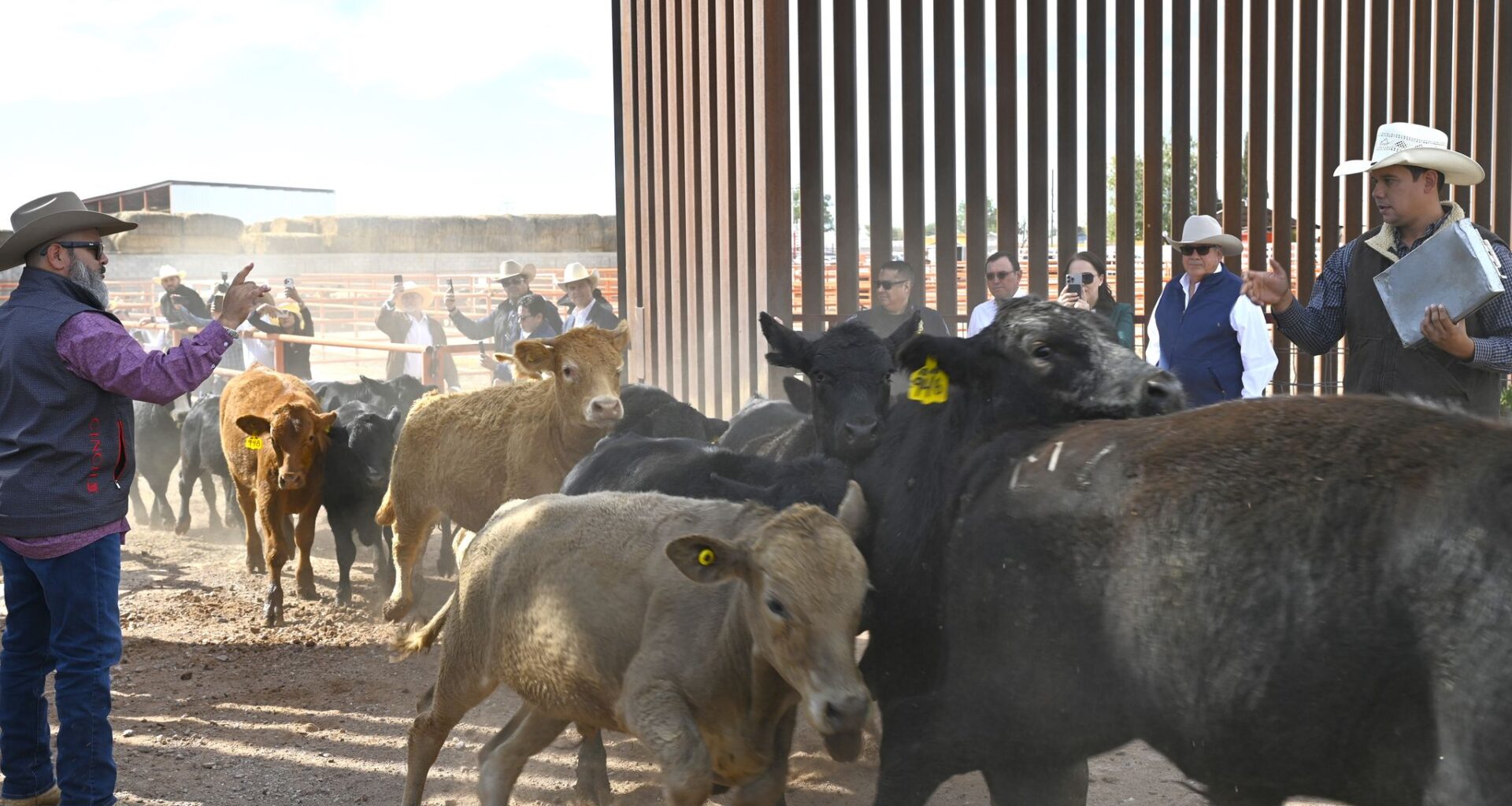
Cattle cross the U.S.-Mexico border at the Columbus Stockyards in Columbus, N.M., as the port of entry reopens to Mexican cattle imports on Monday.
Algernon D’Ammassa/Albuquerque Journal via AP
Branded cattle from Chihuahua, Mexico, wait in a holding pen at the Columbus Stockyards in Columbus, N.M., as the port of entry reopened for cattle imports on Monday.
Algernon D’Ammassa/Albuquerque Journal via AP
A gate in the U.S.-Mexico border wall is open for the resumption of cattle imports from Chihuahua, Mexico, seen from the Columbus Stockyards in Columbus, N.M.
Algernon D’Ammassa/Albuquerque Journal via AP
Cattle imported from Mexico are seen at the Columbus Stockyards in Columbus, N.M., as the international crossing reopened for cattle imports Monday.
Algernon D’Ammassa/Albuquerque Journal via AP
A third cattle border crossing from Mexico has reopened despite an increase in infections of the flesh-eating New World screwworm in Texas and New Mexico.

The reopening of the port of entry at Columbus, N.M., comes as cases are picking up after months of declines that spurred earlier reopenings of livestock crossings in Texas and Arizona. All are open with new safeguards including tests, shots and inspections done before an animal gets close to the border.
Article continues below this ad
“We will continue using every tool at our disposal to keep New World screwworm out of the United States and protect the livelihoods of our American ranchers,” Brooke Rollins, the U.S. secretary of agriculture, said at the opening Monday in New Mexico.
FROM JUNE: After finding first new case of screwworm, Texas ranchers dusting off a game plan from the ’60s
The screwworm — actually a fly larva that burrows into the flesh of livestock, pets and even humans — has threatened the $113 billion U.S. cattle industry since the first infection in decades was found earlier this year in Texas. Containment efforts have cost jobs and trade in border communities, cutting off a source of cattle as the U.S. struggles to rebuild drought-depleted herds and reduce beef prices. Reopening crossings could help ease that squeeze, although experts caution that consumers shouldn’t expect quick relief.
San Antonio Express News Logo
Make us a Preferred Source on Google to see more of us when you search.
Add Preferred Source
The reopenings began in late August in Arizona and last month in Texas after months of declining infections from a peak of 30 animal infections in June. They dropped roughly 87% in August, a trend that continued in September — and with no new cattle infections that month. The month included the first cases of horses infected with screwworm and the first screwworm fly caught in a trap.
Article continues below this ad
READ MORE: New World screwworm infects first horse in Texas outbreak
After that downward trend, though, October has seen a spike in infections, with the number of cases more than tripling from September. As of Tuesday, there were 15 active cases of infected animals in Texas and New Mexico.
Optimism
Michael Schmoyer, director of the New World Screwworm Directorate, a unit operating under the USDA to coordinate the federal response to the flesh-eating larvae, said he was optimistic about October, which kicks off the big-game hunting season in Texas. That is boosting the boots, and eyes, on the ground across rural Texas.
Article continues below this ad
“We’re going to have hunters that are out there that are going to be basically force multipliers for my team in the sense that we’re going to get even more observations in the field,” Schmoyer said.
In fact, a hunter identified and reported the latest infected elk in Pecos County. Since the pest’s resurgence, the USDA has confirmed 66 animal infections.
SA INC.: Get the week’s top local business stories in your inbox
Schmoyer said cooler temperatures this fall and winter could also be a benefit, as the fly thrives in a subtropical environment.
Article continues below this ad
“The colder the weather gets and the drier the weather gets, the better that is in our favor,” Schmoyer said.
Despite the border reopenings and the risk that could pose in spreading the pest, Schmoyer said he feels “very comfortable that it is very unlikely that New World screwworm will be introduced into the U.S. through a port.”
The rigorous port protocol is keeping animals with wounds, even those that are not infected with screwworm, far from the border.
“They’re caught well before they even get near the port,” Schmoyer said. “The process is working. The protocols that we use for New World screwworm are more intense than most animal health protocols that are out there.”
Article continues below this ad
Several requirements must be met before cattle cross into the U.S. — including tuberculous testing, tick treatment and a New World screwworm exam — followed by a pre-export exam and certification from a Mexican official veterinarian. The Animal and Plant Health Inspection Service then conducts a physical exam, a tick scratch test and a detector dog inspection.
Those factors are among the reasons the U.S. Department of Agriculture is reopening crossings despite currently rising numbers.
Reopenings
The first port of entry to reopen in Texas after a 16-month hiatus to try to stop the fly’s northward march was the Santa Teresa Livestock Crossing near El Paso.
Article continues below this ad
Daniel Manzanares, director of the Santa Teresa International Import Export Livestock Facility, put it bluntly at the time.
“It’s about … time,” he said last month. “It’s euphoric, man.”
RELATED: U.S. reopens border to cattle as Texas screwworm fight struggles with sterile fly shortage
More than 400 head of cattle crossed the first day Santa Teresa reopened. At full capacity, it can process more than 3,000 head per day. The channel generated around $1.2 billion worth of commerce in 2024, when it crossed more than 500,000 head of cattle, Manzanares said.
Article continues below this ad
Before the current outbreak, the U.S. was importing about 1 million head of cattle per year. It will take time to get back to that number while keeping a sharp eye on the risks to animal health, said Dudley Hoskins, undersecretary for the USDA.
“As long as we can manage and mitigate that risk at an acceptable level, we will continue to process the safe and legal movement of cattle through these ports,” he said, watching as cattle lined up in the chutes at Columbus.
About one-third of all Mexican cattle imported to the U.S. each year pass through ports in Columbus and Santa Teresa. Gerardo Fierro, executive director of the New Mexico Border Authority, pegged the value of the cattle trade for the area at $1 billion.
“This means a lot,” he said of the reopening.
Article continues below this ad
Another border crossing for cattle in Arizona is due to open in late November.
The influx of Mexican cattle could help replenish the dwindling U.S. cattle herd, which has dropped to historically low levels and driven up beef prices. The average cost for ground beef reached a record $6.79 a pound in September.
Though Mexican ranchers once again have a market for their feeder cattle, experts say it will take time for U.S. ranchers to rebuild after years of persistent drought.
READ MORE: San Antonio gets new weapon in fight against screwworm
Article continues below this ad
Amping up defenses
To protect the gains, Schmoyer is focused on amping up defense against the screwworm fly by the spring season.
His team has deployed more than 2,269 drone flights, using the technology to observe 38,886 animals in Texas since June 4. Trail cameras have allowed for 96,071 observations.
Schmoyer has been candid about the U.S. having a short supply of sterile screwworm flies, which are used to help eradicate the pest. During the last major outbreak in the mid-1960s, nearly 500 million sterile flies were released each week to overwhelm the wild population, mate with the wild female flies and prevent a self-sustaining population.
Article continues below this ad
READ MORE: Texas screwworm cases double in two weeks as USDA reports 32 infections
The U.S. is currently deploying 100 million sterile flies a week from a Panama facility, jointly operated by the USDA and the Panama Ministry of Agriculture Development. Another facility in Metapa, Mexico, is producing 40 million sterile flies a week and is on track to pump out 100 million by the end of the year.
The Moore Air Base facility is scheduled to open up in April, with the goal of scaling production to 100 million flies per week by October 2027. Phase two of the project will add an additional 200 million flies to production by the end of 2028, when there will finally be enough flies to match that 500 million that were deployed decades ago to previously eradicate the pest.
Schmoyer said that facility will produce the Novofly, a genetically modified all-male fly that would essentially double the output. Currently, roughly half of the flies deployed are female, which Schmoyer said, “while they’re lovely critters, they’re really not helping us in the fight.”
Article continues below this ad
The Novofly completed lab testing and is nearing the end of its field trials. Schmoyer is “very optimistic” from the preliminary results from the trial and said that it also has approval from the U.S. Environmental Protection Agency for dispersal in the U.S.
“When fly season does come, we’re going to have a variety of tools in our belt that mankind has never had before,” Schmoyer said.
The Associated Press contributed to this report.