
Editor’s note: In an effort to preserve city history, Fort Worth Report agreed to archive Hollace Weiner’s local history columns beginning in 2025. This column about local history of The Church of Jesus Christ of Latter-day Saints first ran in the Fort Worth Star-Telegram in October 2023 and was updated for the Report.
The first Mormon leader to officially visit the Republic of Texas met with Sam Houston in 1844 to ask if members of his persecuted faith — The Church of Jesus Christ of Latter-day Saints — could establish a Lone Star colony.
Presumably, Houston had no objection because the following year pioneer Mormon leader Lyman Wight led 200 Latter-day Saints to the Texas Hill Country. On the banks of the Pedernales River, they built the doomed settlement of Zodiac. Prone to springtime downpours and raging currents, the Pedernales flooded everything in Zodiac but the cemetery, which later owners plowed over. The Latter-day Saints colonists pulled up stakes and moved their possessions 5 miles from Marble Falls at a place they named Mormon Mills. Faced with Comanche raids and religious prejudice, they moved on. Their third attempt at a colony in 1854 was a site in Bandera County called Mormon Camp. Today it lies below Medina Lake.
During the decade when Texas’ first three Mormon settlements vanished, thousands of Latter-day Saints had begun a pilgrimage across the Great Plains to the Utah Territory and the valley of the Great Salt Lake. Because of their peculiar religion, the Latter-day Saints had been persecuted and driven from parts of New York, Ohio, Illinois and Missouri. Their faith banned alcohol, coffee and tea. It taught of prophets and prophecies beyond those in the Bible. It allowed men to take multiple wives — until 1904 when the religion officially prohibited polygamy.
The Latter-day Saints assigned traveling missionaries to Fort Worth to spread the religion’s controversial post-biblical gospel. Baptisms were in Rockwood Park, at a horse-shoe bend in the Trinity River, with the first conversion in 1915 for Juanita May James, a mother and homemaker. In 1919 several missionaries held a street meeting at the corner of 10th and Main. By the next year, 28 people were actively involved. Presumably, they proselytized their relatives and friends — astonishing activity during years when the Ku Klux Klan had reemerged.
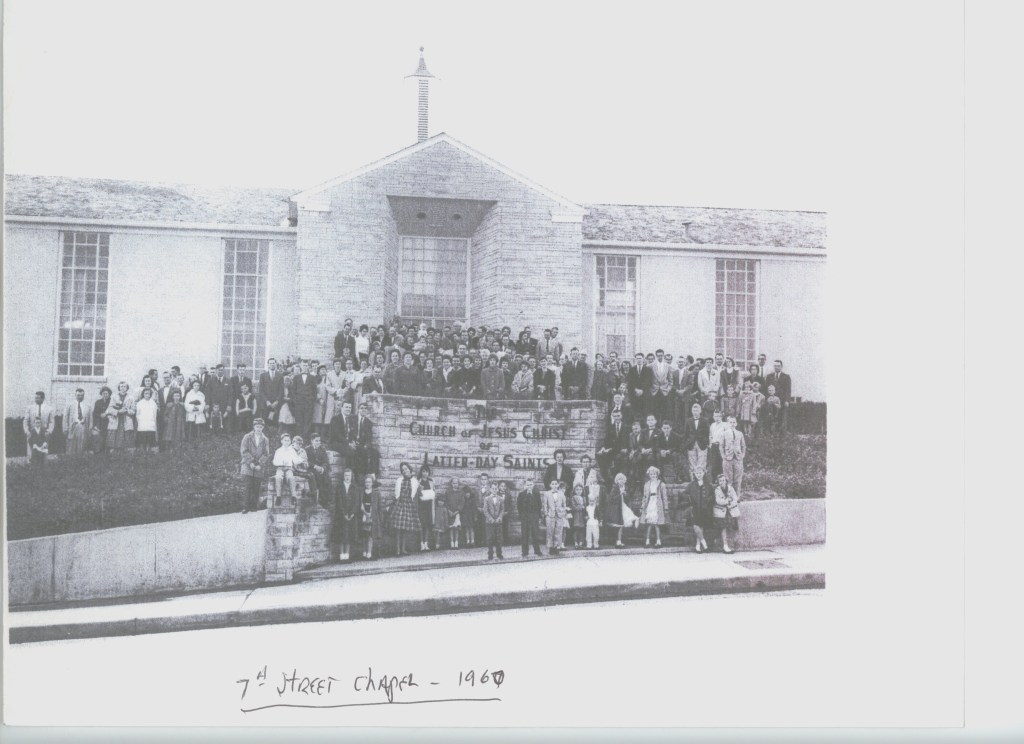 More than 100 congregants, dressed in their Sunday best, posed for a photo outside The Church of Jesus Christ of Latter-day Saints in the 3500 block of West 7th Street, on a Sunday morning in 1960. (Courtesy | FW Texas Stake Relief Society, The Church of Jesus Christ of Latter-day Saints)
Today, a century later, the Latter-day Saints have 43 Tarrant County area congregations, 12 chapels and 14 meetinghouses. The denomination broke ground two years ago for a 30,000-square-foot Latter-day Saints temple, comparable to a grand cathedral. Located on 9 acres in Burleson at 1851 Greenridge Drive, the building was completed in October.
If you go
What: For a limited time, The Church of Jesus Christ of Latter-day Saints Fort Worth Temple is holding a public open house. Once the temple is dedicated, entrance will be reserved for members.
When: Nov. 5 to Nov. 21, excluding Sundays, from 9 a.m. to 8 p.m. After Nov. 21, only Latter-day Saints members will be allowed to enter. The premises will become a place to consecrate marriages and perform rituals specific to the faith.
Where: 1851 Greenridge Drive, Burleson
For more information, visit the website.
A century ago, there was such confidence among Cowtown’s core group of 28 converts that the Latter-day Saints church’s North Texas Division made Fort Worth an official branch on March 3, 1922. The next year, the Division began hosting quarterly conferences at the Hotel Texas. The Fort Worth Record Chronicle took note, printing news articles listing out-of-state speakers. In 1925, the Latter-day Saints winter conference featured live choral music and was staged at the Tarrant County Courthouse in the Confederate Veterans meeting room. A paid newspaper ad in 1926 beckoned the curious with the words, “Everyone is invited to attend and give us a hearing.”
Public awareness grew when the Fort Worth Star-Telegram began including the Latter-day Saints in its “Sunday Church Service Listings.” Local Mormons worshipped in the Elks Hall at 311½ Main St., upstairs in a rented room. By one account, the church had 35 adherents in 1926.
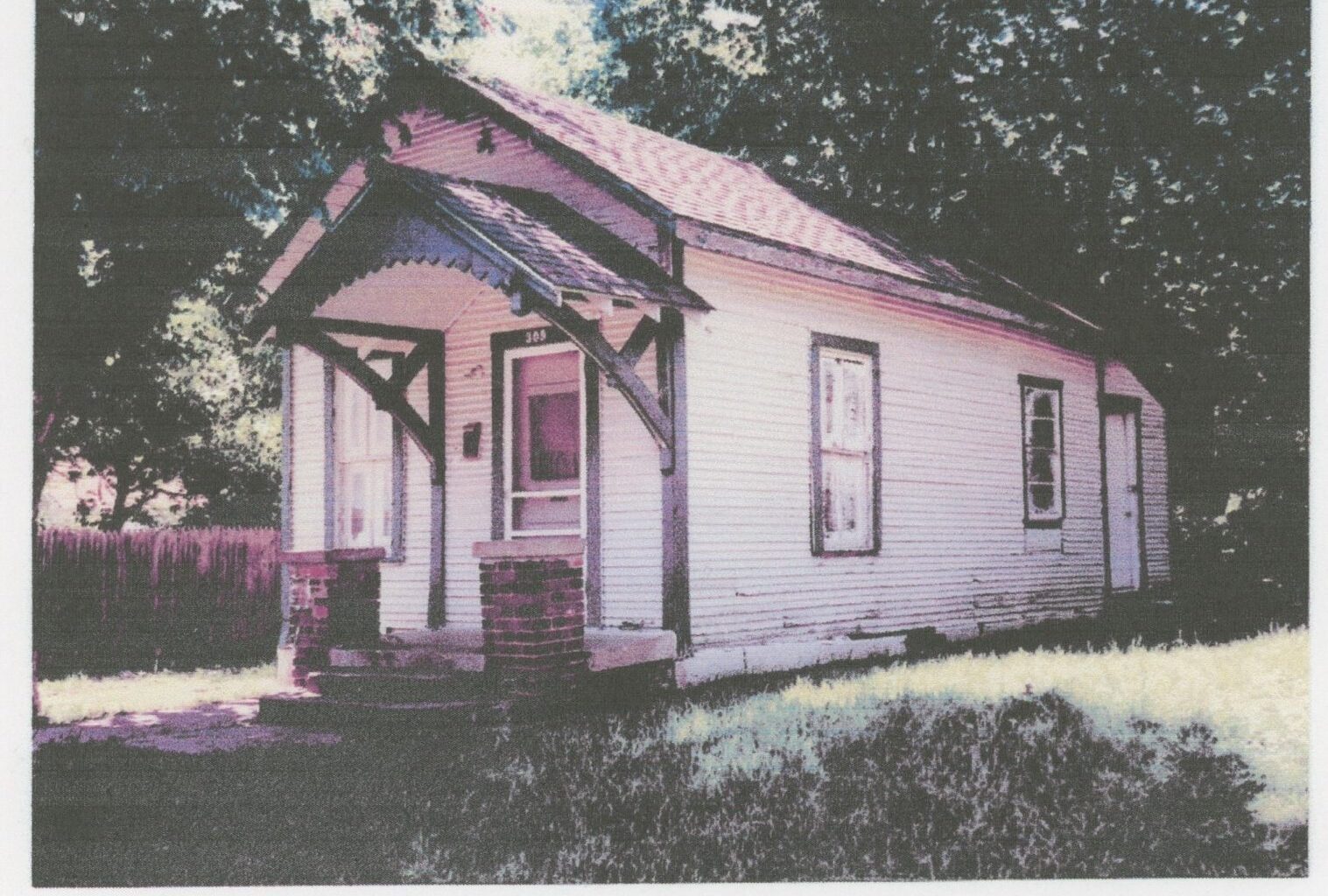
The Latter-day Saints church members tithe 10% of their income. With its treasury growing, local Latter-day Saints in January 1928 purchased a $3,000 corner lot with a chapel at 21st and Clinton on the city’s north side. According to photos and county property records, the 1,800-square-foot chapel had a gabled entrance above a pair of double doors. In 1931, a baptismal font was installed into the floor. When not in use, the sunken font was covered with boards of lumber that matched the polished hardwood floors.
One of the oldest living Mormons in Tarrant County, a 91-year-old widow who grew up near Camp Bowie Boulevard, remembered being baptized at the chapel when she was 8 years old. “The building is still there. It’s a three-bedroom dwelling,” recalled the woman, who out of modesty asked to remain anonymous. Whenever she drives to the Fort Worth Stockyards, she detours past the corner of 21st and Clinton to take a nostalgic look. She wonders if the baptismal font, the size of a small hot tub, is still hidden beneath the floorboards.
The Clinton Avenue chapel served the Mormons until 1952, when it was appraised at $8,500 and sold to a Latin American Assembly of God Church. In 1964 the Friendly Lane Baptist Church bought the property. After 1973, subsequent owners converted the white clapboard structure into a residence. Later occupants alternately turned it back into a chapel, then into a dwelling again.
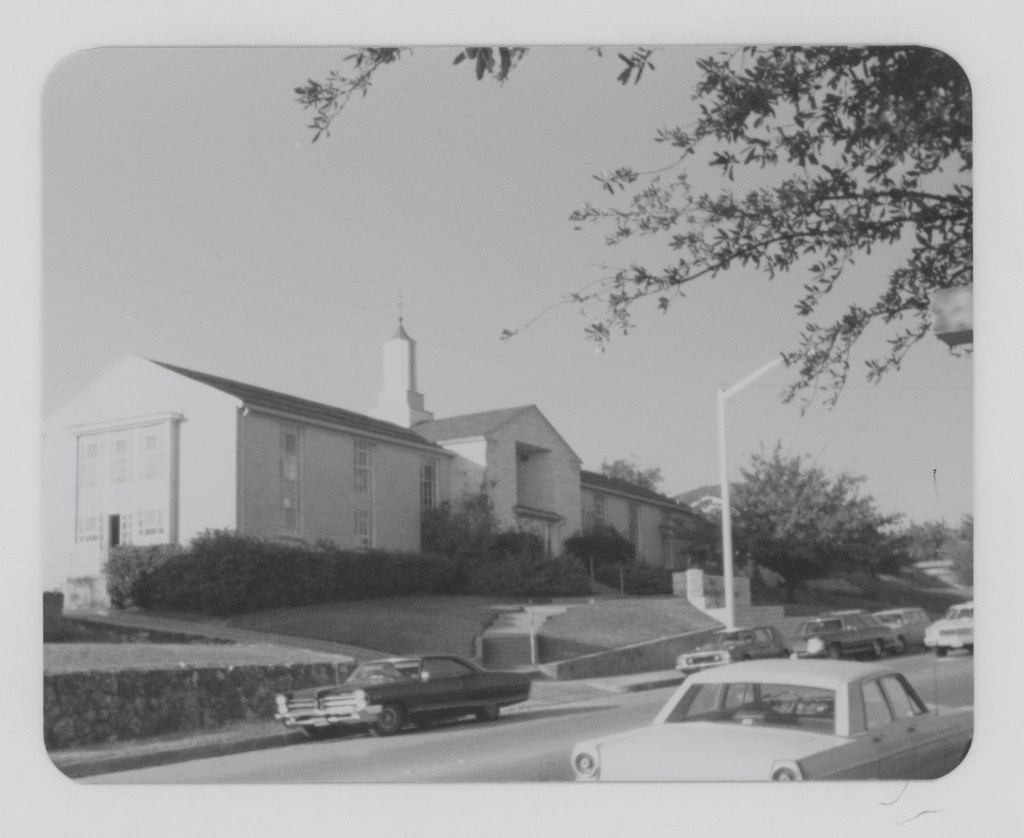 Built on a hillside in the 3500 block West 7th Street, The Church of Jesus Christ of Latter-day Saints is pictured in the 1960s with parked cars lining the curb. The congregation constructed the $90,000 house of worship primarily with members’ donating manual and skilled labor. (Courtesy | FW Texas Stake Relief Society, The Church of Jesus Christ of Latter-day Saints)
The Latter-day Saints remained at the wood-frame chapel until 1952. Seven years earlier they had paid $3,750 for hillside acreage in the 3500 block of West 7th Street, a prominent location facing Monticello Drive. They began planning a $90,000 building constructed of stone and tan brick. Although a paid contractor supervised construction, members donated their manual and skilled labor. On opening day in November of 1952, more than 500 congregants posed in front of the edifice for a celebratory picture.
The building drew the envious eye of its backyard neighbor, the Texas College of Osteopathic Medicine. After 25 years, according to Latter-day Saints history records, TCOM bought the property in 1977 under eminent domain — the power of government to take property for public use. The hillside church, with its sanctuary, steeple, altar and baptismal font, underwent its last conversion, this time into a fitness center.
Hollace Ava Weiner is a Fort Worth historian and archivist.
This article first appeared on Fort Worth Report and is republished here under a Creative Commons Attribution-NoDerivatives 4.0 International License.