
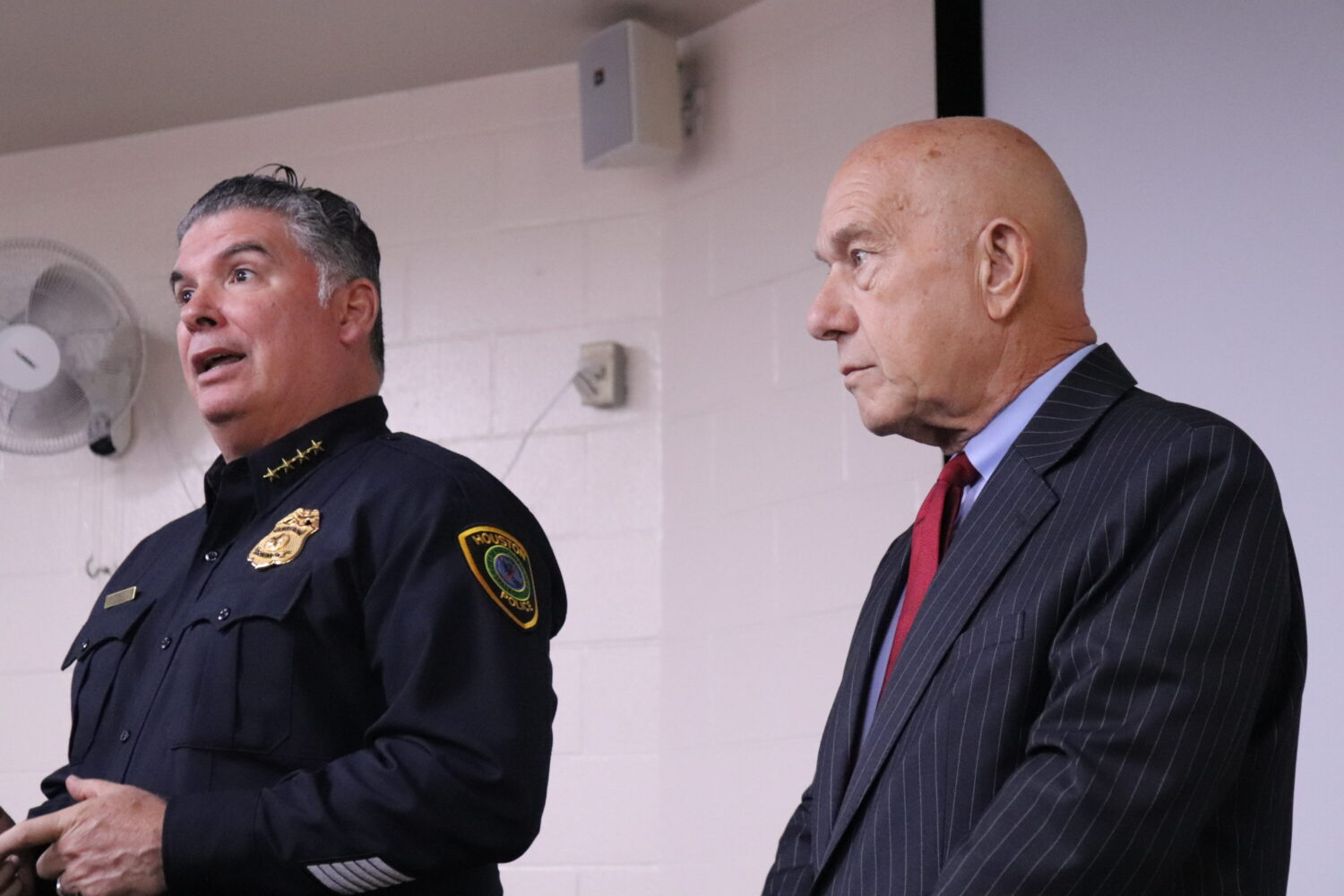
Dominic Anthony Walsh/Houston Public Media
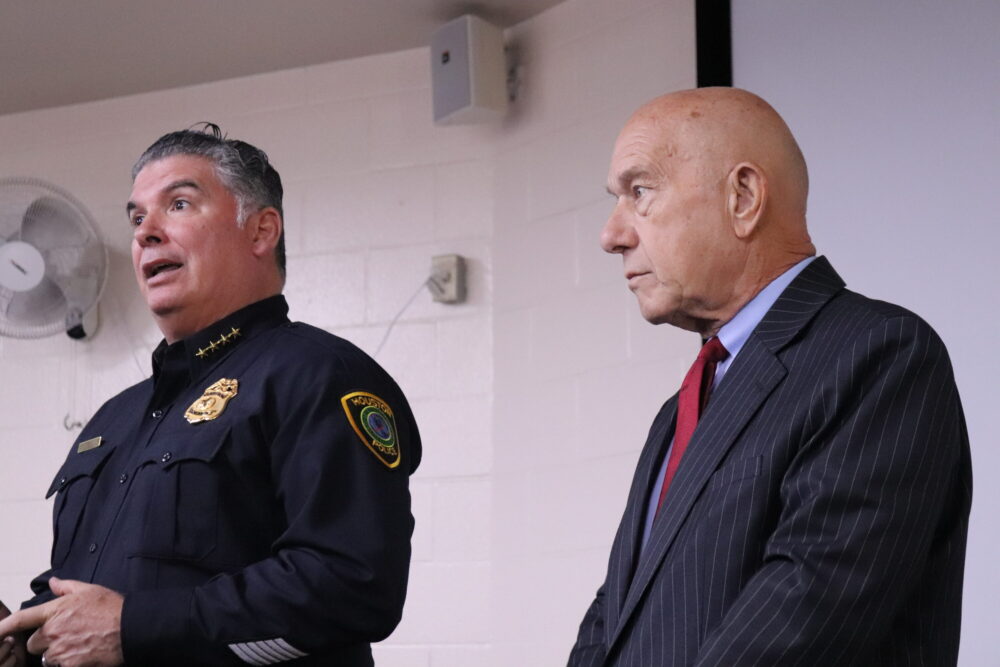
Houston Police Chief Noe Diaz, left, and Mayor John Whitmire announce pay raises for officers at a new HPD cadet class.
Houston police officers contacted federal immigration agents 88 times from July through the end of September, according to data issued by the department on Thursday.
The calls happened when officers found people with immigration warrants. On average, officers detained people for approximately 45 minutes while waiting for agents with U.S. Immigration and Customs Enforcement (ICE) to respond.
According to the figures from the Houston Police Department (HPD), 58 people were released after the calls, 13 were taken to jail for new charges, and 17 were taken into ICE custody.
Sign up for the Hello, Houston! daily newsletter to get local reports like this delivered directly to your inbox.
In 33 cases, officers were responding to a call for emergency services when they encountered someone with an immigration warrant. The data report doesn’t make clear whether the person placing the call for help was the subject of the warrant.
“Out of 300,000 contacts [between HPD and citizens] that have 17 end with ICE involvement speaks for itself,” Houston Mayor John Whitmire told reporters on Wednesday. “Very small, very small number. And for anyone to say different about our involvement is just wrong.”
Related: Houston police responded to a man in a mental health crisis. ICE arrested him
Authorities did not provide full details on each interaction, but records obtained by Houston Public Media for incidents from April through June showed contacts between HPD and ICE during responses to a mental health crisis, a suicide attempt and domestic disturbances.
Asked by a Houston Public Media reporter about community trust, particularly when contacts involve victims of crimes, HPD Chief Noe Diaz said, “I won’t diminish that because that’s real. People feel that. But for us, statistically speaking, the calls for service haven’t changed in the last quarter.”
“No survivor or Houstonian seeking help from the police should have to fear that calling 911 could lead to them or a loved one being detained by ICE.” council member Alejandra Salinas said in a written statement. “I once again call on HPD to explain how calling ICE on crime victims keeps our community safer.”
Interactions between HPD and ICE have been the subject of deep controversy in Houston over the past year. In April, the city council passed an ordinance intended to curtail coordination and require regular reporting about those interactions. After Texas Gov. Greg Abbott intervened, threatening to revoke more than $110 million in public safety funding, city officials rolled back rules prohibiting officers from detaining people due to civil immigration warrants — but they kept the reporting requirements in place.
Still, HPD leadership has been reluctant to provide additional details about the interactions beyond the required data. Diaz skipped a public safety committee meeting in August, citing ongoing litigation filed by a man who was deported after a nearly two-hour traffic stop. At the time, city attorneys cited ongoing litigation as justification for his absence.
Related: HPD Chief Noe Diaz skips meeting on HPD-ICE coordination, city attorney curtails transparency
“It was my decision, based on the city attorney’s advice,” Whitmire told reporters, Diaz sitting next to him. “I made the decision today to invite the chief to have this roundtable discussion to get the facts out and answer any questions.”
Salinas spearheaded the changes in April using relatively new powers granted by Proposition A. Approved by Houston voters in 2023, it allows three or more city council members to place items on the city council’s agenda — a power previously held only by the mayor.
Before releasing the data, Salinas told Houston Public Media she wants to see HPD’s policy change.
“HPD is detaining crime victims and calling ICE on crime victims, which is just a terrible policy that we will continue to urge (Mayor John Whitmire’s) administration to change, but to date they have refused to do so,” Salinas said. “I am continuing to have conversations with my colleagues and the administration, and if I ever believe there is a path forward for Prop A, I will certainly bring it.”