
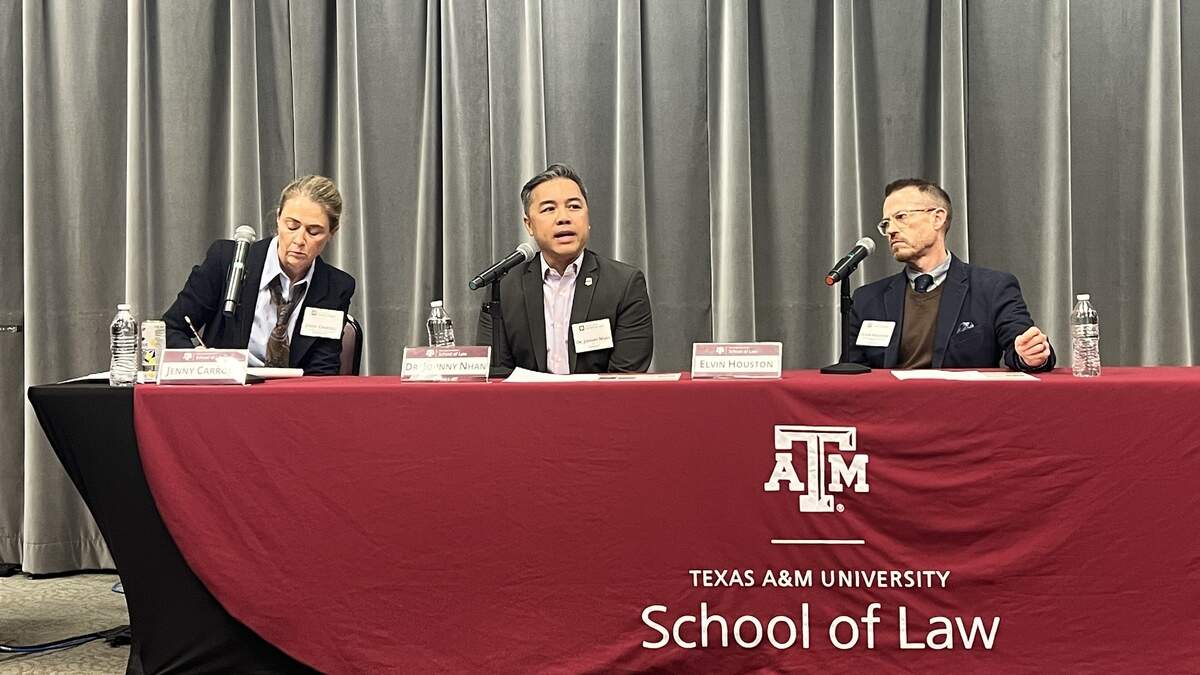
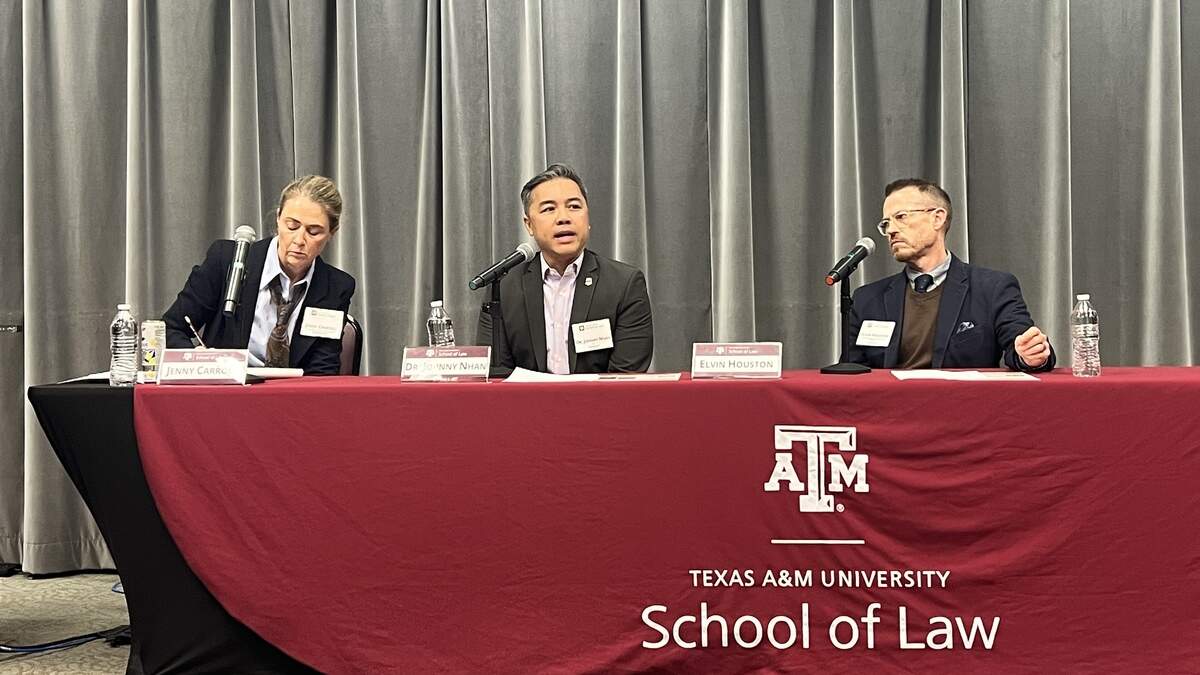
Johnny Nhan, professor of criminology and criminal justice at Texas Christian University, (middle) speaks during a panel discussion about Tarrant County school discipline at Texas A&M University School of Law in downtown Fort Worth on Wednesday, Oct. 28, 2026. Texas A&M University Professor of Law Jenny Carroll (left) moderated the discussion, which included Elvin Houston, a district-side school lawyer with Walsh Gallegos. (right).
Lina Ruiz
FORT WORTH STAR-TELEGRAM
A panel discussion with education and law experts on Wednesday outlined a complicated landscape of school discipline in Tarrant County and statewide, and how a newer state law makes it easier for students to receive punishment.
The discussion, moderated by Texas A&M University School of Law Professor Jenny Carroll in downtown Fort Worth, focused on House Bill 6, which experts called “the biggest rewrite of Texas school discipline law in a generation.”
The law went into effect in the 2025-26 school year. It expanded the ability of teachers to remove students from class for disruptive behavior, including on a single instance. It removed a three-day cap on in-school suspensions, allowing for an open-ended number of days for the form of discipline that must be reviewed every 10 school days.
It also allows students in pre-K through second grade to be given out-of-school suspensions for repeated or significant disruptions. Students caught with e-cigarettes or vape pens can receive at least 10 days of in-school suspension.
Elvin Houston, a district-side school lawyer with Walsh Gallegos, said the new law focuses on expanding opportunities to exclude students from schools to ensure a safe learning environment. But it reflects a larger issue around classroom management and support, he said.
“The individuals who are working in the profession are not being compensated, they’re not being trained adequately and they don’t feel supported. So, it’s hard to then put additional demands on those individuals, to expect them to respond in a different way than the options given to them under House Bill 6. It is very much, I think, a cycle,” he said.
Tarrant County’s largest school district, Fort Worth ISD, disciplined about 10.6% of its students in the 2024-25 school year — the latest data available. This compares to 10.1% of Texas students being disciplined statewide. In the previous school year, there were 11.3% of Fort Worth students who faced discipline and 10.6% statewide. This includes in-school suspensions, out-of-school suspensions and placements in outside disciplinary programs.
Johnny Nhan, professor of criminology and criminal justice at Texas Christian University, said school behavior is a symptom of something bigger happening outside of school. Students in poverty, for example, are typically more concerned about meeting their basic needs rather than focusing in the classroom.
“There’s two things that are happening. Number one: we are starting to skip the helping the kids part. We’re just going straight to the punishment part. And then on the second hand, we haven’t talked about these underlying social conditions, economic conditions, where if you’re in poverty, school is just secondary in terms of your concern,” Nhan said.
The panel also spoke about the school-to-prison pipeline, noting how disciplinary action in schools can lead to exposure to the criminal justice system. House Bill 6 expands the opportunities for a student to be expelled, which triggers mandatory reports to law enforcement, Houston said.
Carroll, a former public defender for juveniles, said she’s noticed patterns in court of who ends up getting involved in the legal system.
“Children I see who are in lower socioeconomic classes, or who are vulnerable in other ways in our community, end up with referrals at higher rates. So, I also think it’s important to acknowledge these aren’t equal applications of this school-to-prison pipeline. It’s not equal within districts. It’s not equal in schools. It’s not equal among populations,” she said.
Related Stories from Fort Worth Star-Telegram

Fort Worth Star-Telegram
Lina Ruiz covers early childhood education in Tarrant County and North Texas for the Fort Worth Star-Telegram. A University of Florida graduate, she previously wrote about local government in South Florida for TCPalm and Treasure Coast Newspapers.