
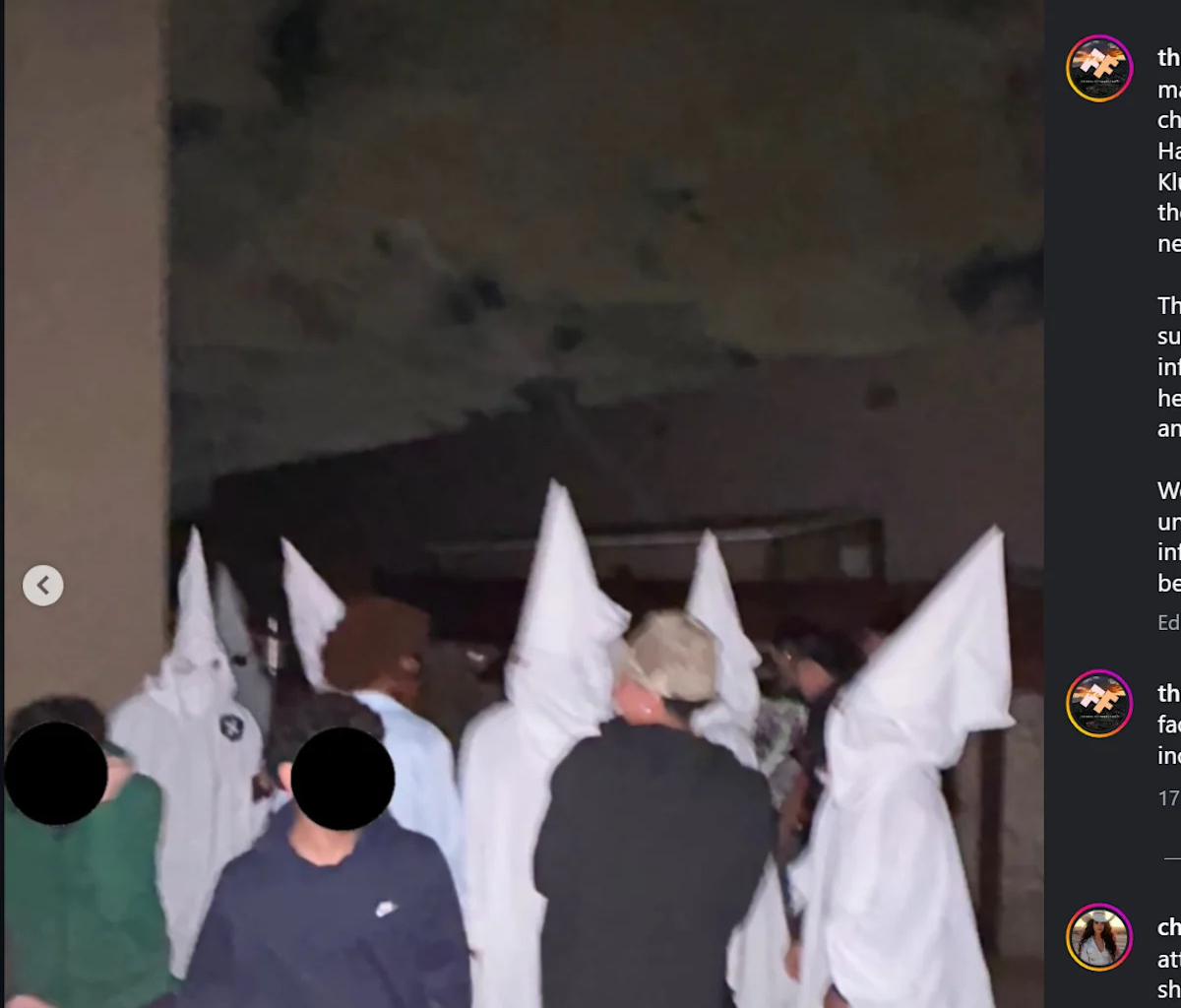
An incident involving people wearing Ku Klux Klan-style costumes in El Paso last weekend drew national attention and sparked a police investigation.
The El Paso Police Department is reviewing whether any laws were broken, including possible disorderly conduct violations.
The El Paso NAACP and local leaders condemned the actions, saying it evokes the Klan’s violent racist history and does not represent the community.
‘Hate is not a costume, racism is not a joke’
El Paso Mayor Renard Johnson had the following to say on the matter; he reiterated his statement during Tuesday’s City council meeting:
“I am deeply disappointed and disturbed by the actions of these individuals who chose to dress as members of the Ku Klux Klan. El Paso is a city built on diversity, respect, and unity. The KKK represents a painful history of racism, hatred, violence, and intimidation that have absolutely no place in our community. Hate is not a costume, racism is not a joke, and our community deserves better. We are better than this, El Paso.
Videos and photos of the gathering circulated on social media and were picked up by national news organizations, including CNN and NBC News.

Video clips and photos on social media depict about six people in pointy white KKK robes in what appears to be a backyard, as shared by Fam El Paso.
This prompted me to check the archives for mention of the KKK in El Paso.
The first mention I found was a Sept. 18, 1912, El Paso Herald report on subcommittees announced for the Os-Aple jubilee, yes that’s El Paso backward. Along with subcommittees on music, transportation, cowboys and Boy Scouts was the Ku Klux Klan headed Dr. I.J. Bush.
Boys Organize Juvenile Ku Klux Klan and Bind Boy; Police Interfere
On Aug. 12, 1916, when Olive Street was in the eastern part of the city, detective T.J. Boyd relayed the following:Motion pictures of dashing riders attired in white garments with “K.K.K.” on their breasts was the inspiration of several boys residing in the eastern section of the city, who organized a Ku Klux Klan of their own, according to a story told by city detective T.J. Boyd:
The discovery of the amateur Ku Klux Klan was the result of a telephone call from a mother residing on Olive Street who said that her son had been caught by a number of other boys and tied up by a rope in an alley near her home. Several boys were taken to the police station for an investigation and then the story of the juvenile Ku Klux Klan was told.
“We saw the pictures of the Ku Klux in the moving picture show,” said one of the boys, “and we thought we would organize one. We did not intend to hurt the boy but he had been throwing eggs at us, and we gave him a warning. After we had let him go he went to the soldier camp, where he was found later.”The boys were then released.
Ku Klux Klan Is Censured By Chief Of Police Edwards
As reported on Sept. 10, 1921, Chief of Police Peyton J. Edwards said he would do all in his power to suppress the KKK and ensured El Pasoans that his force was able to maintain the law here:
“Personally I am against the formation of any kind of an organization that will encourage lawlessness or that by its actions will create an opening for the operation of criminals and I will do all that is within my power to suppress the activities of the Ku Klux Klan or any other secret order that would attempt to mete out punishment to citizens of El Paso.
“El Paso’s police force is amply able to enforce the law here. That has been proven. Past records show it. I am sworn to uphold the law and I will take action against any unlawful demonstrations by members of any organization whether secret or not…
“The organization furnishes an opening for operation of criminals and should not exist. If there was no such organization lawbreakers would have nothing to hide behind.”

March 13, 1922: Flashlight photograph made for The Herald of the outdoor initiation of El Paso Ku Klux Klan, in Piedmont Height addition last Friday night.
El Paso To Ban Ku Klux Klan
An article on Sept. 15, 1921, reported that “a branch of the Ku Klux Klan was organized in El Paso three or four weeks ago. There had been no public recognition of the Klan until city officials determined to stop what they had heard was going to be a parade by the group.
City council met to formulate an ordinance that would allow for a fine of not less than $10 or more than $200 against “each member participating in the parade, ceremony or procession without permission from the chief of police.”The ordinance was not passed as Councilman W.T. Griffith opposed the ordinance because he thought it was unconstitutional, City Attorney Victor M. Moore agreed and began to write a new ordinance that would “subject members of any organization a fine up to $200 for participation in masked demonstration or parade without first filing application for permit with the chief of police, the application to be signed by three members of the order and specifying time, place, route and so forth.”
More: Klan park’s role in El Paso’s July 4th celebrations revealed: Trish Long
Armed Men Wait K.K.K. Parade; Chief Edwards Has All Cops on Duty
The word on March 13, 1922, was that the Klan was going to parade through El Paso at 10 p.m. At 8 p.m. telephones began to ring throughout town and the El Paso Times reported “Five hundred citizens, carrying shotguns, pistols, clubs and bricks, gathered on South Oregon Street” to stop the Klan from their “public demonstration.” There was no parade that night.
Ku Klux Klan Report False; Crowd Is Sunday School Gathering On Mesa
In June of the same year, police were still on high alert for a KKK activity:
A hurried call to the police and a rapid investigation revealed that the Ku Klux Klan was not responsible for the gathering of 100 persons on the Mesa near the foot of Mount Franklin. Cars formed in a circle about a campfire, and children playing with lighted papers on sticks led police to believe that klansmen were initiating a class under a fiery cross.
The Men’s Bible class of the First Baptist church was having a steak fry.

Feb. 25, 1923, El Paso Times, Dudley beats KKK.
DUDLEY BEATS K.K.K. BY 2,120
The Feb. 24, 1923, El Paso election was seen as a measure of whether El Paso was a pro or anti-Klan town. The results showed that “El Paso is not a Ku Klux Klan town”:
El Paso is not a Ku Klux Klan town. This was the word sent out by El Pasoans yesterday to the country after an election which resulted in a decisive victory for the opponents of the hooded organization.
The voting yesterday was for or against the klan. This was the only issue involved. The result showed El Paso was whole-heartedly against such a secret organization.
State Senator R.M. Dudley, candidate for mayor, led his anti-klan ticket in the assault which resulted in a complete routing of the forces sailing under the banner of the Cyclops. P.E. Gardner, the klan-indorsed standard bearer, was subjected to beating at the hands of the senator which he probably will never forget. Mr. Gardner was willing and did concede his defeat as early as 8:30 o’clock last night. Reports coming in from the various voting precincts over the city early convinced the klansmen and their adherents that the fight was lost.
Trish Long may be reached at tlong@elpasotimes.com.
This article originally appeared on El Paso Times: From 1921 to today: El Paso’s pushback against the KKK