
Historian and author Dr. Michael Phillips, SMU Professor Dr. Rick Halperin and Hadi Jawad, co-founder and president of Human Rights Dallas, submitted the op-ed below.
August 25, a devastating fire raged through ten acres of Sand Branch. The unincorporated former Freedmen’s Town stands in a floodplain fourteen miles southwest of downtown Dallas. Its residents, with an average age of 68, scrambled to put out the flames.
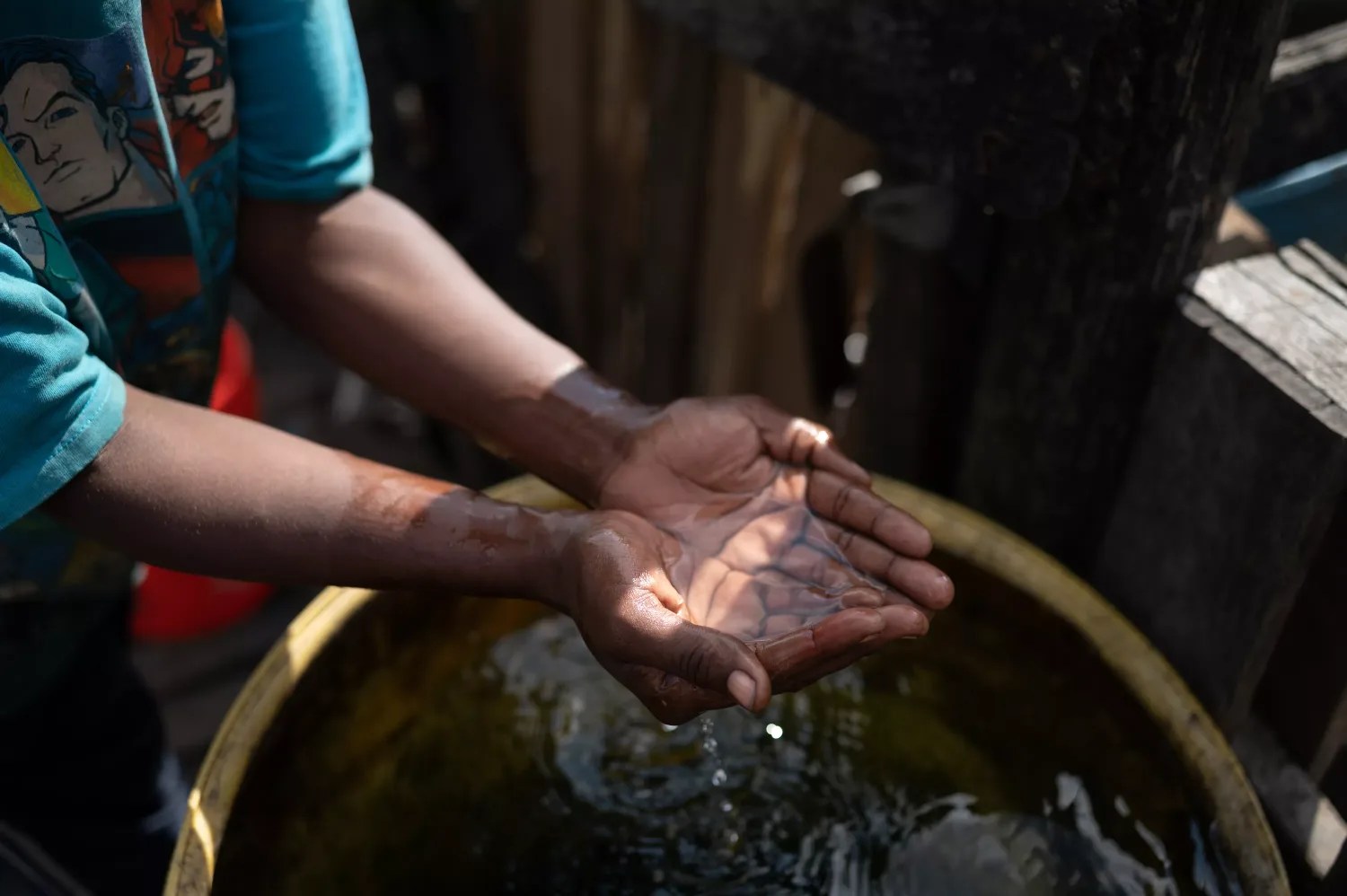
As D Magazine columnist Bethany Erickson noted, the poverty-plagued community lacks clean running water. The people of Sand Branch rely on bottled water to drink and bathe. There are also no fire hydrants in Sand Branch.
Sign up for the This Week’s Top Stories newsletter to get the latest stories delivered to your inbox
THANK YOU!
You’re all set.
CLOSE
As the blaze roared ominously near small, often decaying homes, “residents were using those bottles of water to try to put the flames out,” Erickson wrote. Eventually, firefighters from nearby municipalities arrived and brought the conflagration under control.
Sand Branch residents have been politically abandoned for decades, failed repeatedly by Republicans and Democrats, and by Black and white officeholders.
The community lacks not only running water, but also streetlights, a sewage system and connections to the internet. Because it has no elected city government, people in Sand Branch lack trash collection. Residents are forced to burn their garbage, which only increases cancer-causing toxins in the air and soil. Meanwhile, children have drowned in gravel pits, as D Magazine reported in 1985.
Population estimates vary, but the number living there probably hovers around 100. According to a 2014 study from the Hunger Center of North Texas, African Americans make up 87% of Sand Branch, another 10% are Latino, while whites constitute only three percent. The entire population lives below the poverty line, with income averaging $721 a month.
The United Nations declares, “Access to water and sanitation are recognized . . . as human rights – fundamental to everyone’s health, dignity and prosperity.”
In Dallas County, that right has been trampled upon. As happens so often in local politics, racism and contempt for the poor lie behind this malignant neglect.
“We don’t have water here and you know why?” Ivory Hall, an 83-year-old Black resident of Sand Branch, told The Guardian newspaper back in 2017. “The pigment of my skin. If I were white like you, I bet they’d have water down here.”
For years, Sand Branch has been the site of an illegal trash dump six to eight acres in size that Dallas County Fire Marshal Robert De Los Santos said in early September contained “thousands and thousands of tons . . . of rubbish and debris.”
Sand Branch isn’t the only part of Dallas County to live in such squalor. Perhaps hundreds of residents of another rural community of 7,400, referred to as “No Town,” also lack running water and other modern services, according to a recent Texas Monthly report. There, the yellowish water “smells like feces.”
Most of Dallas tends to overlook the existence of Sand Branch until something terrible happens. Then this place so rich in tragic history is completely forgotten again.
Led by Rev. Allen Hawthorne from Louisiana, twelve African Americans emancipated from slavery the previous decade established Sand Branch (sometimes spelled “Sandbranch”) in 1878. As Dr. Ed Gray, director of the Dallas County Justice Initiative, wrote in his SMU dissertation “Municipal Zoning and its Impact on Communities of Color,” the name of the community derives from the sandy streams flowing from the Trinity River near where Hawthorne and his companions built their settlement.
According to The Guardian, “properties were established by African Americans lured by cheap land and the opportunity to elude the various indignities inflicted by the white bastion of Dallas.” By the mid-twentieth century, the place offered natural beauty, “a rich, verdant landscape of creeks, fields and huge gardens that grew any vegetable in the dictionary,” as the ‘85 D Magazine report noted.
Residents dug wells to reach water for drinking, bathing and cooking. But that all began to change by the 1950s when white Dallas had subjected Sand Branch to the colonization that has always characterized the history of Black communities in this region.
Hogs overran real estate owned by absentee landlords. Gravel mining began. Contamination from the mines combined with pig and human waste poisoned the local water supplies. Residents buried septic tanks that seeped contaminants into the soil, even though the city of Dallas’s Southside Wastewater Treatment plant, built in 1964, is so close that, as Erickson put it, “you can smell it.”
By the mid-1980s, the water smelled bad too, was filled with sand and had turned brown. E. coli bacteria infested the local water supply and started making residents sick. In 1997, the Texas Natural Resources Conservation Commission (now renamed the Texas Commission on Environmental Quality) also discovered that the well water contains metals such as iron and manganese that pose health risks.
As a result, for more than four decades, the community has depended on bottled water, much of it donated by environmental justice groups like Southern Sector Rising and Taproot Earth, for its needs.
“We have kids with no water,” the Rev. Eugene Kehey (the former pastor of Mount Zion Baptist Church in Sand Branch) told Daeja Pemberton, a Texas A&M law student who has extensively researched Sand Branch’s water woes. “We’re like a Third World country, and I don’t say that loosely.”
Dallas County has used Sand Branch’s location in a floodplain as an excuse to do nothing to provide help. As Pemberton noted, in 1985 Dallas County imposed its own restrictions on new construction in floodplains. From that year until 2000, the county allowed 70 structures to rise anyway in violation of those standards. In 2000, the Federal Emergency Management Agency warned Dallas County that it had violated the requirements of the National Flood Insurance Program (NFIP) when it allowed those structures to be constructed. Failure to comply could have resulted in the county losing access to NFIP funds in the future.
FEMA gave Sand Branch residents only thirty days to choose from a menu of expensive, complicated options: raise their homes above flood level, move their residences outside of the floodplain, build a levee, or tear their homes down. Pemberton described what happened next:
After FEMA’s ultimatum to the Sandbranch community, Dallas County created the Dallas County Optional Sandbranch Relocation Assistance Program in 2005. This buyout program provided funding for thirty-six families to relocate, but after those families paid home demolition fees, they were only left with $350 each to move from Sandbranch—this was not enough for a family to afford even a month’s worth of rent.
A 2024 estimate placed the cost for the county to provide Sand Branch water at about $8 million. County commissioners don’t think Sand Branch is worth that price tag. Their preferred option has been offering residents yet another buyout.
Rick Loessberg, Dallas’s retired Director of Planning and Development, said in 2023, “We tried to get them water, but with the cost involved and a declining population, was it good policy to spend millions of public dollars for 88 people?”
Sand Branch sits in Dallas County Precinct 3. John Wiley Price represents the community on the Commissioners’ Court. Price, along with commissioners Elba Garcia and Mike Cantrell, all agree with Loessberg and support some sort of assistance to help residents relocate. “That’s the only way,” Price said in August. “If this was a business proposition, we wouldn’t even be talking about [building water lines]. We’d be talking about relocation.”
That will leave the people of Sand Branch high and dry once again if the relocation aid is similar to the amount provided 20 years ago. Housing has only grown vastly more expensive in the Dallas-Fort Worth area in the two decades since the 2005 buyout. In recent years, demand for housing has significantly outstripped supply. “We had a bigger deterioration of affordability than the average metropolitan area in the U.S.,” J.H. Cullum Clark, director of the Bush Institute-Southern Methodist University Economic Growth Initiative, told The Dallas Morning News earlier this year.
Any likely stipend the people of Sand Branch might receive would likely not provide enough for the Sand Branch diaspora, torn from their close-knit community, to find comparable living space, if any affordable house could be found at all.
Another option would be for the City of Dallas to annex Sand Branch, thus connecting it with municipal trash collection, water and other basic services. But that, according to Pemberton, would cost $11 million while Sand Branch would generate only $24,000 in tax revenue annually.
That price tag would be a hard sell for a city council coping with declining tax revenue. That’s especially true under the leadership of Mayor Eric Johnson, whose questionable priorities include spending $2.23 million on his security detail in 2025.
The city of Dallas, Dallas County, and the entire North Texas legislative delegation, however, could do the right thing by Sand Branch if a bipartisan effort were made to lobby the state Legislature to provide necessary funds to bring Sand Branch infrastructure up to 2026 standards.
The state’s Economic Stabilization Fund, popularly known as the “Rainy Day Fund,” will reach $27.4 billion by the end of the year and will likely hit its legal cap. It’s hard to find a more morally appropriate use for this money, drawn from oil and gas severance taxes, than to help out communities like Sand Branch where it’s always a rainy day but there’s never a drop to drink.
U.S. Senate hopeful James Talarico has called for such a move from Washington, D.C. “Access to clean drinking water is a basic human right,” Talarico said in an interview published by the Observer on September 9. “It’s time for change. In the Senate, we can tackle our state’s growing water crisis by funding the infrastructure needed to get safe, reliable water to communities like Sand Branch.”
If he wins, voters will have to hold Talerico to his words. He will also need allies.
In his second inaugural address in 1937, Franklin Roosevelt said, “The test of our progress is not whether we add more to the abundance of those who have much; it is whether we provide enough for those who have too little.”
To date, Dallas has failed that test. The time to provide Sand Branch basic human necessities is more than four decades overdue.