
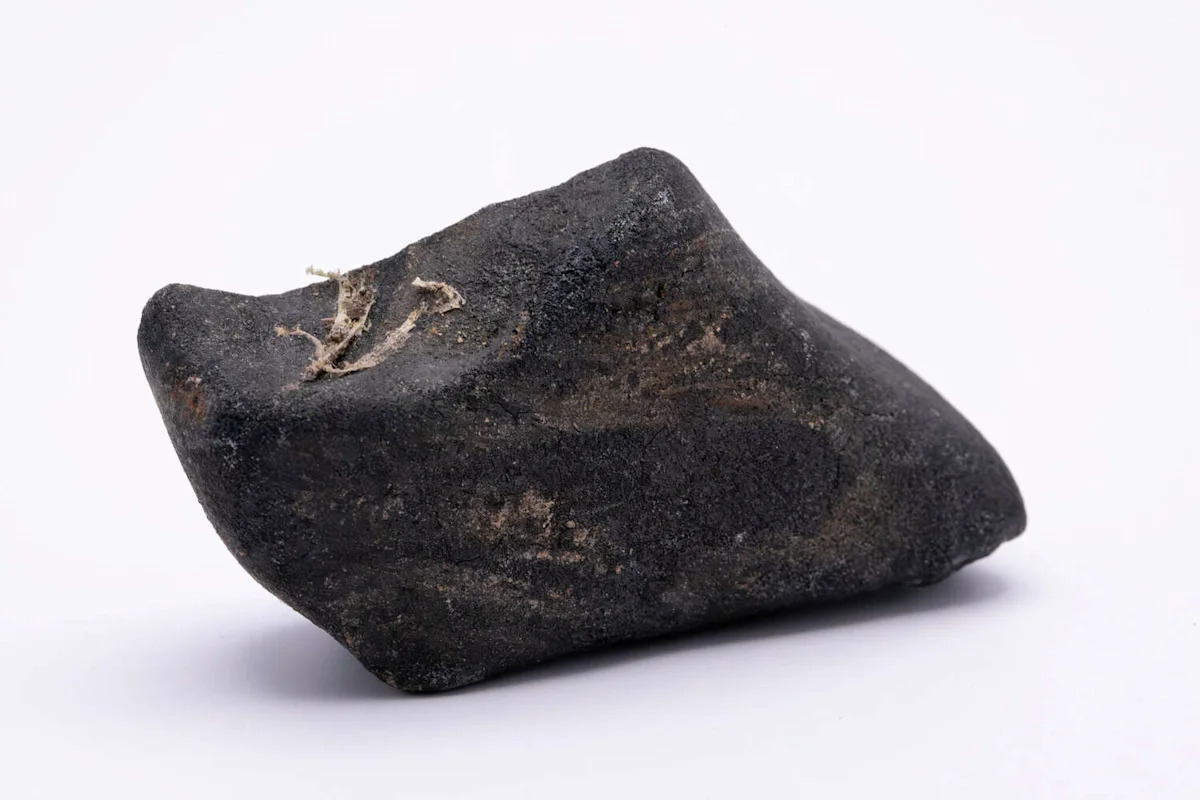
The meteorite that rattled Houston and sent a chunk of space rock crashing through a Spring woman’s roof earlier this year is getting an exhibit of its own.
Starting Nov. 6, the Houston Museum of Natural Science will give visitors an up-close look at the 4.5-billion-year-old meteorite in a new, free exhibit called Fall to Earth.
The meteorite made an unforgettable entrance on March 21. Around 4:40 p.m., a one-ton space rock traveling nearly 35,000 mph broke apart about 29 miles above the Houston area, unleashing an explosion equivalent to 26 tons of TNT. The resulting sonic booms rattled homes across Southeast Texas.
Spring resident Sherrie James got an even closer encounter. She was home when a piece of the meteorite punched through her rood and landed in an upstairs bedroom near her daughter’s bed.
“It’s just exciting to think of where it’s been and how far it’s traveled,” James said. “That little thing has traveled by planets and stars, there’s no telling how far it’s come. So, it’s very exciting. I just feel blessed it came to see me.”

Spring resident Sherrie James was home when a meteorite crashed through her roof and landed in an upstairs bedroom on March 21. (HMNS)
The rare daytime fireball also sparked a meteorite hunt across North Houston. NASA planetary scientist Marc Fries spent days searching areas identified using weather radar, seismometers and eyewitness reports. He eventually recovered a 46-gram fragment in a grassy strip along Cypresswood Drive near the Barbara Bush Branch Library.
Since the meteorite fell, 19 fragments have been recovered throughout the Houston area.
Some of those pieces ended up at Rice University, where researchers uncovered surprising details about the meteorite’s violent past.
The rock is classified as an ordinary chondrite, a type of meteorite containing material left over from the solar system’s formation.
“We call them ordinary only because about 85 percent of meteorites fall into this category,” Linda Fries, a science writer at Rice University, told Chron during an April interview. “That doesn’t make them ordinary by any stretch.”
Further analysis revealed something unusual. The Houston meteorite was missing tiny, rounded mineral grains typically found in chondrites. Researchers determined that the rock had been heated to nearly 2,00 degrees Fahrenheit while still part of its parent asteroid, melting those grains. Evidence also suggests the asteroid experienced a violent collision in space.

A fragment of the meteorite that crashed to Earth in North Houston on March 21. The Houston Museum of Natural Science will open a free exhibit about the space rock on Nov. 6. (Linda Welzenbach, Rice University)
“We think this meteorite was impacted in space,” Rice planetary scientist Bidong Zhang said in a June university report. “It truly is a unique specimen.”
The meteorite’s arrival in a residential neighborhood was just as extraordinary.
“A 4.5-billion-year-old fragment of our solar system’s original formation crashed through the roof of a Houston-area home,” Carolyn Sumners, the museum’s vice president of astronomy, said in a statement. “That’s not something you expect to happen in your own neighborhood.”
Researchers at Rice have proposed naming the meteorite “Houston,” pending approval from the Meteoritical Society.
More Space
Exploration | NASA releases new timeline and mission details for moon base plans
Sentimental | A Friendswood nurse’s legacy is now written on the moon
History | Artemis II breaks Apollo 13’s distance record with daring moon flyby
Exploration | That Houston fireball? It dropped meteorites scientists can now study
For the latest and best from Chron, sign up for our daily newsletter here.
This article originally published at Meteorite that crashed through Houston-area home gets its own exhibit.