
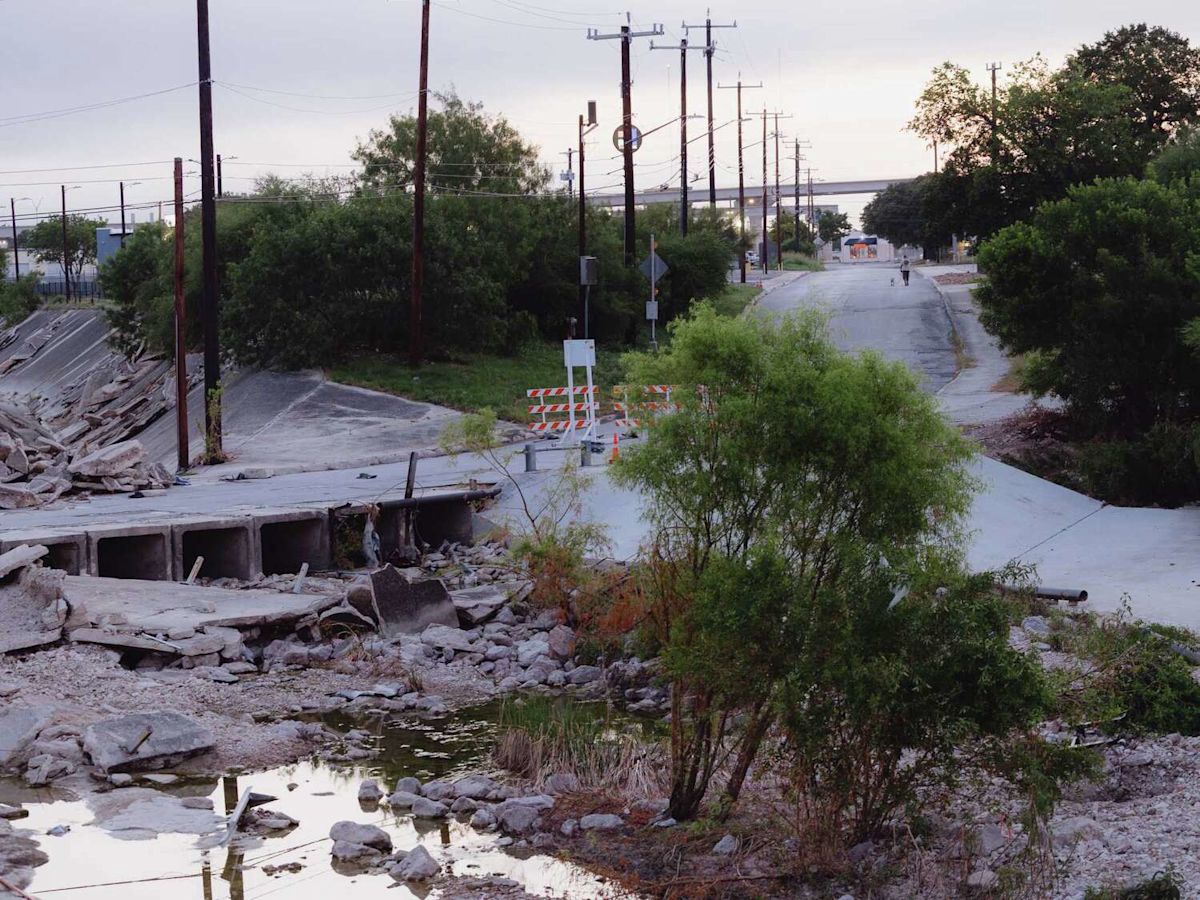
Solving San Antonio’s flooding problems will take billions of dollars – far more than the city can come up with on its own.
As City Council members debate a May bond election and plan to increase stormwater fees to raise revenue, city staffers have put together a list of proposed drainage and flood control projects that would cost more than $2 billion.
But the city has nowhere near enough money available to make that happen. To stretch limited dollars as far as possible, city staffers have recommended raising stormwater fees for the first time since 2019 to cover just a sliver of that list, about $208 million.
How much bond money could your neighborhood get?
Mayor Gina Ortiz Jones has pointed to one possible source of additional money: state government, which doles out money to projects that are listed in the State Flood Plan.
The State Flood Plan is a document created in 2024 to compile statewide information about flood risks. It also included a list of more than 4,000 ways to reduce flood risks – including more than a dozen projects that the city of San Antonio wants to undertake, at a cost of about $840 million.
Jones has repeatedly called those projects a priority. She took office days after flooding killed 13 people in San Antonio, 11 of them on a flooded road on the Northeast Side, and in the months that followed, toured the sites of 14 of those proposed projects and called on local state legislators to advocate for them.
To get money from the state’s Flood Infrastructure Fund, projects have to be in the state plan – so 17 of the city’s proposed projects are eligible for that money. But so are thousands of others around Texas, meaning there’s no guarantee that the city will get any help paying for them.
What is the State Flood Plan?
In 2019, Texas legislators took the first steps toward creating a statewide plan to address flooding issues. The process was modeled after the state’s water planning system: regional groups, assigned geographically, put together plans for their areas. Those are then compiled and adopted by the Texas Water Development Board as one statewide document. The regional groups submitted their first flood plans in 2023, and Texas’ first state plan was adopted in 2024.
The idea is to identify flood risks and different types of approaches – construction projects, like dams or drainage channels, and strategies like policy changes or warning systems, for example – that would reduce those risks.
The 15 regions are grouped by river watersheds, from the Canadian and Upper Red River basin in the Panhandle to the Lower Rio Grande along the southern border. The San Antonio Regional Flood Planning Group, which covers the San Antonio River basin, includes members from Bandera and Kendall counties, all the way to Goliad County on the coast.
The initial 2024 plan included more than 4,600 “flood risk reduction solutions,” though two-thirds of those were “flood management evaluations,” or studies to assess flood risks or identify potential solutions.
The estimated cost of the 615 flood mitigation projects in the plan totaled $49.1 billion, though over half of that was just one project, the Galveston Bay Barrier System, often dubbed the “Ike Dike.”
Projects must be included in the plan to be eligible for money from the Flood Infrastructure Fund, which is administered by the water development board. That money is typically provided as a combination of grants and loans, which local governments must then pay back over time.
San Antonio adopts stricter approval process for new data centers
How does a project qualify?
Sponsors – that’s local government entities like the city of San Antonio, Bexar County and the San Antonio River Authority – can submit projects to each regional plan.
Technical consultants hired for each region then review those projects and determine whether they’re complete, said Erin Cavazos, the river authority’s engineering manager. That process also includes assessing whether they’d cause problems upstream or downstream, she said.
“They really try to work with sponsors to get their projects into the plan,” Cavazos said – so as long as projects are complete and not causing harm, they’re generally included.
Does being in the plan mean a project is more important than others?
No, it doesn’t, Art Reinhardt, San Antonio’s director of public works.
“There were specific characteristics of the type of projects that were eligible to be submitted,” he said – so projects that San Antonio submitted to the plan aren’t inherently higher priorities than those that weren’t submitted.
The state prioritizes projects that are larger and more regional in nature, Reinhardt said, while San Antonio’s flooding issues, and therefore, the city’s proposed solutions, tend to be more localized.
The projects also needed to have detailed analyses complete; while the city has a database of “a few hundred potential future projects,” not all of them have had the full analysis needed to be included.
The city initially had 14 projects in the regional plan; it’s now up to 17, Reinhardt said.
What funding is available?
While a project must be in the plan to qualify for Flood Infrastructure Fund money, that doesn’t mean all projects in the plan will receive money.
All submitted projects are scored and ranked by the Texas Water Development Board, determining which ones can then apply for money.
So far, the Texas Water Development Board has committed $851 million from the fund for 125 active projects, according to the agency’s website.
No projects from the San Antonio regional plan were funded in the 2024-25 cycle, Cavazos said.
Reinhardt said there’s hope that will change in the 2026-27 funding cycle, because the agency has said it will award money to at least one project per region.
But getting that money is “a tough competition,” Reinhardt said.
Jones said she wants San Antonio’s representatives to advocate for the local projects in the plan, calling it a key issue for public safety.
“It’s really important that not only are we clear about our projects, but also that we speak with one voice, so that we’re advocating for the city as best able,” she said.
“As we continue to have extreme weather events, I would hope that this is a an area where the state pays more attention and and sets aside (money),” she said.
What does it mean for the city’s bond plans?
Not much. Because sponsors still have to apply to the state and compete for grant money for flood projects, simply being in the plan doesn’t really mean anything as far as state funding. So if the city wants to go forward now with a project that’s in the plan, it has to be funded another way.
“I’m not going to rely only on the state funding, right? Because there’s so many needs out there,” Reinhardt said. He said the city is moving forward with “what makes sense locally.”
City staffers have proposed a list of 20 projects to fund with the increased stormwater fee; five of those are listed in the flood plan:
Allsup and Flagle area improvements: District 5, $2.5 million. “Construction of a designed project that increases flow and contains flood waters to reduce flooding.”
Barbara Drive drainage Phase 4: District 1, $26.2 million. “Proposed upgrades include upsizing the storm drain under Dellwood Drive.”
Judson and Lookout low water crossing: District 10, $6.9 million. “Construct upgrades to existing low water crossing and channel improvements as applicable.”
Seeling drainage Phase 5: District 7, $29.6 million, “Multi-phase drainage project including street reconstruction, sidewalks, driveways, drainage, and utility upgrades. Earthen-lined channel improvements included.”
Ridge Run drainage improvements: District 6, $15.5 million. “Drainage infrastructure improvements to optimize water flow and mitigate flood risks.”
But those five projects aren’t necessarily the city’s top priorities – or what would be the top priority if they had enough money, city staff have said.
The 20 proposed projects were selected based on criteria from the city’s Storm Water Management Advisory Board, as well as what could fit into the proposed budget, Capital Delivery Director Mike Shannon told the council recently. Most of those projects are phases of larger efforts that are already underway, he said, and priority was given to projects that are already designed and ready for construction.
Other, larger projects were left off the list: for example, the city’s highest-priority of its 17 state plan projects is a $200 million effort to improve Concepcion Creek, Reinhardt said, but that would eat up nearly all the budget on its own, leaving no money for other drainage projects.
He said the city will add more projects to future iterations of the state plan, and will continue seeking money when it’s available.
“If we should happen to get state flood dollars, then you know we could maybe use some of the funding as the match required, and then reallocate those those funds to another project,” he said.
Express-News reporter Molly Smith contributed to this report.
Subscribe
There’s more to San Antonio with the Express-News. Subscribe today for just 25¢.
This article originally published at Will state help San Antonio pay for projects to lower flood risk?.