
Sign up for The Brief, The Texas Tribune’s daily newsletter that keeps readers up to speed on the most essential Texas news.
Audio recording is automated for accessibility. Humans wrote and edited the story. See our AI policy, and give us feedback.
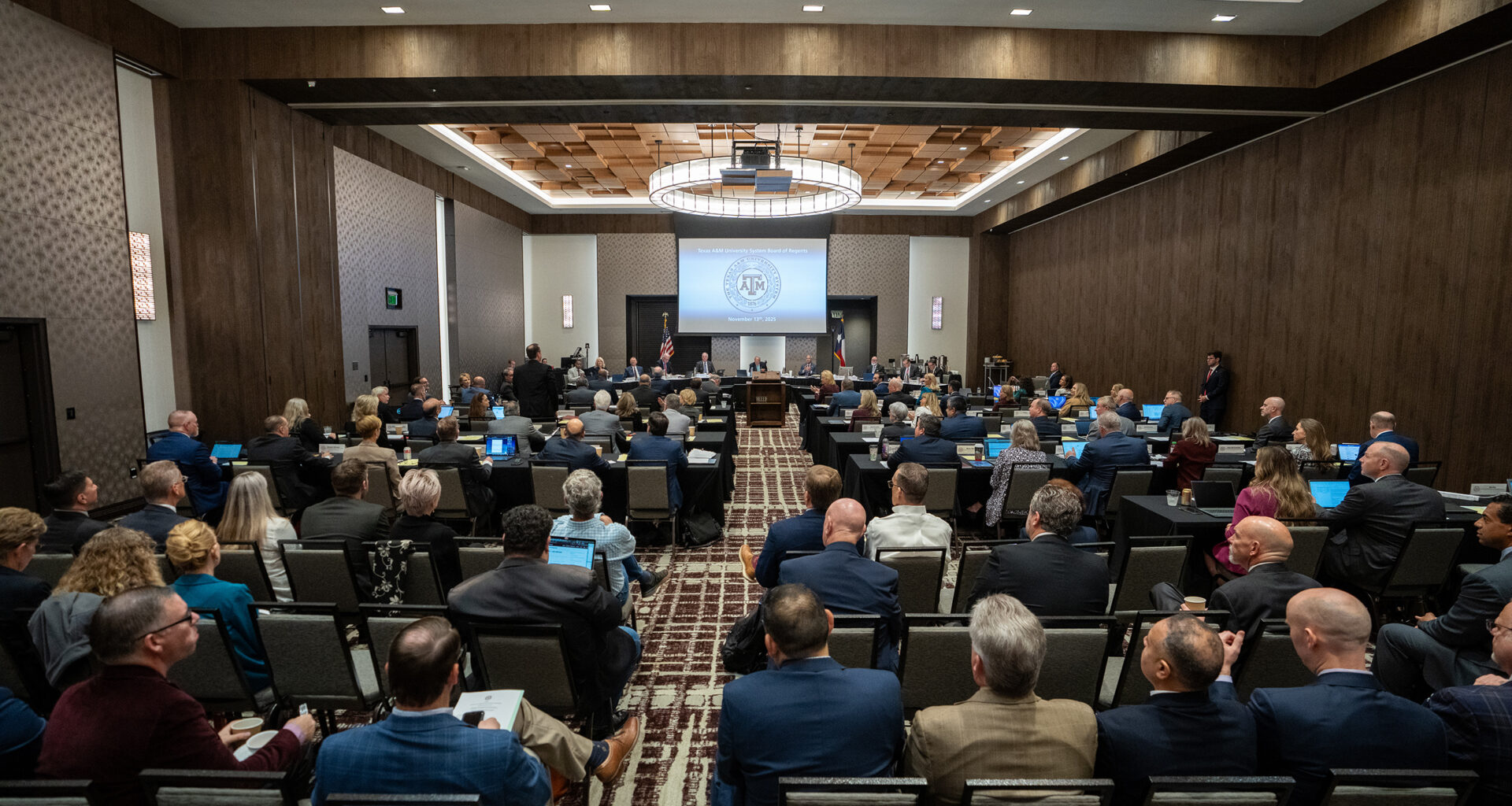
Texas A&M University System regents on Thursday previewed new rules and procedures to audit all course content in the system’s 12 schools every semester, steps that were ordered after a student’s secret recordings of a professor discussing gender identity in a children’s literature course sent shockwaves through Texas’ higher education institutions.
“It’s a serious system-wide review of every course, every syllabus,” regent Sam Torn said Thursday at a meeting of the regents’ subcommittee on academic and student affairs. “We are examining the body of knowledge behind each degree, low-producing programs, workforce relevance and financial stewardship.”
In addition, the subcommittee voted to advance two policy proposals that could work in conjunction with the new course audits and also came in response to the recordings: a rule that would restrict faculty from advocating “race or gender ideology or topics related to sexual orientation or gender identity,” and another that would prohibit faculty from teaching material inconsistent with the approved syllabus for the course.
The full board of regents is expected to vote on the proposals on Thursday afternoon.
The course audit was announced by System Chancellor Glenn Hegar the day after the secret recordings went viral. James R. Hallmark, the system’s vice chancellor for academic affairs and whom Hegar tapped to lead the audit, told regents during the subcommittee’s meeting that each university will now be required to feed syllabi and course details into a database, which will then be examined by artificial intelligence for content not aligned with approved syllabi.
The AI analysis will consider things such as whether the course applies to the core curriculum or is a requirement for a major or elective. It will also take into account the syllabus and details such as where it’s taught and enrollment numbers.
“The purpose of attaining that level of detail was to understand if the course was truly an elective, a choice of the student or if in some way a student may have had no other choice but to take that particular course,” Hallmark said. “This depth of analysis is unprecedented in such reviews.”
The proposal mirrors the concerns university officials raised when they fired professor Melissa McCoul over the videos that went viral in September.
University officials said McCoul refused to change her course content to match the catalog description, but she and other faculty have countered that course descriptions have historically been broad, and that professors are expected to design their own syllabi and teach according to their expertise.
McCoul has appealed her termination through the university’s Committee on Academic Freedom, Responsibility and Tenure, which concluded a hearing on the topic last week. The committee is expected to share a recommendation with interim university President Tommy Williams in the coming weeks on how to respond to McCoul’s appeal, but Williams is not obligated to follow it. A separate A&M faculty panel in September concluded that McCoul’s firing violated her academic freedom.
The system will also launch a 24/7 option for students “to report what they consider inaccurate or misleading course content.” Hallmark added that system staff will review any student reports and work with the appropriate university to address the concerns.
“Let it be noted that the Texas A&M system is stepping up first, setting the model that others will follow,” Torn said.
The presentation came hours before the full board of regents was set to consider major policy changes. The proposal would require faculty to receive the university president’s approval before teaching lessons that could be considered as advocating for “race ideology” — defined in the proposal as “attempts to shame a particular race or ethnicity” or anything that “promotes activism on issues related to race or ethnicity rather than academic instruction” — or “gender ideology,” defined as “a concept of self-assessed gender identity replacing, and disconnected from, the biological category of sex.”
If approved, the changes would go into effect by the spring semester.
“These policy changes complement the academic review and transparency initiative currently underway,” Hallmark said. “And together they ensure clear course purposes, student accessible reporting mechanisms, regular review and continuous quality improvement.”
Since McCoul’s firing, other university systems have begun imposing their own restrictions on classroom content.
On Sept. 25, the Texas Tech University System instructed its faculty to ensure its courses comply with a federal executive order, a letter from Gov. Greg Abbott and a new state law that recognizes only two sexes. In the weeks that followed, other systems announced or began internal audits of their own. All said they were acting to ensure compliance with state or federal law, though few detailed what they were looking for or what changes might follow.
No state or federal law prohibits instruction on race, gender or sexual orientation in universities. However, recent state legislation has put direct and indirect pressure on how universities implement policies related to race and gender.
The proposals have come under fire by free speech experts and university faculty alike. Robert Shilby, special counsel for campus advocacy at the Foundation for Individual Rights and Expression, said the proposal would “invite unlawful censorship, chill academic freedom, and undermine the core purpose of a university.”
“Hiring professors with PhDs is meaningless if administrators are the ones deciding what gets taught,” Shilby said. “Faculty will start asking not, ‘Is this accurate?’ but ‘Will this get me in trouble?’ That’s not education, it’s risk management.”
The changes are also causing confusion among some faculty. In an email sent to faculty on Monday that was obtained by The Texas Tribune, Simon North, the interim dean of Texas A&M’s College of Arts and Sciences, acknowledged the proposals raised questions about its implementation, “such as the criteria that will determine when course content is considered relevant, controversial, or inconsistent with a syllabus.” He added that he is working with the provost’s office to answer those questions and that he will seek input on the proposal from other leaders in the college and department heads.
Disclosure: Texas A&M University System and Texas Tech University System have been financial supporters of The Texas Tribune, a nonprofit, nonpartisan news organization that is funded in part by donations from members, foundations and corporate sponsors. Financial supporters play no role in the Tribune’s journalism. Find a complete list of them here.