
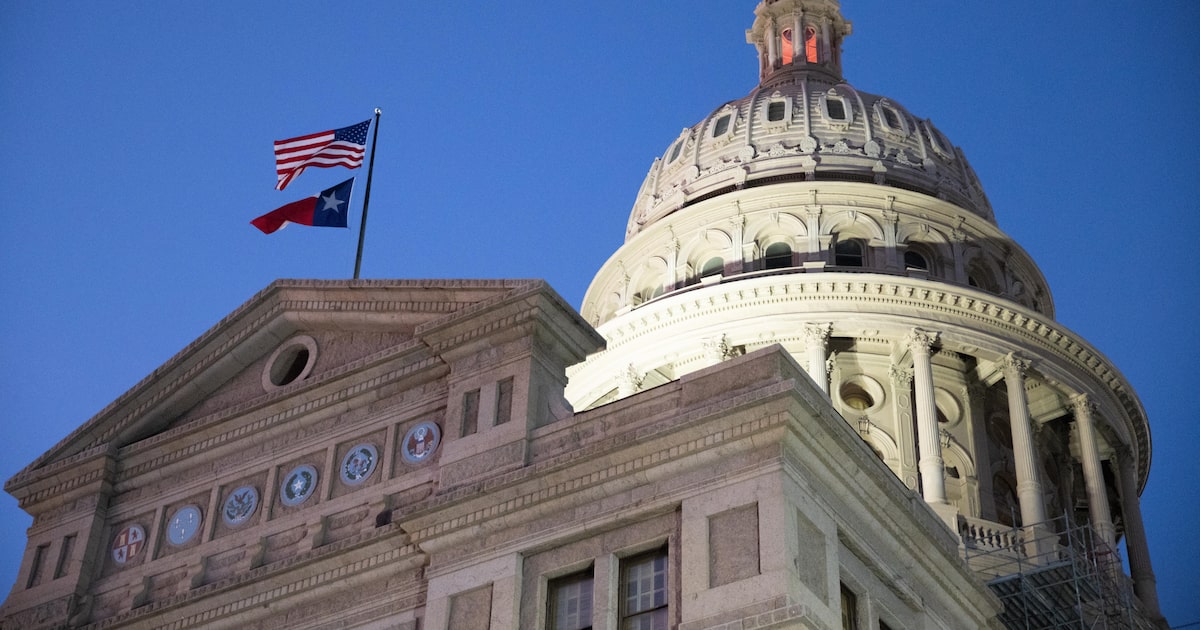
AUSTIN — A bipartisan group of lawmakers on Thursday held its first hearing to examine free speech on college campuses following the September assassination of conservative activist Charlie Kirk.
Lawmakers said civil discourse is important and it embodied the kind of work Kirk did.
“Charlie Kirk, as we honor him in a way of starting this conversation, famously debated opponents with open handshakes instead of closed fists,” said Sen. Lois Kolkhorst, R-Brenham. “We can only have civil discourse and freedom of speech when we welcome all sides of a debate.”
The Select Committees on Civil Discourse & Freedom of Speech in Higher Education held a joint five-hour hearing and lawmakers heard from invited speakers only.
Political Points
Kirk’s death escalated conversations around the price of free speech on university and college campuses — the consequences conservatives can face when expressing their beliefs or the retaliation students and teachers who criticized Kirk faced.
Related
Jim Davis, the president of UT Austin, told lawmakers the university tries to make sure students are able to have wide-ranging discussions in classrooms, including on controversial topics, so students can form their own conclusions.
“Here we expect that our professors build a culture of trust, so that all students feel free to voice their questions and their beliefs, especially when those perspectives might conflict with those of the professor or other students,” Davis said.
Lt. Gov. Dan Patrick and House Speaker Dustin Burrows, R-Lubbock, created the committees so they could examine “bias, discourse, and freedom of speech across Texas college campuses,” a news release said at the time.
Sen. Paul Bettencourt, R-Houston, who chairs the Senate committee, said Thursday the purpose of the committee was to make sure speech isn’t silenced in the future. He added that he believes that in 1968, “liberal speech” was being suppressed.
“What this committee is trying to do is get this right so that free speech and civil discourse are not suppressed in the future,” Bettencourt said. “That’s what we’re trying to accomplish.”
The only students to testify on Thursday were the student government presidents of Texas A&M and UT Austin. Carter Mallory, the A&M’s student body president, said one solution that has helped encourage civil discussions between students and professors is creating opportunities where a smaller group of students can have conversations with a professor.
“The significant number of students we have on our college campus, a 300-person classroom is not a proper or fitting space to have a very heart-to-heart debate and try and change the heart and mind of somebody else,” Mallory said.
Dylan Seiter, a student at Texas A&M who is a member of the university’s Turning Point USA chapter, mentioned that he feels there is an “undercurrent” of disagreement with expressing conservative points of view at the university.
“This unspoken pressure discourages genuine dialogue and can make open discussion feel unsafe, even when policies themselves are neutral,” Seiter said.
Related
Lawmakers also heard from Rickey Adam Jr., the Texas Regional Manager for Club America, the youth program for Turning Point USA. Club America has seen “significant growth” of high school students across the country.
However, Adam said, he has had trouble with some public school employees who, in his view, have “dragged their feet or have been outright denied for various reasons.” Adam believes doing so is overreaching. Before Kirk’s killing, around 100 high schools across the state had signed up for Club America. Since his death, more than 350 have signed up.
Another portion of the hearing focused on Pro-Palestine protests that took place on college campuses last year. On two separate days in April, students and members of the public gathered on campuses to protest the war and Israel’s military action in Gaza. Dozens of individuals were arrested, including some students and alumni.
Sen. Lois Kolkhorst, R-Brenham, asked Amanda Cochran-McCall, UT Austin’s general counsel, if any of the protesters were paid to show up to campus. Cochran-McCall said there wasn’t any evidence to point to that.
Staff writer Milla Surjadi contributed to this story.