
AUSTIN, Texas — Texas lawmakers have filed several bills relating to abortion and reproductive autonomy since filing opened on Monday, Oct. 9.
The filings come after Democrats swept all major offices in Texas in the midterms and saw substantial gains in several states nationwide.
MORE | Texas lawmakers to debate Hinojosa plan for $1,500 payments to households
If passed into law, the bills could significantly change abortion access and reproductive protections for Texans.
“I think that the midterms really have changed some of the thinking around what is possible for legal protection for reproductive rights in Texas,” said Rachel Rebouche, a professor of law at The University of Texas School of Law.
However, bills will require passage by both chambers of the state legislature, which is divided between Democratic control of the House and a Republican majority in the Senate.
House Bill 126 seeks to repeal state abortion bans
Austin-area Representative Donna Howard filed House Bill 126, which addresses several healthcare-related issues including abortion.
HB 126 seeks to repeal Texas’ three abortion bans, including the 2022 trigger ban, the 2021 SB 8 Texas Heartbeat Act, and a state abortion law from 1925.
It also aims to repeal forced pre-abortion sonogram requirements, as well as restrictions on abortion medications passed in 2021.
“Texas has one of the strictest abortion bans in the country,” said Rebouche. “It bans all abortion from conception with the exception of an abortion that saves the life of the mother, so there’s no exception for health; there’s no exception for labor, incest, or fatal fetal anomaly.”
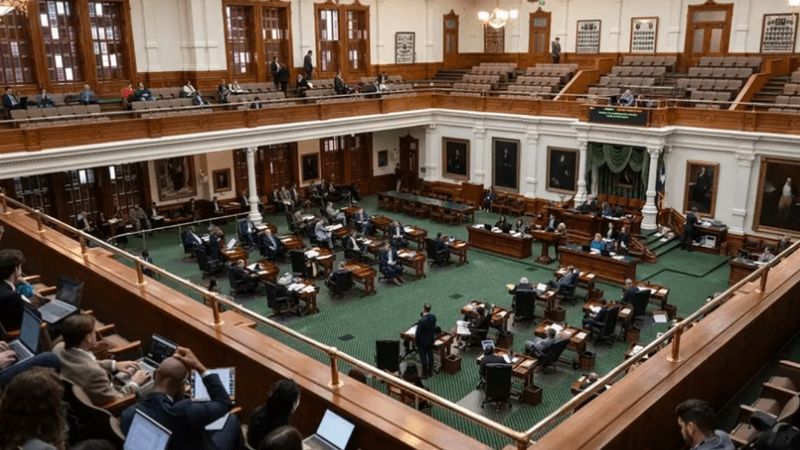
Texas Legislature (Photo: SBG Digital)
HB 126 includes provisions beyond abortion. As an omnibus healthcare bill, the legislation also seeks to remove state restrictions on gender-affirming care for minors.
“I think that this bill could pass the House, but will have difficulty passing the Senate,” said Rebouche. “And in many ways, it is an initiative to message what are the priorities of its drafters.”
Rebouche said even if bills like HB 126 do not pass, they send a message.
KEYE
“I think what that does is it puts on record the people who will vote against it… I also think it builds coalitions and momentum for a time when such a bill can pass,” she said.
To pass into law, the bill would need to be passed by both chambers before signature by the governor.
Constitutional amendments require a higher bar for approval
John Bucy, a lawmaker also representing the Austin area, has filed House Joint Resolution 24, which proposes amending the state constitution to include the right to “personal reproductive autonomy” for every Texan.
“This bill will attack three things: It’ll guarantee in vitro fertilization. It will guarantee the right and access to contraception. It will guarantee body autonomy, including abortion,” Bucy said.
When asked why he chose to file a constitutional amendment proposal over a standard bill, Bucy said he and his colleagues are pursuing legislation from several angles.
“Sometimes there’s more bipartisan support in constitutional amendments because then you allow the voters to decide,” said Bucy. “Sometimes the other approach works better. So we’re gonna be running both avenues.”
ALSO | Despite big wins for Texas Democrats, this legislative session will need to be bipartisan
Constitutional amendments require a two-thirds vote in both legislative chambers, as well as voter approval.
Rebouche said amendments can be more enduring than standard bills, or statutes.
“There’s much less durability for a statute as compared to a constitutional amendment, which is much harder to pass, has more staying power, cannot just be rewritten or repealed by a future legislature,” said Rebouche, “So it has a permanency, and it forces courts to think about future abortion restrictions as constitutional matters.”
Incoming representative Samantha Lopez-Resendez also filed a constitutional amendment proposal, HJR 68, which would prohibit the Texas Legislature from restricting an individual’s access to abortion and related healthcare.
Do these bills have enough bipartisan support?
With the Texas Legislature split between a Democratic House and Republican Senate, Rebouche said a total abortion repeal may or may not garner sufficient bipartisan support to pass into law.
However, there could be greater support for the addition of more narrow exceptions to Texas’ current abortion laws.
“There may or may not be support for a total repeal of the abortion ban, but there may be more support for adding exceptions to Texas abortion law,” she said. “Many other states have exceptions for rape and incest, sexual assault, and have exceptions for ending a pregnancy when there’s no chance of survival after birth…”
Rep. Bucy said he is ready to work across the aisle to pass HJR 24 and other bills.
“I’ve never passed a bill without Republican support in my eight years,” he said, “And that’s something that we’re going to need to continue to do with the House and Senate. And I feel poised to work with my good friends in the Senate and all of my Republican friends across the aisle.”
However, some groups do not support any attempt to loosen or reverse abortion restrictions in Texas.
Mary Elizabeth Castle, Director of Government Relations with Texas Values, wrote in a statement to CBS Austin,
Texas Values will continue to fight for the life of the unborn in the upcoming Session regardless of any attempts to reverse some of our state’s law to protect human life. Both the Texas Heartbeat Law and the Human Life Protection Act received bipartisan support in order to pass. It is important that our state continue in the direction of supporting women and children and promote a culture of life.
The 90th Texas Legislative Session begins in January 2027.