
While it can be hard to determine a cultural scene’s beginnings with indisputable accuracy, I shouldn’t be surprised anymore when I hear that the catalyst was an empty warehouse. And in the case of Fort Worth’s Near Southside neighborhood, that catalyst was spelled “Where House.” This past October, I was admiring the event space’s long-shuttered brick building—a facade that marries Old West jail and 1980s Chinese restaurant—with its former co-curator, painter Jay Wilkinson, who laid out what was once his version of house rules: “Make sure nobody burns. No one dies. And besides that, go nuts.”
Around the Where House’s inception, in 2010, Near Southside, just south of downtown, was becoming a paradise for young musicians and artists: a playground of abandoned warehouses and medical offices, with few neighbors to call in noise complaints. Wilkinson said he could ride his bike down the middle of the street in the late afternoon and see no one for blocks. His friend Casey Smith, a woodworker and builder who restores structures, rented an empty building for a workshop, fixed its precarious electrical wiring, and began throwing parties, inviting Wilkinson to collaborate on themes and installations. Somewhere along the way, the building acquired its name. “The Where House became a catchall for anybody to be like, ‘Hey, I have an idea,’ and I’m like, ‘Great, please come do it here.’” Soon they were hosting art shows together, one of which featured a twenty-foot-tall papier-mâché cyclops. They put on concerts by the Quaker City Night Hawks, White Denim, and Telegraph Canyon. They arranged an open mic night that drew a local dishwasher named Leon Bridges out onto the stage. Before long, adventurous types who weren’t already in the neighborhood found cool, affordable places to live, and naturally, other outfits bubbled up nearby: a cafe, a dive bar, more multiuse spaces.
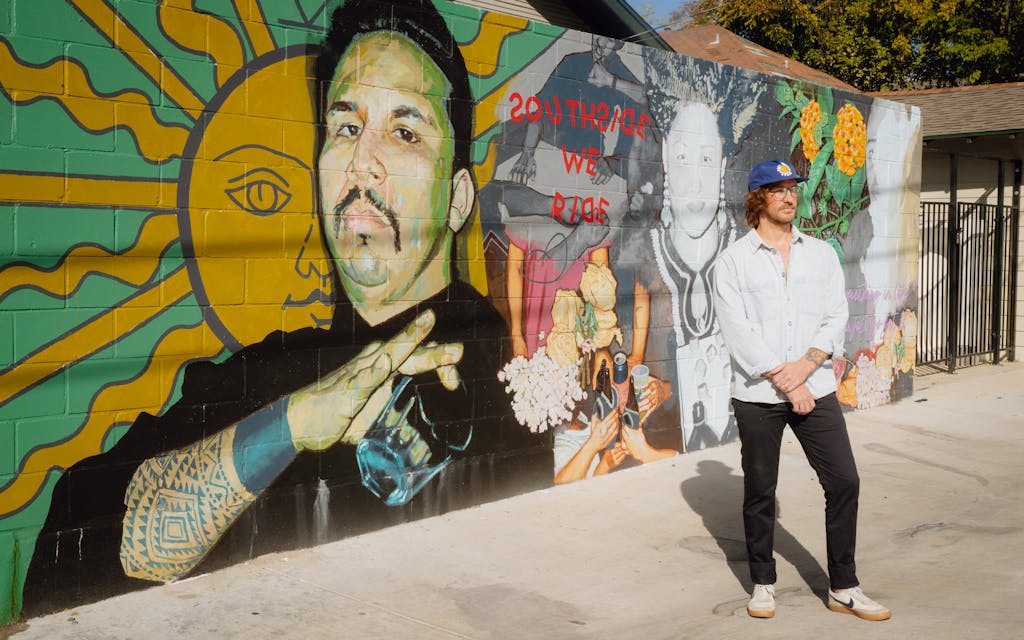 Jay Wilkinson in front of a mural he created.Photograph by Desiree Rios
Near Southside would become the yin to Sundance Square’s yang. Continuing a tradition of Fort Worth artists who have steered clear of on-the-nose Western imagery, the creators of Near Southside embraced an ethos that was less Cowtown and more Funky Town, a nickname dating back to 1986, when then R&B radio station KKDA 104.5 ordained the city Funky Town Fort Worth. No one was exactly hostile toward cowboy boots or horses, Wilkinson said, but as he put it, “Southside is the last bastion of really trying to develop itself and keep that out.”
Of course, the neighborhood evolved over the next fifteen years. Fort Worth’s population boomed; it’s now the fourth most populous city in Texas, just under Houston, Dallas, and San Antonio, and just above Austin. Near Southside’s first stretch of enticing businesses, along West Magnolia Avenue, garnered rising interest, which was followed by rising rent and a turnover in proprietors. In 2017 the owner of the building where the Where House had been hosting events wanted his space back, and that era came to an end.
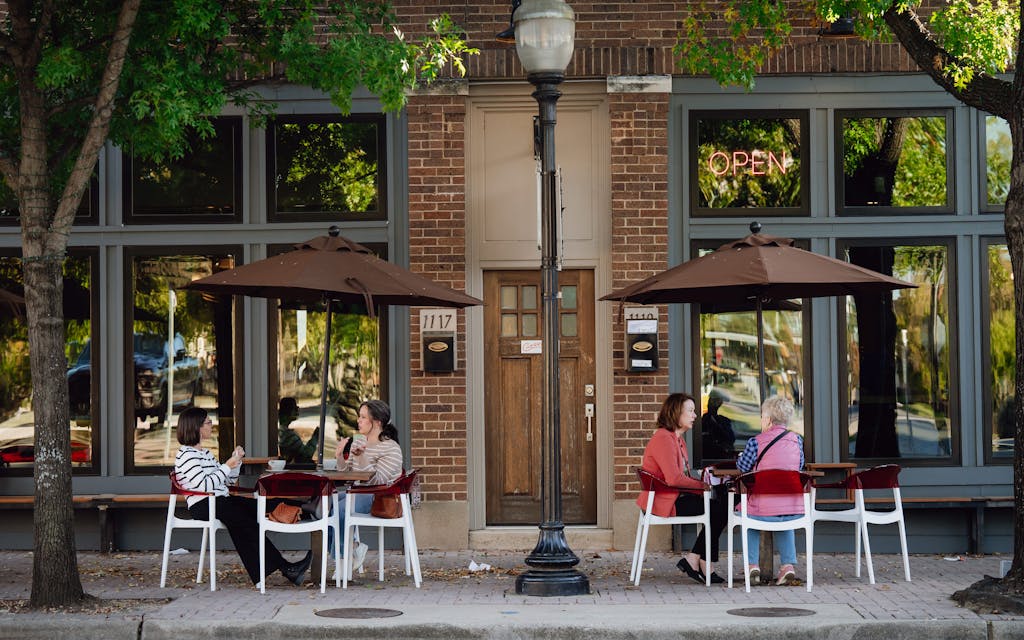
Patrons outside Cherry Coffee Shop, on West Magnolia Avenue.Photograph by Desiree Rios
That’s the bad news. (Oh come on, you knew that was coming.)
The good news is that the whole area around West Magnolia Avenue, called Magnolia Village, is now an established destination, and the spark generated by early pioneers like Wilkinson and Smith has spread to other parts of Near Southside. And newcomers are aware that they have a duty to uphold that trailblazing spirit. For Jonny Arguello, who owns Gustos Burger Bar + More, that means giving artists and musicians day jobs—and accepting the challenges that brings. “We had to weed out a few, but we need ’em!” he told me. He pointed toward his kitchen staff and said that one of his cooks was getting a record deal and another would be performing at the restaurant the following weekend. Standing nearby, Wilkinson looked as if he wanted to hand Arguello a medal.
Gustos anchors the west side of Magnolia Village, the older of Near Southside’s two hubs. Traveling east, you’ll see businesses like Panther City Vinyl, an old auto-shop-turned-cafe called Avoca Coffee, the ice cream shop Melt, an old grocery store-turned-cafe called Cherry Coffee Shop, and Heim Craft BBQ, along with dive bars like the Chat Room Pub and the Boiled Owl. (“It’s called the Chat Room because it was literally a chat room with computer access to the internet,” said Wilkinson.) On the easternmost end, the Southside Preservation Hall hosts monthly cult-classic movie nights called Weird Wednesday, and Paris Coffee Shop, which dates back to 1926, lists more than the obligatory two specialty pies on its menu. The day I visited, I counted seven.
Still taking shape is Near Southside’s other hub: South Main Village. To learn how it differed from Magnolia Village, I called Megan Henderson, the director of events and communications at the nonprofit Near Southside Inc. and the neighborhood’s go-to source for information. Magnolia has more of a family vibe these days, she said; South Main is more counterculture. “It’s all the old indie-rock kids who are now business owners in the neighborhood,” she said.
Starting on the north end of South Main Village, near T Bone Burnett Boulevard and Leon Bridges Way, I made a pilgrimage to Record Town, a business that has been a polestar in Fort Worth since 1957, when it opened at its original location, near Texas Christian University. It would be hard to convey the impact that co-owners Sumter Bruton II and Kathleen Bruton had on generations of music lovers and musicians. The Brutons’ son Stephen became a touring and recording artist, and when Sumter II died, in 1988, Stephen’s brother, Sumter III, helped manage the store, turning yet another generation on to local jazz legends like Ornette Coleman and King Curtis.
“Oh yeah, the customers are hardcore,” said Zack Quiroz, who was working the counter the day I stopped by. “Sometimes I feel like a drug dealer.” (In fact, it was two longtime shoppers who bought the business when the Bruton family decided to sell.) One wall of the shop is lined with framed posters, records, news articles, and photos of Fort Worth legends; others display eye-catching vintage album covers preserved in clear plastic sleeves, such as Ike & Tina Turner’s Kings of Rhythm Dance and Bo Diddley’s self-titled 1958 LP.
Quiroz was talking about the upcoming Fort Worth Songwriter Festival with Southside Preservation Hall director Matthew Williams and songwriter Keegan McInroe. “I think the old Record Town site is now a Jimmy John’s,” he said. (More precisely, the former address is now attached to Ampersand Coffee; the sub shop is next door.)
“The homogenization of America,” said McInroe, “It’s like, ‘Ooh, look! Another PetSmart!”
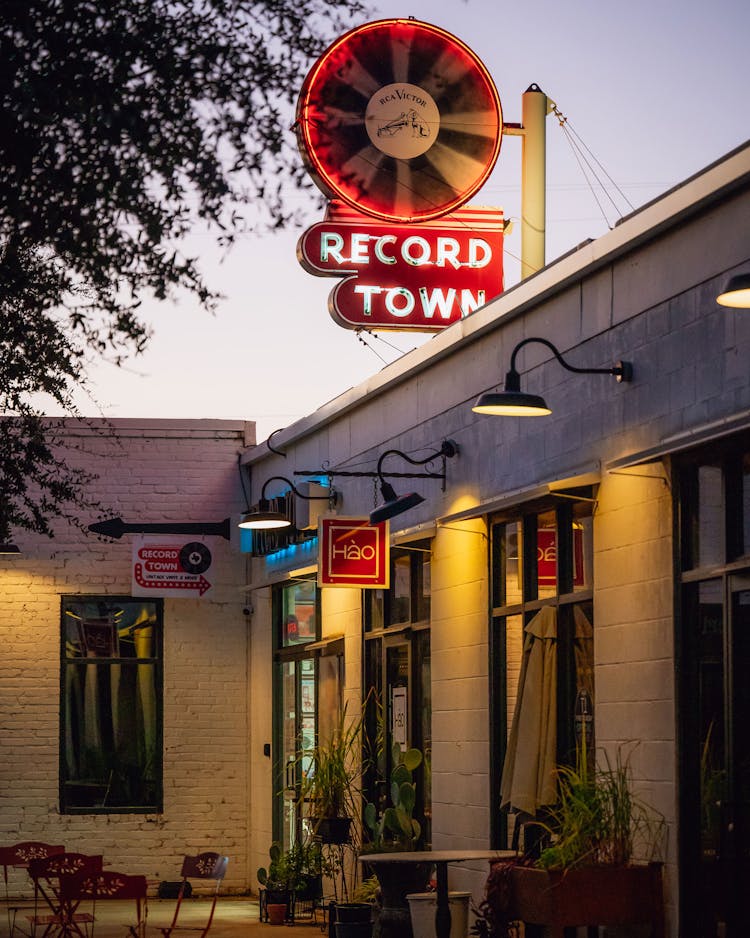 Outside Record Town. Photograph by Desiree Rios
 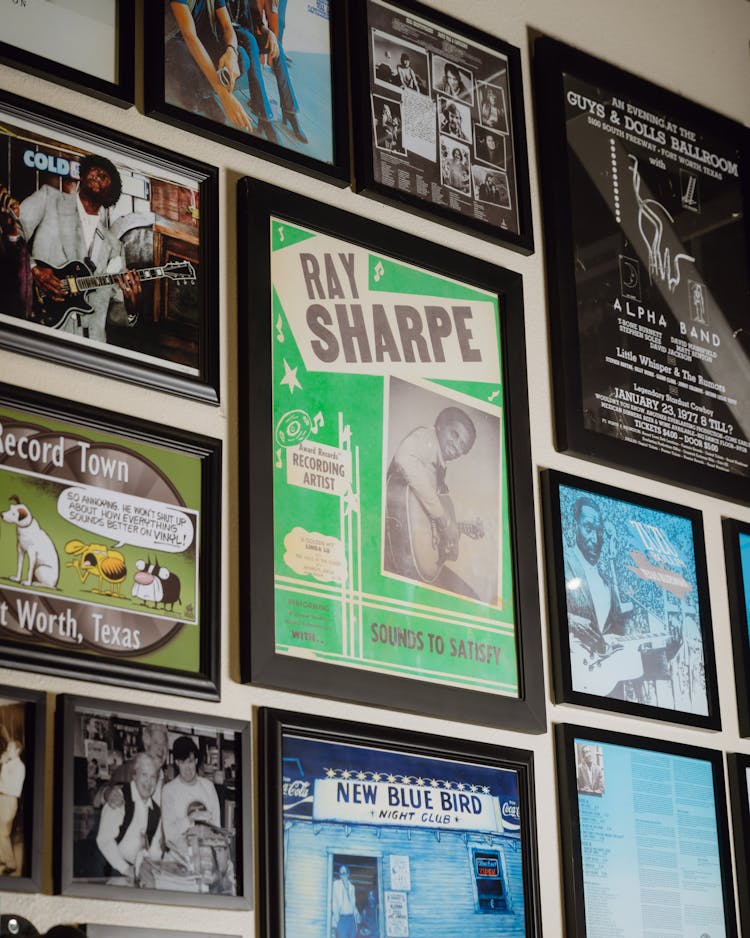 A wall inside Record Town. Photograph by Desiree Rios
“That’s one of the things I like about the Near Southside: It hasn’t been completely gentrified,” said Quiroz.
McInroe qualified this. “Well, gentrification, yes. Corporatization, not so much.”
Unlike the record stores, the neighborhood’s live-music venues have hit a slump. Tulips and the Cicada, both in South Main Village, are the only ones in the neighborhood. Younger audiences don’t buy booze in the same quantities as their soaked forebears, and reduced alcohol sales, which propped up clubs for years, have created a nationwide conundrum for a dwindling number of venue owners.
Looking for a way to further establish relationships between bands and local audiences, the neighborhood started Lost ’N Sound, with the next event taking place on November 15. Bands will set up all over the neighborhood—in the South Main Micro Park and in bars like HopFusion Ale Works, Nickel City, and the Bearded Lady—for a day of music.
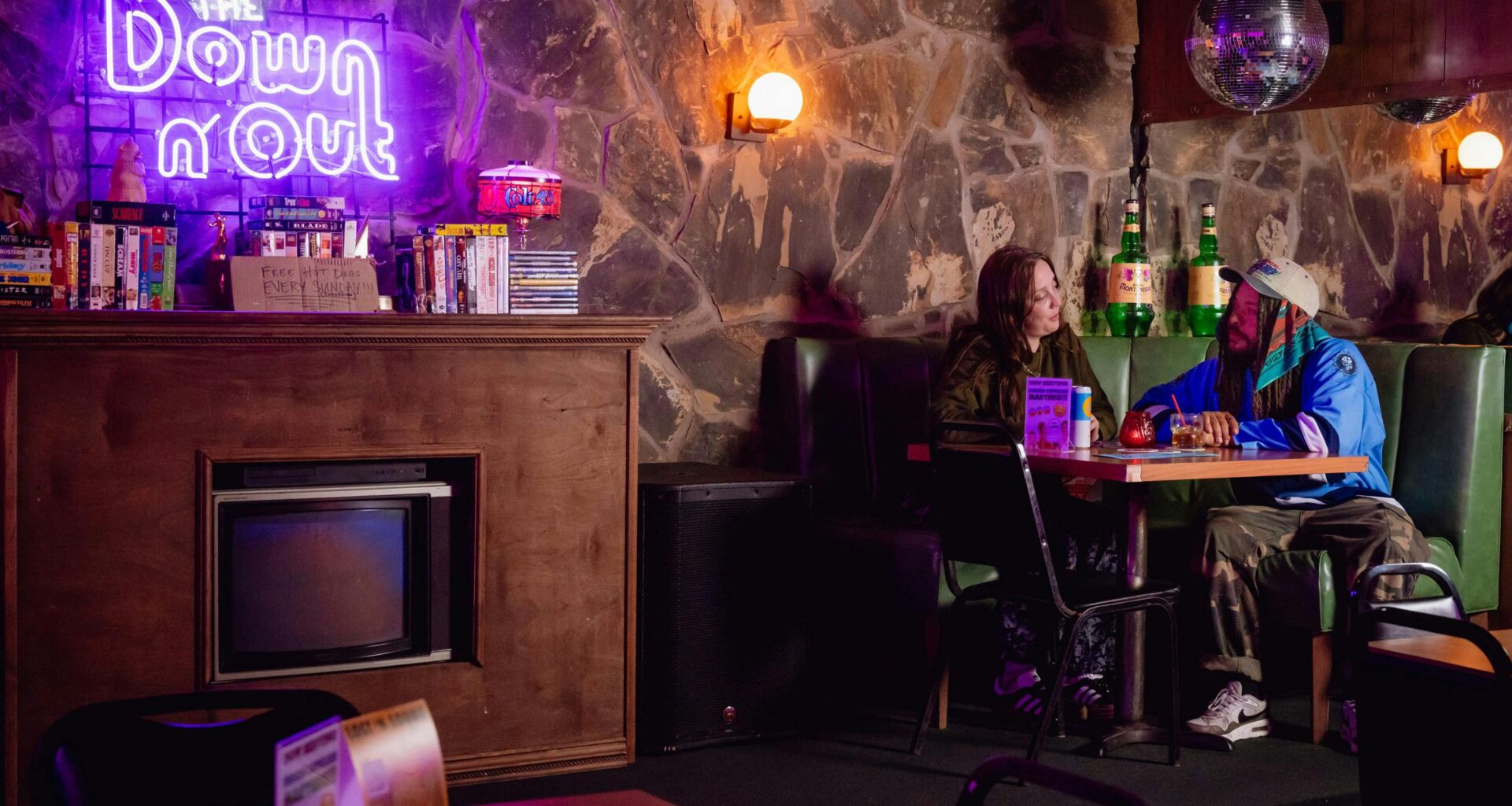
They’ll also find a makeshift stage in the Down n’ Out bar. When I popped my head in, owner Eric Vickers, wearing a T-shirt that read “Near Southside Is for Lovers,” said, “Somebody told me this was a millennial dive bar. I was like, ‘Wait, what are you accusing me of?’” Feigning outrage, he motioned toward the red-leather pub stools, votive candles, and the eighties television sets playing VHS movies.
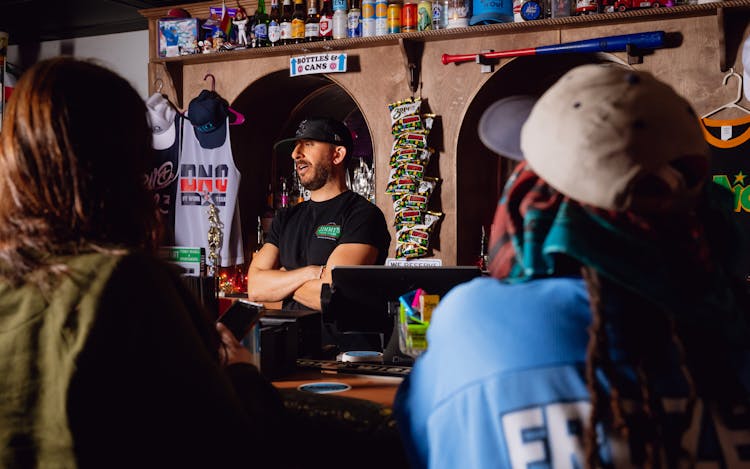 Eric Vickers, the owner of the Down n’ Out, behind the bar. Photograph by Desiree Rios
 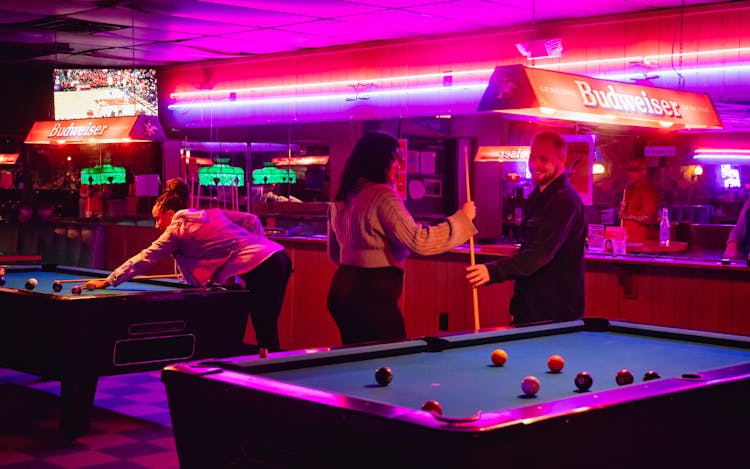 Patrons playing pool at the Down n’ Out. Photograph by Desiree Rios
Earlier in the day, when Wilkinson was showing me around, we came upon the Tarantula Tiki Lounge (too early for a drink), and I pressed my face to the front window to imagine a band set up in the Day-Glo interior. Wilkinson told me that he’d instructed his wife to look for him at the Tiki if he ever went missing. He explained that he’d find safety in this haunt, though after looking at the drink menu, I wondered if it’d be more likely that he’d pass out. Drinks include the Black Spider Grog (“Our signature swill. Three rums, grapefruit, blackberry, allspice”) along with “bowls” with names such as Mermaid Orgy (“A hypnotic aphrodisiac from deep within the South Seas. Rum, vodka, passion fruit, curacao, coconut water. Serves 3–4”).
Inside an old Supreme Golf warehouse that radiated the ambiance of a circus-painted bomb shelter, Wilkinson took me down a few hallways, passing doors to various businesses, and introduced me to the musician Robert Ellis, who shook my hand and quickly gave us a tour. Now co-owner to two well-established spaces inside the warehouse—both the music studio Niles City Sound and Distribution Bar—Ellis led us to the entrance to the bar, which is undergoing a remodel. “I don’t know how long that’ll take,” he told us as we peeked in at the round, dark-wood tables and giant glass chandelier. It’s a place where Ellis has spent plenty of time, seeing concerts and performing himself. When it went up for sale, he said, “I just got a wild hair and was like, ‘I’m going to buy this.’”
While construction wraps up at the bar, he spends time at Niles City Sound, named after the independent municipality Niles City, which was annexed by Fort Worth in 1923. Ellis recorded his 2019 release Texas Piano Man in this studio when it was under the original ownership, he said, but right after Covid, while living in Austin, he felt a gravitational pull to move north permanently, for the neighborhood vibe. He moved into a 1904 house in Near Southside and eventually took part ownership of the studio.
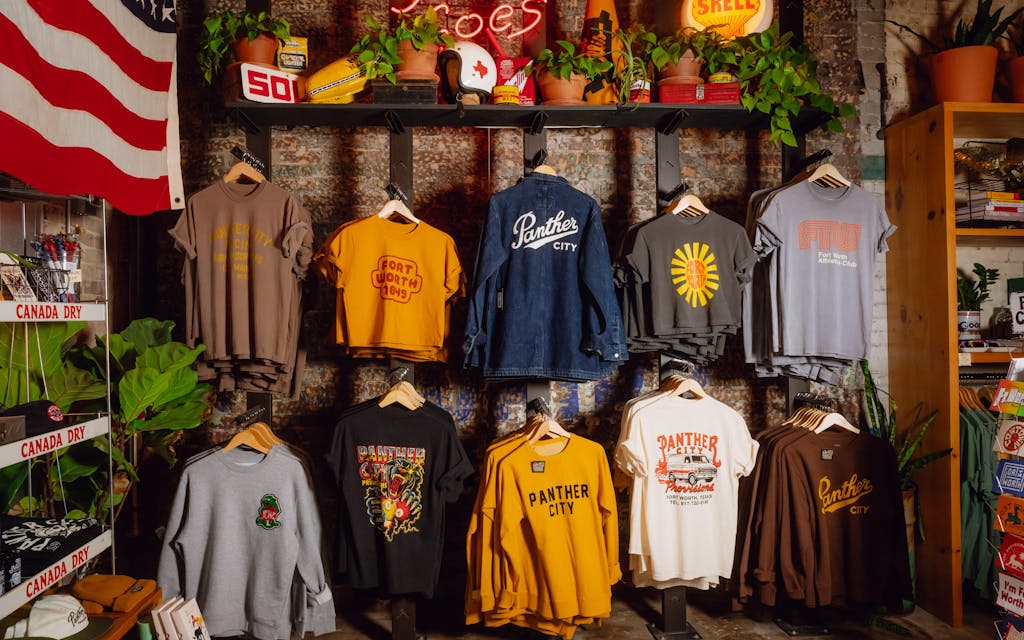 T-shirts, jackets, and other merchandise on display at Morgan Mercantile. Photograph by Desiree Rios
“You’ve seen this neighborhood change a lot?” I asked.
“There’s just a lot more happening,” he said. “The vibe of the neighborhood itself was really cool, but now there’s actually stuff to do. When we used to work in here, there would be nowhere to get food. Now there are five options within a block.”
He took us inside the studio, where we could see the Abbey Road–style layout, with a control room overlooking an open performance space. Often pointed to by locals as the place where Leon Bridges recorded Coming Home in 2014, it has since become a godsend to musicians like Ellis trying to balance a touring life with a family life. “I just got back from a little tour late last night, took my kids to school this morning, and then came here to work,” he said.
Farther south, at the Holly, a natural wine bar and shop (past Morgan Mercantile, T-shirt maker for all things Fort Worth), co-owner Liz Mears was equally bullish on South Main Village’s future. “You’re seeing it in its infancy, right?” she said. “South Main trees and lampposts were put in, what, six years ago now? And Magnolia was just ten years ago.” A new bookstore, Recluse Books, just opened in April. On the horizon are ten independent restaurants, six on South Main. Two coffeehouses are coming in. A whiskey distillery. A speakeasy-style nonalcoholic club.
As I was driving Wilkinson back to his car, he pointed out all the places where he’d painted murals or owned a gallery or worked a temporary job. “It’s really fascinating to have gotten to be part of all this,” he said. “I really do think that you get one of these areas by just following what’s happening.”
Check it out now before the next iteration.
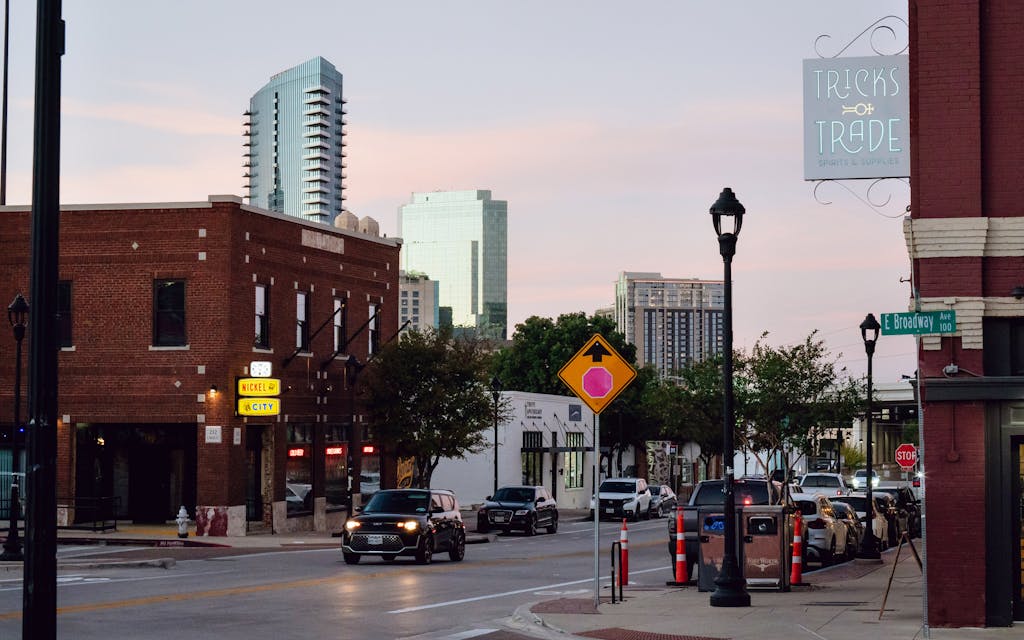 South Main Street.Photograph by Desiree RiosRestaurants
Sabar BBQ: Pitmaster Zain Shafi, an alumnus of the much-lauded Goldee’s Bar-B Q, opened this food truck last fall, marrying Texas smoked meats and Pakistani flavors. Sample the brisket–but also the seekh kebab sausage.
Bocca Osteria Romana: Accessible from an alley, this restaurant opens up into a little oasis for top-notch Italian dishes like butter-and-sage ravioli.
Ichirō Izakaya: Expect charcoal-grilled yakitori but also grilled eel over sushi rice.
Walloon’s Restaurant: If you’re craving cold-water oysters and a martini, this American bistro is perfect.
Beren Mediterranean: Most of the Turkish dishes here are house-made, from tender kebabs to beautifully pan-seared salmon. Don’t miss the Pink Sultan appetizer: a dip of pureed red beets with garlicky yogurt and virgin olive oil.
Bars
The Down n’ Out: This millennial dive bar is a hit with the locals, who occasionally meet to swap VHS tapes.
The Boiled Owl: Craft beers and comfort food are on offer at this sleepy bar frequented by regulars.
Nickel City: It has a million drink choices, but we refer you to the Recession Special: a Miller High Life, a shot of Benchmark Bourbon, and a fried mortadella sandwich.
Read Next