
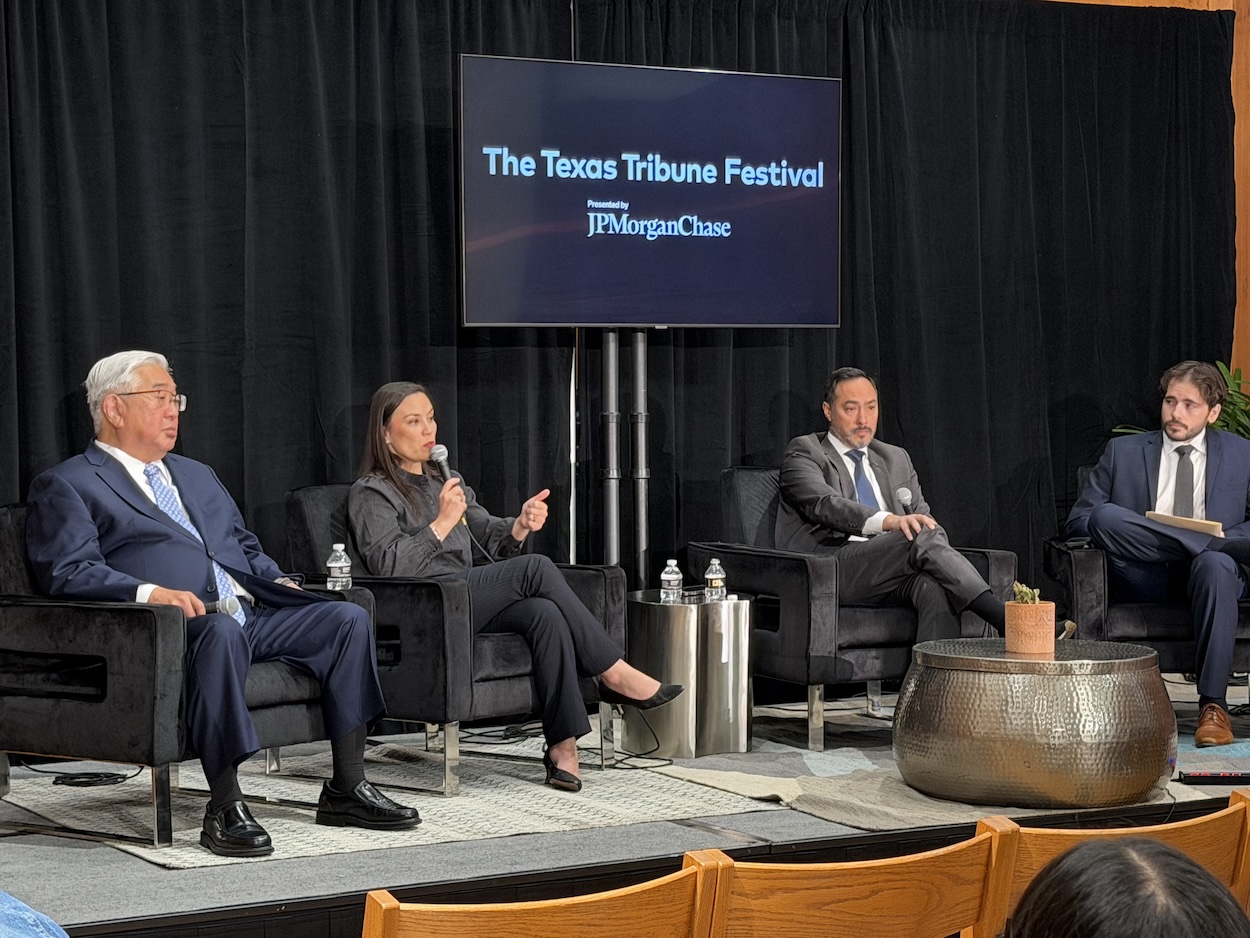
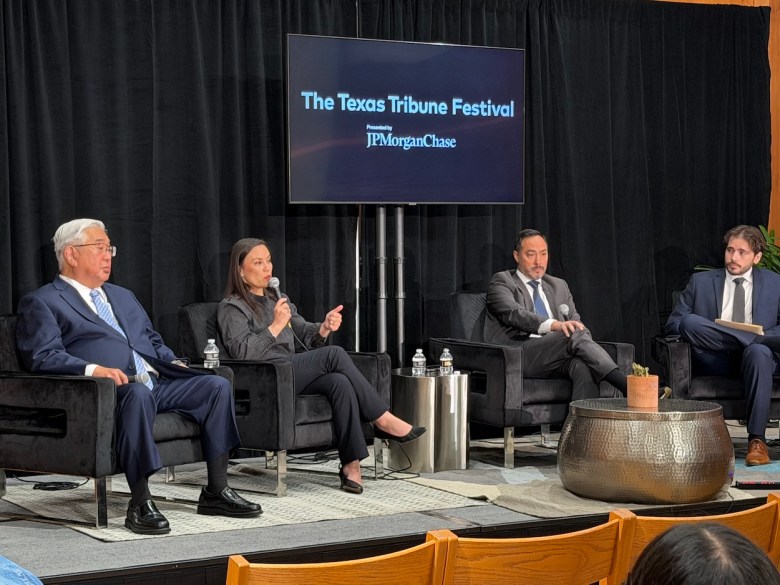
 Left to right: Bexar County Judge Peter Sakai, San Antonio Mayor Gina Ortiz Jones and U.S. Rep. Joaquin Castro participate in a panel at the 2025 Texas Tribune Festival in Austin. Credit: Michael Karlis
AUSTIN — San Antonio Mayor Gina Ortiz Jones during a Friday appearance said she will continue asking tough questions about the new Spurs arena project and isn’t done fighting for a revenue-sharing agreement between the city and the team.
“That revenue sharing that I’m asking for with the arena, that’s not going in my 401(k),” Jones said during a panel discussion at this year’s Texas Tribune Festival. “That’s going to the general fund, that’s going to things that we need to invest in, because we’re seeing it cut at the federal level. We need to ask for what we deserve.”
Jones said a revenue-sharing agreement with the Spurs is more critical now than ever to help fund city initiatives, including affordable childcare access, incentives for affordable housing downtown and job training programs, including Ready for Work. The city is struggling to cover those resources amid federal budget cuts by the Trump administration, she added.
“When we think about a revitalized downtown, we’ve got to prioritize infrastructure like childcare that will allow that type of downtown to be realized and make sure we are supporting our working families in many ways,” Jones said.
U.S. Rep. Joaquin Castro, D-San Antonio, also expressed skepticism about the new Spurs arena plan and the minor league baseball stadium project approved last year. Castro, who was on the same panel with Jones and Bexar County Judge Peter Sakai, said that if San Antonio is to become a modern metropolis, it must invest in its people.
“[When I say] I’m from San Antonio, they say ‘Oh, I really want to visit Austin,’” Castro said. “They remember [Austin] because it was driven by an intense focus on education and research and became an economic powerhouse and helped lift its people up. I think San Antonio has the ability to do the same thing, but we have to invest in people.”
Castro also noted that Austin achieved economic prosperity and global recognition despite its lack of professional sports teams.
Although Bexar County voters narrowly approved more than $800 million in public financing for the Spurs’ new $1.3 billion arena, it’s not yet a done deal.
The city is still expected to ask voters to approve an infrastructure bond for improvements at Hemisfair along with the possible expansion or relocation of a SAWS chiller plant as part of the broader vision for the Project Marvel sports-and-entertainment district.
What’s more, City Council is in the early phase of figuring out how to divvy up $75 million in community benefits from the Spurs as part of the recently approved public-financing deal.
Meanwhile, Jones said she will continue to seek an independent economic study and due diligence on the project to ensure San Antonio’s working class, which mostly voted against the new arena, doesn’t get left behind.
“I think there is an underappreciation for these questions, because, frankly, they haven’t been asked,” Jones said. “They should have been asked a while ago. I’m proud to ask them and will continue to do so.”
Subscribe to SA Current newsletters.
Follow us: Apple News | Google News | NewsBreak | Reddit | Instagram | Facebook | Twitter | Or sign up for our RSS Feed
Related Stories

Although voters narrowly approved a new Spurs arena, many were unaware they also could be asked to cough up another $500 million for the development.
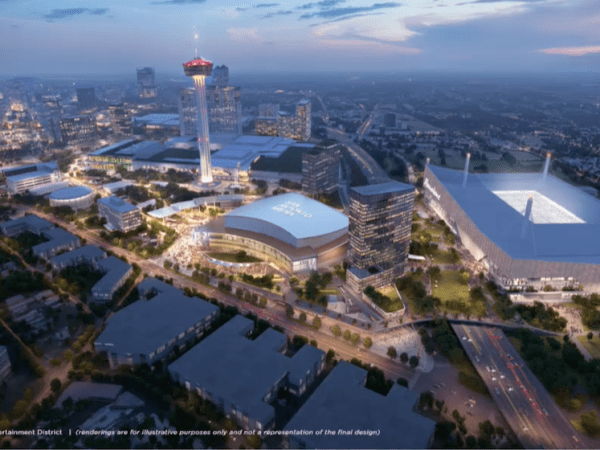
The news comes as Bexar County residents head to the polls to decide whether to approve a new Spurs arena.
Economist J.C. Bradbury warns that taxpayers will likely be on the hook for the pricy facility. It’s already happened in similar deals across the nation, he said.