
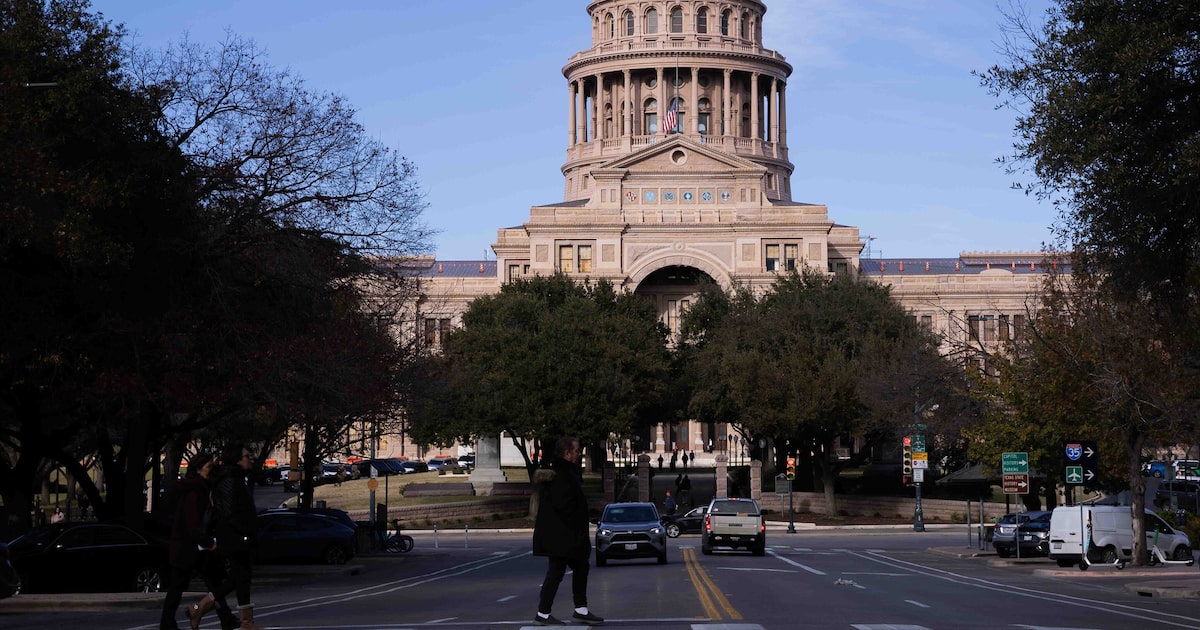
Governor-appointed regents now have unprecedented oversight of Texas’ public universities under a new law that is transforming the face of higher education in Texas.
A cornerstone of Texas Gov. Greg Abbott’s promise to lead the nation in eradicating liberal ideology from campuses, the law strips professors of the influence they traditionally held to shape university life and advance teaching. University system regents, who are appointed by Abbott and typically oversee high-level operations, now have final say over day-to-day decisions on what is taught and who is hired.
The law has spurred a debate over the mission of public universities — and whether lawmakers or academics should steer it.
College professors say the law is an attack on academic freedom. Republican lawmakers say it’s needed to address ideological biases on campuses and will grant students “degrees of value” faster and at a lower cost.
The Education Lab
Related

Since the bill’s signing earlier this year, Republican state leaders have further scrutinized higher education institutions, raising concerns about civil discourse on campuses and ideological content in classrooms. The pressure has led regents and university leaders, including those at the Texas A&M, University of Texas and Texas Tech systems, to institute policies and reviews on how topics like gender and race are taught in classrooms.
Related

Colleges across the state are poised to see more transformation when most of the law takes effect in the next year.
Here’s what to know about how the law impacts Texas’ public universities.
Reviewing core courses
Each public university system’s board of regents will have final say over what courses students have to take to graduate. Students are typically required to take over a dozen classes — which they can select from a larger list — in certain subject areas to fulfill the core curriculum requirement.
The courses, which will be reviewed by the governing boards every five years, must be “foundational and fundamental,” and “prepare students for civic and professional life” and “participation in the workforce.”
Regents may also consider the cost of an undergraduate degree at the university and how long it takes students to graduate.
Related

A similar review will happen on the state level.
Over the next year, a state committee will recommend which courses students across the state are required to take. The committee is also charged with reducing the number of required classes.
The group will issue recommendations by November 2026 to the Texas Higher Education Coordinating Board, which will put forward state law proposals to the Legislature by the end of the year.
Minor degree review
Campus presidents will identify which minor degree and certificate programs have low enrollment and could be consolidated or eliminated. Presidents will review programs every five years.
If the program has few students, but has “specific industry data to substantiate workforce demand,” it can avoid elimination. What constitutes “low enrollment” is not detailed in the legislation.
Related

Regents have final say over a president’s decision to cut a program.
The University of North Texas is already assessing its degree programs, in part to ensure compliance with state law.
President Harrison Keller said some programs have raised “red flags,” such as a slow return on investment, high cost for the institution or low enrollment, though he declined to be specific.
Related
 Expanded power for boards of regents
In addition to new authority over course and program decisions, regents will have final say on the hiring of administrators at individual campuses, including provosts, vice presidents and deans.
Regents typically only participate in hiring processes for campus presidents or system chancellors. This law expands their influence over a handful of positions to dozens within a single university.
Faculty senates overhaul
Faculty members’ influence at multiple systems has significantly shrunk under the legislation. The law directed regents to decide whether to keep faculty senates at their campuses by September.
Related

The faculty bodies, which develop academic policy, have long been considered a cornerstone of the authority professors have at universities. For decades, the senates have helped advance teaching and research at Texas’ schools. In recent years, they’ve also emerged as targets for state leaders who see campuses as overtaken by liberal bias.
Related
Under the law, if a school preserves its senate, membership is capped at 60 and presidents must assign half of the spots, among other restrictions. The law reinforces that senates play only an advisory role.
The University of North Texas, Texas A&M and Texas Tech systems preserved their existing senates by restructuring them to comply with the law.
The Texas State System temporarily dissolved its senates and the UT System abolished them.
Office regulating state law compliance
A new governor-appointed ombudsman will lead an office that ensures schools are complying with state law.
The office will investigate matters such as whether a school is getting around the state ban on diversity, equity and inclusion initiatives. Students and faculty can submit reports to the office if they believe a school is violating a law.
The office can recommend lawmakers bar a school from spending state funding while it is under investigation.
State support is one of the main funding sources for public universities, though tuition and fees typically provide the largest revenue chunk. At the University of North Texas, for example, state appropriations provide 16% of this fiscal year’s revenue. The University of Texas at Austin sees 22% of its budget come from the state endowment and appropriations.
The DMN Education Lab deepens the coverage and conversation about urgent education issues critical to the future of North Texas.
The DMN Education Lab is a community-funded journalism initiative, with support from Bobby and Lottye Lyle, Communities Foundation of Texas, The Dallas Foundation, Dallas Regional Chamber, Deedie Rose, Garrett and Cecilia Boone, Judy and Jim Gibbs, The Meadows Foundation, The Murrell Foundation, Ron and Phyllis Steinhart, Solutions Journalism Network, Southern Methodist University, Sydney Smith Hicks, and the University of Texas at Dallas. The Dallas Morning News retains full editorial control of the Education Lab’s journalism.