

Published
17/11/2025 às 12:52
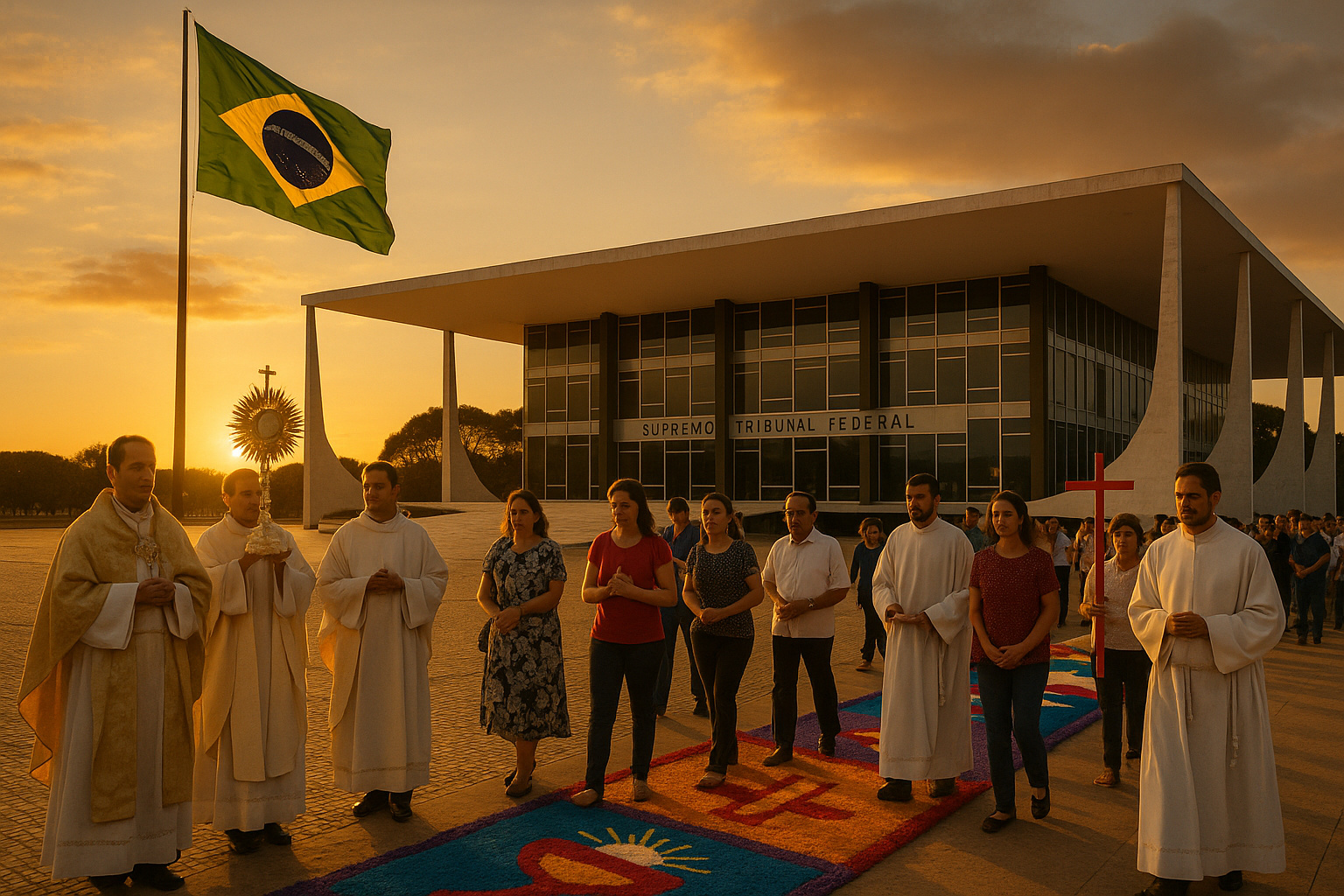
The National Confederation of Commerce is asking the Supreme Federal Court to suspend the law that made Corpus Christi a state holiday in Rio de Janeiro, arguing that the measure violates the Constitution and threatens the economic stability of thousands of businesses.
the holiday of Corpus Christi in the state of Rio de Janeiro It has taken on controversial dimensions since the entry into force of Law 11.002 / 2025, approved by the governor Claudio CastroThe standard transformed into state holiday a date that was previously just Facultative pointopening the door to a legal and economic battle of enormous proportions.
A National Confederation of Trade in Goods, Services and Tourism (CNC)Concerned about the financial impacts of the measure, she decided to take the matter to the Supreme Federal Court (STF) to question your constitutionalityAccording to the organization, businesses in Rio de Janeiro are being directly harmed, since the change forces entrepreneurs to… pay double to employees who work during the holiday, as determined by Consolidation of Labor Laws (CLT).
The discussion intensified among representatives of the productive sector, legal experts, and state authorities, reigniting the debate about the limits between… religious freedom and secularism of the Brazilian State.
— ARTICLE CONTINUES BELOW —
CNC files direct action in the Supreme Court and points to unconstitutionality.
A CNC filed Direct Action of Unconstitutionality (ADI) 7898 No. STF, under the reporting of Minister Carmen LuciaIn the lawsuit, the confederation argues that the state law exceeds constitutional limits by establishing a religious holiday, which, according to the text of federal ConstitutionIt is the exclusive responsibility of the Union.
In addition to the legal aspect, the entity emphasizes the negative economic effects Regarding the measure, business owners claim that the mandatory shutdown on the holiday directly impacts productivity and revenue, especially in sectors that depend on a continuous flow of sales, such as street commerce, bars, restaurants, and shopping malls.
According to the CNC, the mandatory double payment — combined with the operating restrictions imposed by law — creates a additional financial burdenwhich could jeopardize the economic stability of small and medium-sized businesses in the state.
The information was released by the company itself. National Trade Confederationwhich reinforces that the measure, in addition to unfair and unconstitutionalThis creates inequality between the federative units, since only Rio de Janeiro adopt Corpus Christi as a state holiday.
Debate on secularism and religious tradition
Before approval of Law 11.002 / 2025, Corpus Christi was treated as Facultative point throughout the state of Rio de Janeiro. Thus, the operation of trade it was the responsibility of collective agreements for each category. Workers who chose to work on the day received only the standard pay, except in special cases stipulated in labor agreements.
With the new law, this flexibility ceased to exist, and the holiday became fixed. mandatory, forcing establishments to close their doors or face the consequences doubled labor costs.
For legal experts, the issue goes beyond the economic aspect. secularism of the Brazilian StateThe constitutional principle that guarantees the separation of church and state is at the heart of the discussion. Critics argue that establishing a state religious holiday violates this premise, while proponents of the law argue that… Corpus Christi It’s already part of Brazilian cultural tradition and therefore it should be officially recognized.
Supreme Court will decide the future of the state holiday.
The decision of the Supreme Court Regarding the case, the outcome will be crucial in determining the course of this controversy. If the STF deem the CNC’s action admissible, Law 11.002 / 2025 it may be suspended, returning the Corpus Christi the status of Facultative point No. Rio de Janeiro.
On the other hand, if the Court upholds the validity of the rule, the state of Rio de Janeiro will continue to be the only one in the country to have a day of… Corpus Christi as an official holiday. This decision, therefore, will not only directly affect the local calendar and economy, but could also set a precedent for other states to adopt similar measures.
Regardless of the outcome, the case raises a reflection on the balance between religious tradition, freedom of belief, economic interest e state neutralityThese are themes that continue to shape the complex relationship between faith and politics in contemporary Brazil.