

A federal panel on Tuesday issued a preliminary injunction against Texas’ revised congressional map.
If the order stands, candidates would run for Congress under the previous boundaries.
“The Court ORDERS that the 2026 congressional election in Texas shall proceed under the map that the Texas Legislature enacted in 2021,” the order states.
The ruling will be appealed directly to the U.S. Supreme Court.
A group of plaintiffs brought the lawsuit after Texas in September approved new congressional boundaries through a rare mid-decade redistricting process that could determine the balance of power in Congress.
Political Points
For Republicans Texas was the first in a series of redistricting plans across the country requested by President Donald Trump, who wants Republicans to keep control of the U.S. House after the 2026 elections.
The new map, approved by the Texas Legislature in August and signed by Gov. Greg Abbott, was designed for Republicans to flip five seats currently held by Democrats — one each in Dallas-Fort Worth, the Houston area, Central Texas, South Texas and the Rio Grande Valley.
Democrats were unable to block the proposal, despite a two-week quorum break in August that featured dozens of House Democrats leaving the state for Illinois.
The lawsuit seeking a restraining order marked the beginning of a legal fight that could stretch over years. A fight over a redistricting conducted in 2021 after the decennial U.S. Census still has not been resolved.
During the nine-day hearing in El Paso on the latest redistricting plan, plaintiffs argued that Texas lawmakers intentionally targeted minority residents when drawing the maps.
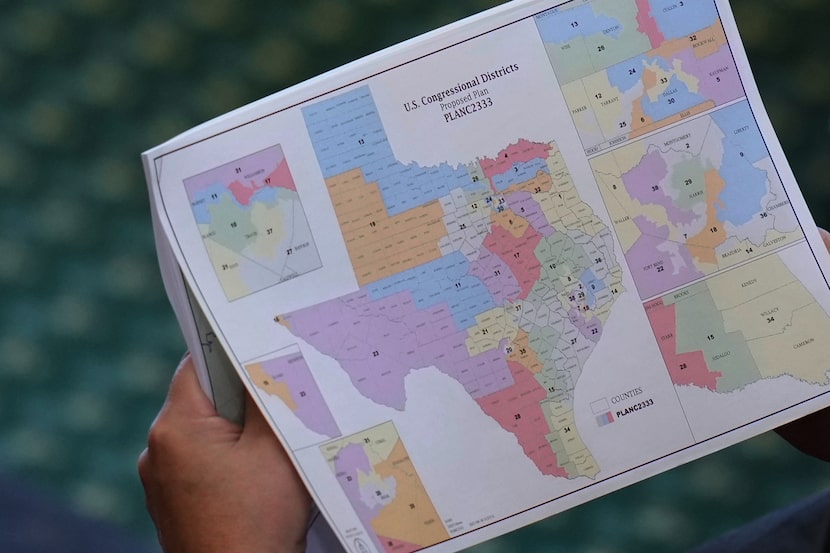
FILE – Texas state Sen. Pete Flores, R-Pleasanton, looks over a redrawn U.S. congressional map during debate over a bill in the Senate Chamber at the Texas Capitol in Austin, Texas, Aug. 22, 2025. (AP Photo/Eric Gay, File)
Eric Gay / AP
Though Trump’s involvement suggests hardball politics, the rare mid-decade redistricting, lawyers argue, was prompted by U.S. Assistant Attorney General Harmeet Dhillon’s July 7 letter to Abbott and Attorney General Ken Paxton. The letter stated that four congressional districts — three in the Houston area and one in Dallas-Fort Worth — violated the Voting Rights Act and the Constitution because they were drawn as “coalition districts” composed of a majority of non-white residents. Three of those districts have long been held by Black representatives and one by a Latino member.
Abbott used the Justice Department’s warning as a reason to add redistricting to a special legislative session. In his proclamation for the first special session, the governor said he was reacting “in light of constitutional concerns raised by the U.S. Department of Justice.” Abbott didn’t add the constitutional concerns reference when he added redistricting to a second special session.
The governor also gave several media interviews, saying the Department of Justice letter prompted him to call the special session. During the hearing, plaintiffs’ lawyers replayed Abbott’s and Dhillon’s interviews discussing the need to end coalition districts.
Witnesses for the plaintiffs testified that Abbott and the Justice Department used race as a catalyst for developing the new map.
During the trial, it was revealed that the political operative who drew the map, Adam Kincaid of Virginia, saw a draft of the Justice Department letter before it was sent to Abbott and Paxton.
Kincaid, the executive director of the National Republican Redistricting Trust and creator of the 2021 Texas congressional and legislative maps, said under cross-examination that White House Chief of Staff James Blair showed him the letter during a West Wing meeting. Kincaid said he was on the phone with Abbott as he skimmed the letter.
A lawyer for Abbott convinced the three-judge panel that the governor’s conversations with Kincaid were privileged and could not be presented in court, so what he said to Abbott was not revealed.
Kincaid testified he told Justice Department officials the letter was “dumb” and “unnecessary.”
The panel’s ruling seemed to hinge on Kincaid’s testimony.
Though plaintiff lawyers were able to get him to concede that he knew about the racial makeup of Texas’ congressional districts when drawing the map, he insisted he didn’t think about race during the process.
Kincaid and other witnesses testified that they were driven by a partisan agenda, which made the map, even though it involved the upheaval in districts with a strong minority voting presence, legal.
[]
The Dallas-Fort Worth area loomed large in determining whether to issue the injunction against the new congressional map.
Kincaid said part of his map strategy was overhauling North Texas in order to net Republicans one seat in Congress while fortifying other GOP districts.
Much of the overhaul occurred in Democratic strongholds.
“I completely transformed Texas 32,” Kincaid testified. “I knew there was a Republican district in north Dallas County that we could have drawn [in 2021] that we didn’t draw.”
Kincaid took District 32, represented by U.S. Rep. Julie Johnson, D-Farmers Branch, and stretched it into the rural, Republican areas of East Texas. The map keeps Republican-leaning parts of northern Dallas County in the district and places Johnson’s home in nearby District 24, represented by Irving Republican Beth Van Duyne.
“I took what became 30 and 33 and drew one mega-district,” he said. “I put all the Democrats in 30 and 33.”
District 33 was one of the districts mentioned in the Justice Department letter targeting coalition districts. It was drawn by the courts after the 2011 redistricting process. Fort Worth Democrat Marc Veasey, who is Black, has held the seat since 2013.
Kincaid sliced Tarrant County from the district, which is now anchored in Dallas County, with white Democrats being the dominant demographic group. Veasey’s home was placed in District 25, which jets out to West Texas. And about 250,000 Tarrant County residents were packed into District 30, represented by Crockett, who is now in District 33.
Crockett, Johnson and Veasey were all awaiting the El Paso panel’s ruling before deciding their next moves.
Johnson has said that if the map is upheld, she’ll run in District 33, which is now represented by Veasey.
Crockett is exploring several options, including reelection to District 30, running in District 33–where she now lives–and mounting a 2026 campaign for U.S. Senate.
Veasey says he’s considering running for reelection in District 33, though he now lives in Republican-controlled District 25. He also has the option of running in District 30. Some Democrats want him to challenge Republican incumbent Tim O’Hare for Tarrant County Judge in 2026.
This is a developing story and will be updated.