

Five weeks into the school year, on a Monday morning at Lively Middle School, English teachers were called in for an unexpected training session with Austin ISD officials. They were soon informed that, starting that Wednesday, they had to trash the syllabi they were already teaching – Texas Essential Knowledge and Skills-compliant lesson plans that many of the teachers had crafted and used over several years – and begin to teach directly out of a textbook called SAVVAS myPerspectives, to which they previously had access but were not strictly limited.
“One of the best parts of my job is the freedom to develop curriculum using texts that are personally meaningful and use them to design high-quality instruction for my students,” Elijah Benson, one of those teachers, wrote to the Chronicle a week later. “For all intents and purposes, I have to learn how to do my job anew. I’ve never taught from a textbook before.”
The same thing happened around that time at eight other middle schools in AISD, including two that are now slated to be closed next year, Martin and Bedichek. The nine schools had been selected to “pilot” this change to using a uniform instructional material in every classroom, one designed for test prep – a move recommended by a third-party education consulting nonprofit partnered with AISD called TNTP (formerly known as The New Teacher Project) – in an effort to raise students’ scores on the State of Texas Assessments of Academic Readiness exam.
“It’s not a secret that we have middle schools where we want to see students’ performance increasing,” Jessica Jolliffe, AISD’s secondary director of humanities who led the training, told the Chronicle. “We want to help support teachers in that work. And this work required a shift when we received our accountability rating [on Aug. 13]. It became really clear that we really needed to make some quick and fast adjustments to our curriculum.”
Thus, the impromptu training for teachers five weeks later on Sept. 22 and 23. “And everyone knows this is an abrupt change,” Jolliffe acknowledged, later adding, “We can’t control when we get our accountability scores.” Jolliffe also said that her department, at the district level, had already developed curriculum for the entire year that they also needed to revise.
Low scores on the STAAR exam since the COVID-19 pandemic in AISD (and across the entire state) have triggered an escalating cascade of “accountability” intervention from the Texas Education Agency, the state agency charged to hold public school districts accountable for educating students effectively. The TEA measures how effectively students are learning largely by one metric: standardized testing.
The TEA uses that metric when the STAAR testing system disadvantages middle and high school students who are learning English (the TEA only offers the test in English after fifth grade – children across the state sit to answer questions they can’t read) and low-income students, who consistently score lower than their English-speaking and more affluent peers. “Such a claim regarding STAAR does not reflect reality,” the TEA wrote to the Chronicle. “361 high poverty campuses in Texas earned an A rating in 2025, and the accountability system gives all campuses the ability to earn a high rating no matter where students are.”
According to the TEA’s own data for 2025, in sixth grade, 50% and 48% of economically disadvantaged students did not pass STAAR math and reading, respectively, compared to 11% and 6% of their non-disadvantaged peers. In the same grade, 59% and 69% of ESL (English as a Second Language) students did not pass STAAR math and reading, respectively, compared to 29% and 22% of their non-ESL peers. The disparity continues in seventh and eighth grade. The fact that the Texas Legislature rebranded and changed the STAAR system to three tests a year instead of one last session doesn’t do much to level the playing field for those students.
Moreover, The Texas Tribune reported that in 2025, 10% of high poverty campuses (over 80% economically disadvantaged) received an A, while 39% received a D or F.
What does state accountability look like? Both schools and school districts get an A through F grade every year, and STAAR results carry the most weight to determine that score. With two failing strikes, the TEA requires that the district write a turnaround plan (TAP) for the school to either “restart” – with all new teachers (though AISD will hire back teachers that meet TEA’s teacher standards for TAP schools), principals, and curriculum – or close it down.
With five failing strikes at any single school, the state of Texas obligates the TEA to either close the single school or take over management of the entire school district. Under the latter, nuclear option, the school board is replaced with a TEA-appointed board of managers and a new superintendent. Per the TEA, those individuals report to and work closely with Texas Education Commissioner Mike Morath. (By contrast, the locally elected trustees that currently sit on our school board answer first to the community.)
The TEA has gone with the nuclear option in eight school districts since 2016, the year Morath was appointed commissioner – including Fort Worth ISD last month. The TEA pointed out that since 2019, Morath chose the school closure over takeover option in Snyder, Midland, and San Antonio ISDs. “The unique circumstances of each district guided the Commissioner’s decision-making process, with the ultimate factor being which path forward would best support improved student academic outcomes,” the TEA wrote to the Chronicle.
AISD is going to great lengths to retain local control of the school district. That effort, right now, is manifesting in highly visible ways – AISD families have protested the district’s proposed school closures for the last seven weeks – and in less visible ways, like quietly standardizing middle school English and math curriculum with no notice, giving teachers two days to implement it in the middle of the school week.
Jolliffe told the Chronicle that curriculum standardization ensures that every student is reading grade-level material and is equally prepared for STAAR, regardless of their teacher. AISD has already made the switch at the elementary level. But it also strips educators of the creative freedom to share texts with their students that they find compelling to teach reading and writing, or that they know their specific group of students would enjoy or find relatable.
After a month of using myPerspectives, Benson wrote to the Chronicle that “The materials and activities just aren’t very engaging. … Some of the whole-class texts are written at an 11th to 12th grade level in classes where the average reading level hovers around fifth, with some students as low as second.” A study proving the effectiveness of myPerspectives was pre-pandemic, based on a student pool that was 77% white, 0.8% learners of English as a second language, and 52% Free and Reduced Lunch-eligible – different in some metrics from Benson’s Title I classroom demographic.
 Middle school teacher Elijah Benson Credit: Jana Birchum
“My goal as an English teacher is, by law, to help my students reach these very arbitrary and toxic metrics,” Benson said. “But really, what I’m trying to do is help students cultivate a life of literacy, where they’re developing this love of reading and love of writing that … follows them outside of school.”
Benson, who is in his fourth year of teaching in AISD, has one student in particular who was displaying behavioral issues in class. Before the curriculum change, Benson had taught a lesson using a packet of poems that he had put together, ones he simply wanted to share with his classes. The student was so interested in the poems that he began transcribing them into his notebook, and writing his own poems inspired by the ones Benson assigned. “He is motivated by what he is reading to write, and he’s motivated by what he’s writing to read more,” Benson said excitedly.
“In the classroom, our relationship is totally different. He is so respectful, he is so driven, and when he’s bored, he just writes. If I could cultivate that in all of my students, then STAAR would honestly just be an afterthought,” Benson added. “That story does not take place with the myPerspectives textbook. It’s just impossible.”
The student shared one of his poems with the Chronicle, which reads in part, “you love reading but/ you hate it when they forced you/ in school … but why is it different,/ it is different because we/ want all of these things to/ be optional.”

How Did We Get Here?
The day after this issue arrives on stands, the AISD administration must submit 24 turnaround plans to the TEA, hoping that every single one succeeds in raising STAAR scores enough to avoid state takeover. The district is already implementing three turnaround plans at Dobie, Webb, and Burnet middle schools, which are all on their fourth F and on the brink of that takeover trigger, the fifth strike.
The district is under a $19.7 million budget deficit. Trustees, at board meetings, have communicated a risk of takeover for financial mismanagement – a reason the TEA has cited for taking over other districts. AISD can’t afford the number of schools it currently runs – it took out a $19 million loan on Oct. 31 to make payroll this month. Education costs per student have universally increased under inflation, and that hasn’t been matched with a proportional increase in state funding for education from the Legislature, even given two record budget surpluses over the last four years. AISD has also seen chronic, declining enrollment over the last decade, which also reduces the amount of state funding the district receives.
Finally, on Sept. 3, the TEA mandated that AISD produce 24 turnaround plans for schools with at least two unacceptable strikes in a row, with a deadline for submission of Nov. 21.
On the afternoon of Nov. 14, the district released their final recommendation to close 10 elementary and two middle school campuses next school year, to comply with the TAPs and save needed money, dismantling longstanding school communities in those neighborhoods.
The schools closing with state-mandated turnaround plans are Barrington, Dawson, Oak Springs, Winn, and Widén elementaries, and Martin and Bedichek middle schools.
Becker, Ridgetop, and Sunset Valley elementaries are closing, according to the district, to save money, fill too-empty schools, and to move those campuswide dual-language programs closer to where emergent bilingual students live in the city.
Moreover, the local students currently attending six other schools that will remain open but become non-zoned, campuswide dual-language, or Montessori schools will also be reassigned to a new neighborhood school next fall.
Trustees will vote on the plan Thursday night, Nov. 20, reassigning 3,796 AISD students that currently attend 16 total schools to a new school next fall, and sending the turnaround plans to Morath’s desk. The district will hear back from the TEA in January as to whether or not the TAPs are approved or given an initial rejection with feedback.
How did we get here? The Texas Legislature and the TEA are certainly to blame for creating a STAAR-test-based accountability system that penalizes schools and school districts for having high percentages of low-income and emergent bilingual students, learning English as a second language. But AISD isn’t faultless – it has previously failed to adequately serve special education and emergent bilingual students in particular, bringing TEA accountability to its own doorstep.
Public school districts including Austin ISD must provide, by law, special education evaluations and individualized education plans for kids who need them. Back in 2023, the TEA found in a parent-initiated investigation that, since at least 2020, there was an unacceptable backlog of AISD students who were simply left waiting for their SPED evaluation appointment. “With any developmental delay, you can’t go back,” said current Trustee Kathryn Whitley Chu, whose own child was affected by the backlog.
In March of 2023, the TEA sent the district their intent to assign a conservator over special education in AISD. After two years of conservatorship, the state can legally take control.
AISD resisted the state’s decision, and ultimately signed an agreed order in place of the conservatorship: a list of 99 tasks that the district needs to complete before their new state monitor – who can advise district decisions, but not control or make them as a conservator would – would be removed. Under AISD Superintendent Matias Segura and the current school board, the district was able to clear the backlog of SPED evaluations by early 2024.
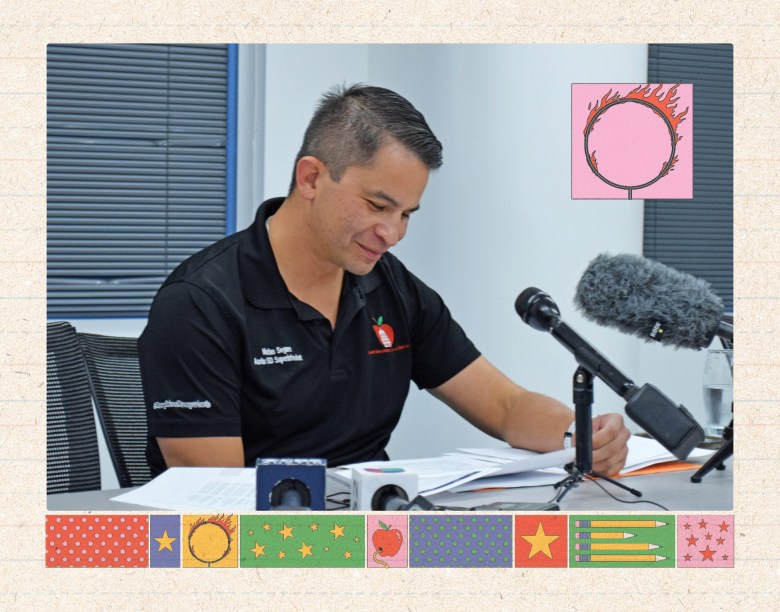 AISD Superintendent Matias Segura Credit: Sammie Seamon
AISD trustees also agreed to undergo coaching through Lone Star Governance, the Texas chapter of a national organization that coaches school boards and superintendents under the stated core belief: “School systems exist for one reason and one reason only: to improve student outcomes.” That belief centers hard metrics like STAAR scores, not developing well-rounded critical thinkers and lifelong learners.
According to Trustee Whitley Chu, board members have since sat through 16-hour-long LSG training sessions on Saturdays, filling out self-evaluations about how they have “failed students” because, as AISD’s LSG coach Ashley Paz has said repeatedly during public board meetings, “student outcomes don’t change until adult behaviors change.”
Trustees also lost control over how they use their board meeting time. Under LSG rules, board meetings must devote 50% of their time talking about student outcomes and special education compliance. “Student outcomes time” doesn’t allow for discussion of the budget issues, turnaround plans, or school closure and consolidations – all decisions that were pressed for time, given the Nov. 21 deadline, and will imminently impact thousands of students in Austin.
David DeMatthews, a professor of education policy at UT-Austin, noted that TEA has not hired researchers to evaluate if LSG actually improves student performance within the districts it coaches. “Who says Lone Star Governance works well? Well, TEA does, with pretty flimsy data. That, to me as a researcher, is concerning. It’s just anecdotal … and it makes it even harder to trust what TEA says.” When asked for research supporting LSG’s effectiveness, the TEA pointed the Chronicle to a list of recommended books and reference materials within the LSG manual.
And school districts that completed LSG coaching were still ultimately taken over. After Houston, Fort Worth ISD was taken over last month, the second major metropolitan district in two years. Connally, Lake Worth, Beaumont, and Wichita Falls ISDs all now have five consecutive F’s, The Texas Tribune first reported, making them newly primed for takeover. And Austin ISD also joins that at-risk list, at F four out of five.
To understand why so many school districts are suddenly in this position, it’s worth taking a look back at the last five years of TEA accountability scores.
No accountability scores were released for the 2019-2020 and 2020-2021 school years due to the COVID-19 pandemic. Students predictably began to struggle academically, particularly those with fewer resources. By 2021, only 35% of students in Texas were on grade level for math.
For the 2021-2022 school year, accountability scores weren’t released for what would be D- and F-rated schools. Then, over 100 school districts sued against the release of the 2022-2023 scores.
Their argument: The TEA had made the STAAR test harder in the same year that they dramatically changed the accountability system. For instance, to get an A, the percentage of a school’s graduates needing to meet College, Career, and Military Readiness criteria jumped from 60% to 88%. This would affect district ratings even retroactively, suddenly plunging school districts across Texas into lower and failing ratings.
A Travis County judge defended the school districts in August 2024, blocking the release of the scores. In April 2025, the 15th Court of Appeals overturned that injunction, allowing the TEA to release them.
Over 30 school districts then sued against the release of the 2023-2024 scores, which were released by a judge in August along with the regularly scheduled 2024-2025 ratings. In Austin ISD, with two years of accountability released at once on Aug. 13, 16 campuses suddenly plunged from a B grade to an F.
The accountability goalposts keep moving, the scores say that public school performance across the state has suddenly tanked, and the state of Texas will open applications for private school vouchers next school year. School districts across Texas, not just AISD, must submit turnaround plans for hundreds of schools to the TEA on Nov. 21.
“In this moment when public education is under attack, it’s on us, on Austin, to ensure that our public schools are healthy, thriving, and serving every student now and for generations to come,” AISD Board President Lynn Boswell said on Oct. 2. “We must do all that we can to keep local control of our local public schools.”
The next day, the district released the initial school closure list. The same week, AISD families began protesting outside of TEA headquarters, recognizing the situation as state-manufactured.
“It is dire,” Segura told reporters during a briefing on Nov. 14, speaking on the state of public school districts in Texas. “If there’s one fish in the water that’s dead, it’s probably something wrong with the fish. … But if every fish is dead, then something’s wrong with the water.”
Gaps
Sheri Guess’ ESOL classroom (English for Speakers of Other Languages) at Lively Middle School is for students whose ability to read and write in English is either nonexistent or at the beginner level on the Texas English Language Proficiency Assessment System exam, used to evaluate all non-English speaking students when they enroll in a Texas public school.
Her students have been in the U.S. for two years or less. Many have had noncontinuous education. Some have never been to school before. Some cannot read well in any language. But because they’re already in middle school, Guess’ students take the STAAR test in English, with grade-level English, math, and science questions. The TEA doesn’t count those students’ test scores in their first year in the U.S. in accountability calculations, but does in their second year and beyond.
That means schools with high percentages of emergent bilingual students (defined as students learning English who speak their first language at home) have chronically low accountability ratings because of STAAR performance. Dobie, Webb, and Burnet middle schools (with four F’s) have 72-80% English language learner populations.
“We’re adopting … a whole new culture, a whole new set of rules, and a whole new language. And the only thing that they really understand is that there is a test coming,” Guess said. “That’s so disheartening to someone who actually really believes in … giving kids a chance to succeed on their own terms, right? The school system was not built for that.”
In AISD, the bulk of support for emergent bilingual students is in elementary school, as most enter the public school system at that level. The district offers dual-language programs at 57 of its elementary schools, 13 middle schools, and five high schools.
But kids are falling through gaps in AISD. Once a student is in the system for three years, the district will usually place them into a regular English class like Benson’s, rather than ESOL class like Guess’, assuming that they’ve mastered enough English with modest improvement on TELPAS.
“But functionally what’s happening is, I have a lot of students who have been in the country for five years … they’ve taken TELPAS five times, and so they’ve been placed into this language arts classroom, despite the fact that, realistically, they would still benefit from ESOL instruction,” Benson emphasized.
“But at the same time, if they’ve been in ESOL for three years, and they’re still at that level, something isn’t working. Which means it’s also this matter of, how effective are our ESOL programs, actually?” Benson continued.
Guess agrees that ESOL programs are simply not very effective as they are run now. While emergent bilingual students have electives in their first language, their core classes are still in English. “Think about what it might be like to have your classes be in a language that you don’t understand, all day long,” Guess said. “That causes behavior issues. It causes a lack of interest. It’s just not functional for our kids.”
In a more ideal situation, Guess explained, emergent bilingual students could learn and be taught in both English and Spanish (for example) in tandem, in every class throughout the day. But that option is only available at AISD’s four campuswide dual-language schools. Those schools are currently slated to close, with programs to be rehoused at Wooten, Odom, Sánchez, and Pickle elementaries next school year; emergent bilingual students will have to uproot and follow those programs. Nonetheless, four is a limited number, and not all English learners in the district get that experience.
“They need that. You can’t make a good transition from your L1, your first language, to your L2, your second language, without going back and forth all the time. Science has proven that, we know this, but we’re not addressing it,” Guess said.
And Guess’ students face even more challenges than U.S.-born emergent bilingual students, who already have the system working against them. Today’s political reality in Texas has disrupted many of her students’ lives much more deeply than just their education. “Federal government changes have been felt in our schools,” Segura told press during Friday’s briefing. “Immigration changes have seen a huge reduction in families accessing public education.”
Moreover, the biggest avenue of support that exists for foreign-born emergent bilingual students in AISD is International High School, a school dedicated for multilingual, internationally born students entering the system at the high school level with a focus on ESOL support. But the school, which currently shares a campus with Northeast ECHS, is also slated to close next year and become just a program housed at Navarro HS.
As Guess continues to educate and advocate for her students, she measures their success in metrics that are not STAAR results. “Feeling safe in the classroom, feeling like you have somewhere to go, someone to talk to,” Guess said. “I think what the issue is, rather than [ESOL] curriculum, is just an understanding and an acceptance of where these kids are … there’s a myriad of things that they’ve gone through.”
Takeover
Austin ISD families have heard the stories about what has happened in Houston ISD under a TEA takeover. During an Austin Council of PTAs panel on Sept. 27, Brandie Dowda, an ex-HISD librarian, recounted many of them.
Mike Miles, the TEA-appointed superintendent, created New Education System schools, removed some of their libraries, and repurposed them as student disciplinary centers. Campus specialists who made sure that students had shelter, food, and clean clothes to wear were removed and replaced by Sunrise Centers. “From what I’ve heard from other community members is, when you call, nobody answers,” Dowda said. “We are hemorrhaging teachers.”
On Oct. 5, dozens of AISD parents and elementary-aged children gathered against the colossal marble back of TEA’s state headquarters on Congress Avenue. Jessie Neufeld, a parent of AISD students, took the megaphone in the middle of the group.
“We don’t need takeovers. We need collaboration. We don’t need you silencing our school board,” Neufeld said. “Standing up for our schools … is as critical as breathing, because education is oxygen and public schools are the lungs of our democracy.”
 October 5: Parents, teachers, and students rally outside the TEA’s offices, in opposition to turnarounds and a potential takeover Credit: John Anderson
UT-Austin education policy professor DeMatthews emphasized to the Chronicle that the TEA accountability system is innately a flawed approach – to base school and school district evaluations largely on STAAR isn’t holistic. “And when you do that, you can create conditions where people manipulate what is happening … in schools to artificially raise that singular number, right?”
Whistleblowers have called out the TEA for doing exactly that in Houston ISD. Texas Monthly reported in July that Mike Miles held back students in his NES schools from advanced math and science classes in order to artificially raise STAAR scores and the district’s accountability score. “It’s shameful. He’s saying that he’s helping kids, and he is irrevocably hurting them,” Ruth Kravetz, a retired HISD teacher and administrator, said during the Sept. 27 Austin Council of PTAs panel.
The explicit purpose of a TEA takeover is to improve student performance. But, as DeMatthews told the ACPTA panel, that simply isn’t the reality of state agency takeovers across the country. “Researchers, on average, don’t find any improvements in student achievement outcomes. They often even see declines. There’s an erosion of community trust, there’s a reduction in family engagement, there’s often increased spending per pupil,” DeMatthews said.
Mike Morath maintained that isn’t true in HISD, in public conversation with the Houston Chronicle on Oct. 22. “You see far higher levels of proficiency today in Houston than you did two years ago,” Morath said. “There’s a lot of chatter that there’s something incorrect in the outcomes, but those arguments are all false.”
The state of Texas has also pushed private, third-party charter management onto its public schools, which opens opportunities for private individuals to profit off of public education. Since Senate Bill 1882 was passed in 2017, the state has monetarily incentivized public schools to partner with a charter company through the possibility of extra state funding for that campus. It also pressures vulnerable schools facing turnaround requirements to “restart” using a charter partner, where the charter manages faculty rehiring and curriculum redesign in place of the school district, offering “An exemption from certain accountability interventions for two years.”
That period of accountability relief could spare a school district from TEA takeover, a rock-and-a-hard-place situation. AISD’s Mendez MS is being managed today by Third Future Schools, a charter company founded by Mike Miles, due to Mendez’s low STAAR scores since 2014. It did work – Mendez’s score rose from an F to a B, released this year. “Mendez is going to come back to Austin ISD. The data is not certain yet, but that’s our school. We want to welcome our students … and have a strong program when we do welcome them,” Segura said on Nov. 14.
Now the district may need to do the same for Dobie, Webb, and Burnet middle schools to avoid a fifth F. It put out a call for possible charter partners in September.
For AISD’s 24 TAPs submitted Nov. 21, none of the campuses will use the charter restart option, and the district will manage the hiring and rehiring process at those schools.
“I don’t know of any evidence that suggests that a charter taking over a failing school is any more likely to improve that school than the public school district itself,” DeMatthews told the Chronicle. “And so why there’s an incentive, to me, does not seem to be rooted in an empirical consensus that charter operators are better at turnaround.”
“SB 1882 partnerships provide Texas school districts with a strategic approach to improving student academic outcomes and offering innovative models to their students,” the TEA wrote to the Chronicle. “TEA has strengthened the requirements for turnaround partnerships to ensure that only experienced, high-performing partners are entrusted with operating these schools.”
TNTP also reappears in AISD’s TAP drafts, which will require monthly “Lighthouse/Learning Lab” professional development sessions led by the education consulting group at TAP schools like Pecan Springs ES through May 2028. “I’d like to know how TNTP was chosen, who else was considered, and how much we will be paying if this is approved,” Boswell asked district officials during the Oct. 30 board meeting. (The district didn’t respond by press deadline to a request for clarification on why TNTP was chosen as a partner.)
“In a system where there are literally billions and billions and billions of dollars, there is certainly room for corruption and for behaviors that are perhaps legal but unethical,” DeMatthews told the Chronicle, speaking broadly about third-party education partners. “But I do think sometimes it makes sense for a district that is really struggling, like Austin … to try to find partners that can help them improve quickly.”
And AISD is in a pressing situation. Still under a special education agreed order, TAPs, LSG, and financial problems, some AISD parents have prematurely begun to assume that state takeover is an inevitability.
DeMatthews would agree that, “in some shape or form, an increased TEA intervention seems likely,” he told the Chronicle. But he also questioned whether the TEA would be willing to deal with the protests that would regularly ensue at the doors of their state headquarters.
“It’s a different takeover when you’re taking over the school district in the capital,” DeMatthews said dryly. “Where the TEA commissioner goes to work and lives, where the Legislature is enacted.”
Segura maintains confidence that a state takeover wouldn’t just be a “black box,” and that there will be a longer workshopping process. “But in the event that we had to dig into the end and [the turnaround plans are] not accepted, then we would absolutely have to move forward with something that we know will be accepted,” he said during Friday’s press briefing.
Dowda, the ex-HISD librarian, nonetheless encouraged Austinites to prepare for the possibility during the panel. “If you start strengthening [community] connections now, then you have that much more strength to oppose issues that come up during a TEA takeover. You have that much more voice,” she said.
At the same panel, DeMatthews concluded his thoughts on a subdued note:
“One thing I will say is, I don’t believe the majority of Texans of any faith, tradition, political party, color, creed, believe that this is right.”
Possibilities
As the Austin ISD administration writes turnaround plans, checks off boxes on the TEA agreed order, and navigates Lone Star Governance requirements, classroom teachers in the district remain on the front line of educating students.
For middle school teacher Elijah Benson, he’s still workshopping how to teach from a textbook in ways that his students will enjoy and pay attention to. He imagines what his class could look like without a high-stakes test that commands so much weight on the futures of students, teachers, and their schools.
“My dream class would just be, every day, students come in, they’ve got books that they’ve picked for themselves or their friends have recommended to them, and they are reading, and then they’re talking about what they’re reading,” Benson reflected. “Then they’re writing, and they’re talking about their writing.”
STAAR results are psychological: A “Did Not Meet Grade Level” score can make a student feel like a failure, and their teacher feel like a failure. An administrator had even once told Benson that STAAR prep is important primarily because students will internalize a failing score. But, the standardized testing system in Texas is simply not designed in a way that gives every student an equal chance to succeed. “And that’s beyond their control, that’s beyond our control,” Benson said.
“They just need more time and more exposure. And so let’s spend that time changing how they view themselves as readers and writers, in a way that’s entirely divorced [from STAAR],” Benson continued. “We can change the field that students view themselves as participating in, so that the moving goalposts of STAAR scores are not necessarily something that they’re internalizing and building an identity around.”
While test scores place pressure on their own job security and compensation, Benson and other teachers across Texas will continue to put their students’ education and well-being first. “Our students [are] the reason that we’re all here,” Benson said. “It’s the responsibility of teachers right now to be brave.”

This article appears in November 21 • 2025.
A note to readers: Bold and uncensored, The Austin Chronicle has been Austin’s independent news source for over 40 years, expressing the community’s political and environmental concerns and supporting its active cultural scene. Now more than ever, we need your support to continue supplying Austin with independent, free press. If real news is important to you, please consider making a donation of $5, $10 or whatever you can afford, to help keep our journalism on stands.