
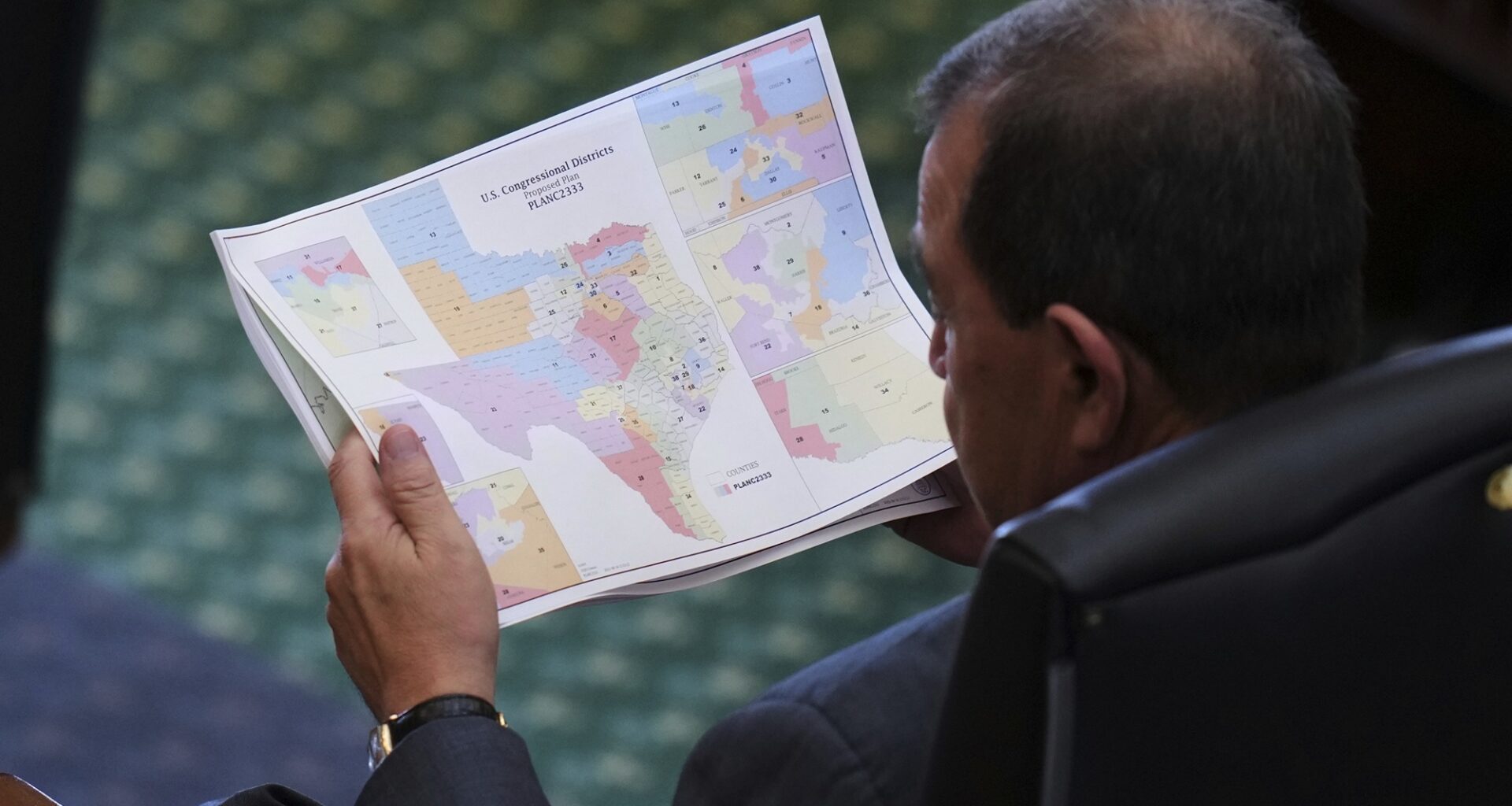
We have litigated ourselves into absurd contortions with legislative redistricting, thanks to the right-wing Supreme Court majority. If you want to gerrymander a map with purely partisan intent, federal courts will not stand in your way. If you want to ignore the prohibitions against racially discriminatory maps embedded in Section 2 of the Voting Rights Act, the Court will probably accept your arguments and let you gerrymander. But if you say certain magic words that come into conflict with different racial gerrymandering restrictions in the 14th and 15th Amendments to the Constitution, well then that’s a bridge too far.
A federal judicial panel ruled on Tuesday that Donald Trump’s Justice Department, Texas Gov. Greg Abbott, and everyone who mattered in the redistricting of Texas’s congressional map said those magic words. And now, the map they drew to give Republicans up to five more seats in the next elections has been thrown out, with almost no time to resurrect it before the candidate filing deadline on December 8.
Meanwhile in California, new maps approved overwhelmingly in a ballot measure earlier this month are being challenged in exactly the same way, using exactly the same arguments, by exactly the same people whose ham-fisted handling of Texas redistricting produced the judge’s ruling throwing the maps out.
The whole thing speaks to the colossal stupidity that John Roberts has pushed the country into regarding redistricting. It should be illegal for maps to be drawn for partisan advantage; because the Supreme Court has decided this is the one thing they’re not allowed to adjudicate, in some states it is illegal (see Utah) and in some states it’s not, really. Under our Constitution, you cannot “abridge” the right to vote based on race, and legislation can enforce that; but the legislation that does enforce it by enabling minority representation in Congress is about to be tossed out, on the grounds that this infringes on the constitutional voting rights of white people.
Now, as Roberts and his fellow justices receive the Texas case on appeal, they will have to figure out how to twist themselves to allow an explicitly racially gerrymandered map while also denying other racially gerrymandered maps. The entire thing is untenable, and it reinforces the fact that “fair maps” are an impossible construct.
In the meantime, though, it’s amusing to watch the Trump administration trip on their way to rigging the 2026 election through nothing but their own rank incompetence.
THINK OF GERRYMANDERING AS LIKE the old children’s board game Operation. In that game, you are allowed to pick the bone out of the patient, as long as you don’t hit the edge with the tweezers so the buzzer goes off. By the same token, you are allowed under federal law to gerrymander, as long as you don’t say out loud that you’re doing it to pack voters of a particular race into a district. You can even do that, you just can’t say it. Don’t hit the edge with the tweezers, in other words.
In Texas, Republicans hit the edge.
Judge Jeffrey Brown, who was appointed by Trump, painstakingly documents this in his ruling. Texas lawmakers were uninterested in redistricting this year, until Assistant Attorney General for the Justice Department Civil Rights Division Harmeet Dhillon sent a letter saying that four districts in the state were unconstitutional “coalition” districts that put multiple minority groups together to reach a majority, and under new case law that came after Texas’s 2021 map-drawing, they must change those districts.
It’s important to note that Dhillon was wrong. The legal standard she cited, from a case called Petteway, does not say that coalition districts are unconstitutional, just that states are not obligated to draw coalition districts. Dhillon’s letter is variously described as “‘legally[] unsound,’ ‘baseless,’ ‘erroneous,’ ‘ham-fisted,’ and ‘a mess.’” But it’s what Texas Republicans seized upon to change their position and start redistricting. In their telling, they weren’t doing Trump’s bidding, they were merely complying with the law by increasing the number of majority-Hispanic districts in Texas.
That’s what Abbott says when adding redistricting to the special session “in light of constitutional concerns raised by the U.S. Department of Justice.” It’s what a number of Texas House and Senate leaders say on the legislative floor and in the media to justify the maps, arguing that they are not racially motivated and that they merely want to make more Hispanic districts. The legislative record is full of racial statistics and references to Petteway, which again is a case that does not apply. And in all but one case, the districts DOJ cited are made majority-Hispanic, as are several others.
It turns out that this isn’t legal. “Texas racially gerrymandered the 2025 Map,” Judge Brown states, providing copious evidence of this and ruling based on the Constitution, not the Voting Rights Act, Section 2, that is under threat at the Supreme Court.
The important part of the Brown ruling to me is this line: “[I]t is not illegal for a legislature to enact a redistricting plan with the purpose of favoring one political party over another. When a plaintiff brings race-based gerrymandering claims, ‘partisan motivation [acts] as a defense, not a jurisdictional bar.’” In other words, Republicans used an entirely useless and actually erroneous talking point to deny that they were following Trump’s orders, and to assure Hispanics that they were fighting for them. That was unlikely to work on its face, as Hispanic voters are fleeing the Republican Party after a brief flirtation in 2024. But by saying this out loud, Republicans hit the edge with the tweezers, and triggered the one thing that can get your maps thrown out.
The appeal goes directly to the Supreme Court, which now must fit the overwhelming evidence into their bizarre conception of what is and is not an illegal gerrymander. But the clock is ticking: The candidate filing deadline for Texas’s rather early primaries is December 8, just 18 days away. Even if the Roberts Court rides to the rescue, it may be too late for 2026.
CALIFORNIA DID THINGS DIFFERENTLY. Led by Gov. Gavin Newsom, they publicly pitched their redrawing of congressional maps as entirely about fighting Trump, and the public agreed to it in Proposition 50. Under the Supreme Court’s standard of backing off partisan gerrymandering, that’s totally fine.
But Republicans in California wanted to fight these maps. So they turned to the only possible objection in federal courts: The map is a racial gerrymander. The initial lawsuit was filed the day after the election by … Dhillon Law Group, which was formerly helmed by Harmeet Dhillon, literally the same person who demanded a racial gerrymander in Texas. When the DOJ signed on to the lawsuit, it was forced to note that Dhillon had recused herself from the case.
The evidence that Dhillon Law Group has for a racial gerrymander in California is thin. It cherry-picks one line in a press release from state Senate leader Mike McGuire that the new map “retains and expands Voting Rights Act districts that empower Latino voters to elect their candidates of choices.” The lead of that press release says: “This is about more than drawing lines on a map, it’s about drawing a line in the sand to stop Texas and Trump from rigging the election.”
The suit then hits Paul Mitchell, the consultant who drew the maps, for saying that he added a “Latino district” that the independent redistricting commission rejected. But there’s an interesting parallel to the Texas case, where its consultant, Adam Kincaid, claimed that he didn’t look at race at all in setting the maps. That’s a dubious claim, given that he created a bunch of districts that were just barely over 50 percent Hispanic, and it would be impossible to do that accidentally. But even if he did, the judge in Texas said, the legislature demonstrated fully that their intentions were racially motivated.
By contrast, outside of a secondary line in a press release and a few stray comments (which were all about complying with the still-operative Section 2 of the Voting Rights Act), this was not remotely the main thrust of any Democratic lawmakers in California. And we know this because there are numerous public ads saying that they wanted to fight back against Trump. Plus, the ballot language and arguments to voters, who ultimately decided to approve the maps, are entirely about Prop 50 being a partisan maneuver.
For this reason, most experts believe the California case will get thrown out. But again, this is only because they mostly avoided the magic words that would tip a partisan gerrymander into a racial gerrymander. If which magic words you use are the only difference between a “fair” and an “unfair” map in the eyes of the law, then does the word “fair” have any actual meaning?
As I said back in August, all of the arbitrary lines placed on a map are instruments of politics and changeable based on circumstance. Trump is on the verge of a historic blunder because Democrats woke up and decided to fight slanted maps with slanted maps; Trump and his toadies just happen to be epically bad at execution, so the fight isn’t playing out in his favor. But someday there will be a Republican who isn’t an idiot (I have faith, there has to be one somewhere), and this game of predetermining elections will go on endlessly, as long as you use the right salad fork when you do it.
We can just watch this play out, hope our side is better at the structural niceties, see Congress become thoroughly unreflective of the popular will, and attempt some kind of gerrymandering détente. Better yet, we can end the fiction that such a thing as a “perfect” or “fair” map can actually exist in a time of extreme ideological-geographic clustering. Proportional representation (and many more representatives) is the only way to have our legislature mirror the desires of the public, as long as you combine it with stripping the Senate of all policymaking power and devolve it into an American House of Lords. I know that asking for equal representation for every voter is a radical notion at odds with our entire history. But it’s the right thing to fight for.
Recommended Reading