
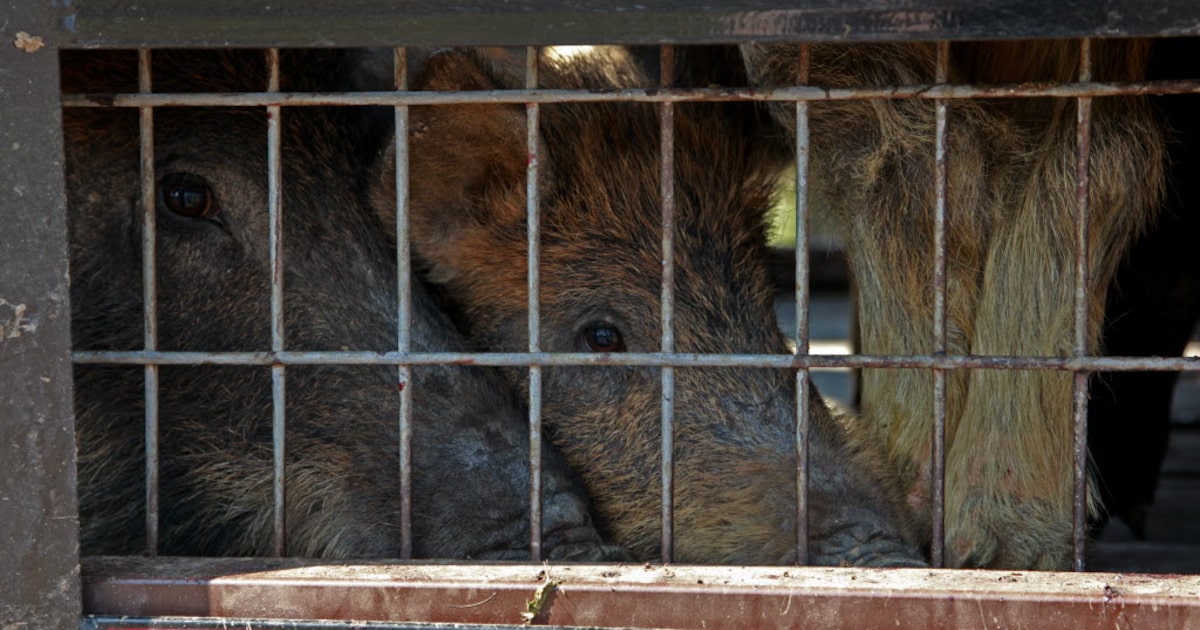
Wild hogs were spotted in Coppell and in two neighborhoods in Roanoke last week, officials said.
The animals are an invasive species known for destroying property and vegetation in their search for food.
They have been listed as one of the top 100 worst exotic invasive species in the world, according to the Texas Parks & Wildlife website.
The most recent sighting of wild hogs in Coppell was Nov. 14 in the Riverchase Estates subdivision, J.J. Ceniceros, a spokesperson for the Coppell Police Department, said in a statement.
Breaking News
“Feral swine activity is not abnormal for the area with sightings occurring on a seasonal basis and for multiple years,” Ceniceros said. “Feral swine in Coppell are typically found around the Elm Fork Trinity River.”
Coppell police and animal services do not believe the hogs currently pose a threat to public safety, Ceniceros said.
The United States Department of Agriculture sent a private hog trapper to the area to set up traps and address the concern.
Wild hogs were also spotted in the Fairway Ranch and Briarwyck neighborhoods in Roanoke last week, according to a Roanoke Police Department statement.
Roanoke police said they have been increasing patrols in the two neighborhoods to help locate the hogs.
Officers and city staff will not be independently removing the hogs and are in touch with a contractor who will begin the hog trapping process as early as next week.
Here’s a few things to know about wild hogs and what to do if you see one.
Where can wild hogs be found in Texas?
According to the Texas A&M AgriLife Extension website, data from 2022 indicates that wild hogs have established populations in 253 of the 254 Texas counties.
Wild hogs are commonly seen in areas with dense vegetation, water and food sources, such as near rivers, Ceniceros said.
It is suspected that wild hogs travel into populated areas in search of food when there is limited precipitation.
What threats do wild hogs impose?
Most damage caused by wild hogs is done through rooting, where they use their snouts to dig into the ground and turn over soil in search of food, according to the Texas Parks & Wildlife website.
In 2007, researchers estimated that each wild hog carried a damage and control cost of $300 per year. If the estimate has remained constant, the annual costs associated with wild hogs in the U.S. are likely close to $2.1 billion today, the website says.
Wild hogs can also transmit at least 30 bacterial, fungal and viral diseases to humans, livestock and wildlife.
For details on which diseases they carry, visit the U.S. Department of Agriculture Animal and Plant Health Inspection Service wild hog disease brochure.
What to do if you see a wild hog
Wild hogs tend to be most active at dawn, dusk and during the night and are fearful of human activity, so encountering one is unlikely, Ceniceros said.
In the chance you do encounter one, remain calm and keep a safe distance away. Do not approach the hog or run, as that can trigger a chase response.
Those who encounter a wild hog are encouraged to report them to local police, animal services and the Squeal On Pigs wild hog population tracker.