
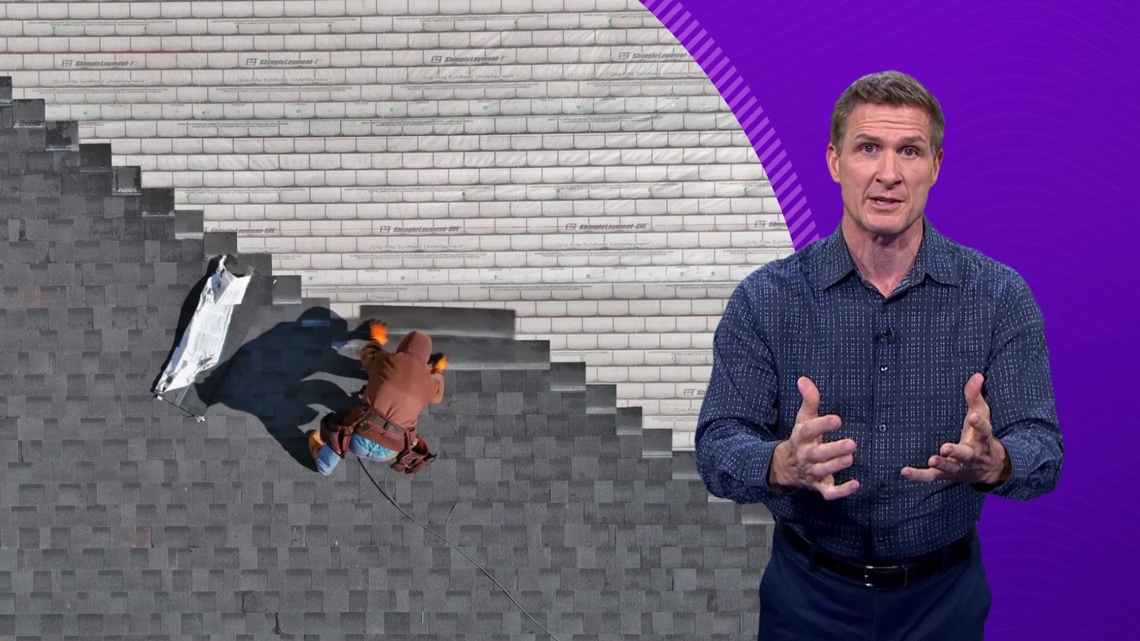
Despite research that damage claims can be reduced significantly by a home fortification program, Texas lawmakers haven’t agreed to give grants like some states.
DALLAS — Roof replacement…I have been there, done that, and paid a lot for it.
My insurance company paid much more. And yet it was my choice whether I wanted to spend more and rebuild it stronger, or just replace it with the same kind of roof that just got pummeled.
When you are making that decision, it’s good to know some of the things the Insurance Institute for Business & Home Safety has come up with for their Fortified home program, which focuses heavily on strengthening the roof.
It’s not just about shingles
I visited IBHS and found out it’s not just the shingles that matter. They say you should also consider small but very significant things, like ring-shank 8D nails on the roof decking.
IBHS Meteorologist & Science Producer Rachael Gauthier says that small change “doubles the uplift strength of your roof by having these little grooves” on the nail go down into the roof.
Also important: upgrades to your underlayment–the sheet that goes beneath the shingles. That is often held in place with standard staples. The Fortified program calls for underlayment that is twice as thick and is held in place with button cap nails in a “Certain spacing and certain pattern so that is going to help keep the underlayment attached to your roof deck as well”.
And then there is tape to consider…yes, tape. The plywood beneath your underlayment has cracks so it can expand and contract with temperature changes. That is standard. The Fortified roof has flashing tape that covers those cracks and expands with them.
“Our research here at IBHS shows that for every one inch of rain that falls, up to nine bathtubs of water enters through those cracks in your roof and into your home,” Gauthier said. “Your insurance claim could be three times higher because the water has made its way into your house. You’re going to be dealing with things like mold. And you’re going to have to replace sheetrock and flooring…insulation.”
And that could have been prevented by something as simple as tape that Gauthier says “can cost as little as an extra $500”.
In total, they estimate that when re-roofing a 2,000-square-foot home you may spend an extra $1,000 to $3,000 to make it Fortified. And it would cost still more to upgrade to the most hail resistant shingles.
States incentivizing Fortified standards
Some states like Oklahoma and Alabama offer homeowners up to $10,000 in grants to build back stronger. In Hurricane Sally 2020 in Alabama, researchers found Fortified roofs held up 50% better than regular roofs.
And they figured that if 25,093 conventional homes that were damaged would have been Fortified, it would’ve saved policyholders up to $34.6 million in deductibles and insurers would have saved up to $111.8 million.
Because of that, insurers give wind and hail premium discounts up to 42% in Oklahoma and up to 60% in Alabama for Fortified homes.
What about Texas?
In the Texas Legislature, which was awash in billions of surplus dollars this last session, a bill that would create a similar grant program here passed the House with overwhelming and bipartisan support, but died in a Senate committee. Here is the response to that bill failure from Richard Johnson, Director of Communications and Public Affairs for the Insurance Council of Texas, which represents insurers:
HB 1576 passed the Texas House with strong bipartisan support but died in the Senate Business & Commerce Committee without a hearing. This could have been a gamechanger for Texas homeowners — especially those in high-risk regions facing rising premiums, deductibles, or non-renewals. As you alluded to, other states like Alabama have moved forward on similar programs, and the contrast with Texas is striking. We need to start looking at solutions to lower the cost of claims, and possibly even lower claims overall and that starts with how and where we build new homes and rebuild after catastrophes.”
We will see whether Texas lawmakers take up the issue again when they convene in 2027, which in Texas terms is many storms and many more roof replacements away.
Read more about the Fortified program here.
And this page gives suggestions for better fortifying your home on a budget.