
All year we have covered the stories that matter most to San Antonio, at no cost to you or the community. Your support fuels our work.
Will you help us make our $95,000 year-end goal to keep us going?
Commentaries at the San Antonio Report provide space for our community to share perspectives and offer solutions to pressing local issues. The views expressed in this commentary belong to the author alone.
Many of us remember growing up, listening to our parents and grandparents recall how hard they worked for basic needs, like access to food, water and education. While those stories may sound like they belong to another time, that reality still exists today for many, just across the U.S.-Mexico border.
In Victoria, Mexico, only a few hours from Laredo, water only runs for a couple of hours a day, depending on the neighborhood. For me and my dad, it was between 4 a.m. and 5 a.m. We would wake up before sunrise to fill buckets for cleaning, showering, washing dishes and brushing our teeth.
Never miss San Antonio Report’s biggest stories.
Sign up for The Recap, a newsletter rundown of the most important news, delivered every Monday and Thursday.
Some mornings, the water that came out was brown or smelled bad; other days, it didn’t come at all. On the news, I’d learn of nearby towns going days without a single drop. When stores ran out of bottled water, people collected it from broken pipes or showered on the street beside leaks out of desperation.
I was so used to having limited access to water that I never questioned the reason behind it. It was just normal. But I learned early on that something as basic as water is not guaranteed. It’s a privilege.
When I moved to San Antonio at 17, I saw a completely different reality. Here, clean water is available at any time of the day. People leave the tap running while brushing their teeth, throw away half-empty bottles or take long showers without a second thought. When I arrived, I did, too. Like many people, I assumed water was limitless and forgot about my reality back home.
As a student at Trinity University, I am currently taking former Mayor Ron Nirenberg’s class, “How a Modern City Works,” where we engage with organizations and leaders shaping San Antonio’s development. Through this course, I recently visited the San Antonio Water System (SAWS) and the San Antonio River Authority (SARA) — visits that profoundly shifted my perspective.
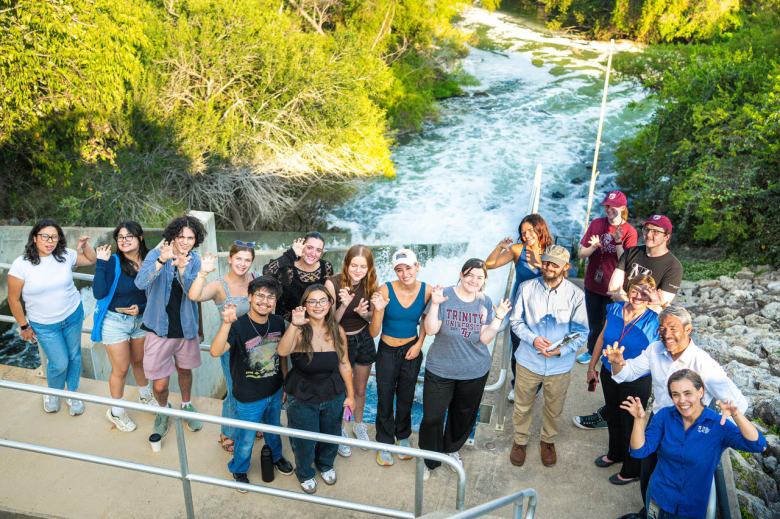 The final stop on “How a Modern City Works” class tour at SAWS, where students learned about the full process water goes through — from the moment it is flushed, through treatment, to its reuse for non-drinkable purposes that benefit local industries and the broader community. Credit: Courtesy / Alynn Jimenez Miranda
Seeing firsthand the immense effort required to ensure that such a vital resource is available to us every day made me reflect not only on the privilege of reliable access but also on its deeper significance in this region.
Four hundred years ago, people settled in this region because of its proximity to fresh water provided by the San Antonio River (then named the Yanaguana River) and Edwards Aquifer — two important resources that continue to sustain our lives every day.
But as San Antonio grows, so does its thirst. The city’s population is projected to reach 2.1 million by 2075, and currently, each person uses approximately 117 gallons of water per day. In response, SAWS has been investing in diversifying San Antonio’s water sources to reduce reliance on the Edwards Aquifer and in recycling non-drinkable water to support other services and industries that benefit residents.
Clean and accessible water is not guaranteed because it has diverse sources. It depends on the health of the natural systems that feed our rivers and aquifers — and we’re fortunate to have organizations such as SARA working to maintain and restore these systems, protecting our water quality, filtering pollutants and supporting sustainable water supplies for the city.
Yet most of us often don’t think about it. We assume that turning on the faucet will always produce clean water. But as Texas faces more frequent droughts and record-breaking heat, that assumption is becoming risky.
Our habits, like leaving the water running for a couple of minutes before showering, flushing wipes or pouring grease down the drain, might seem harmless, but they have real consequences for the environment and the people who maintain these systems.
According to SAWS, every time a wipe is flushed, a worker has to manually remove the buildup. Likewise, grease poured down the drain can solidify and mix with debris, creating blockages in the sewer and damaging equipment. These small actions slow down the system, cost money to repair, and make it harder to keep water flowing efficiently. At the end of the day, access to clean water doesn’t depend solely on technology or infrastructure. It depends on the choices we make every day.
Even the most advanced water plants can’t replace the need for personal responsibility. Water shouldn’t be something we only think about in times of crisis. It should be a daily habit. Every extra minute in the shower, every leaky faucet and every item we throw in the toilet has an impact.
After my visit to SAWS and SARA, I encourage others to do the same — go see where your water comes from. Attend a community event. Learn what it takes, and who it takes, to bring water to your tap.
You can engage directly by volunteering through the SARA River Warrior program to help clean up the watershed and restore habitats, or by joining River Aid San Antonio volunteer cleanup events. SAWS offers “Rain to Drain” tours to see how water is treated and delivered, as well as the SAH₂O speaker series to learn about conservation and water management. Behind every glass you drink is a network of passionate individuals working tirelessly to make sure you never have to think twice about it — but every time I visit Victoria, I’m reminded that it’s not the case for everyone.
I no longer have to wake up at 4 a.m. to fill buckets of water, but for many, that’s not a choice. It’s reality. Every drop is a privilege, and every privilege comes with responsibility.
Are you doing your part?
You’ve read unlimited of unlimited articles this month. That’s right — we’re committed to providing free, fair journalism for all.
But without donor support, our nonprofit newsroom can’t do its job to inform and empower your community.
Are you in? Your donation of any amount will help keep articles like this one accessible to all San Antonians.