
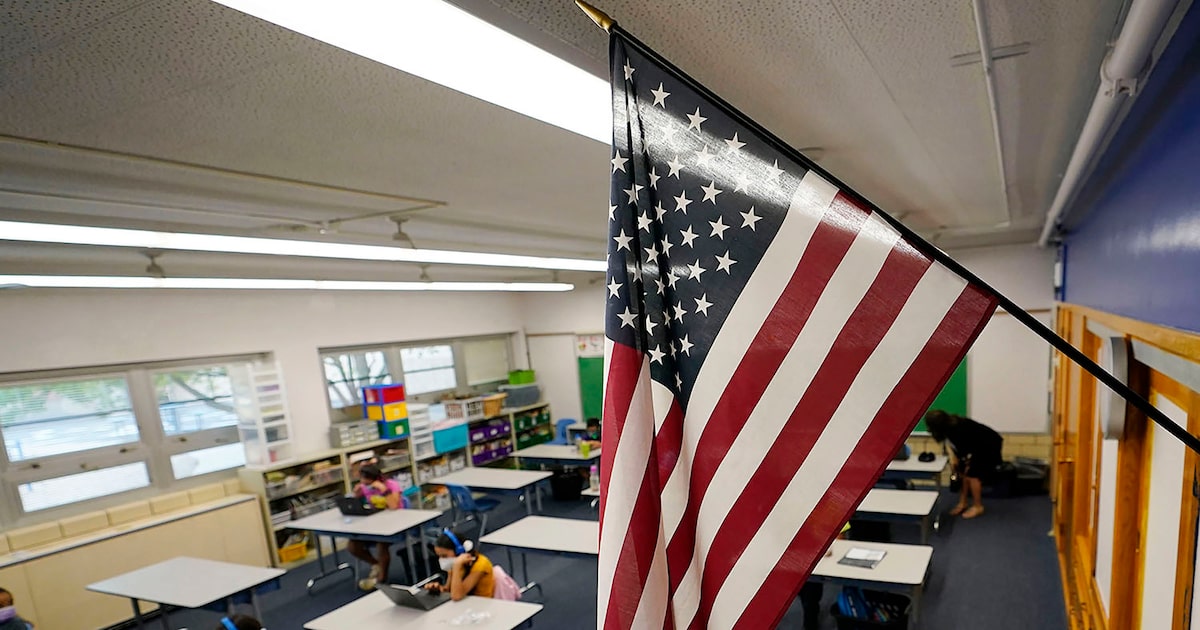
The Texas State Board of Education moved forward this week on overhauling the K-12 social studies curriculum. New learning materials will hone in on Texas and U.S. history, while de-emphasizing world history and cultures.
The elected 15-member board, where Republicans hold a majority, discussed key topics that would fall under a new framework approved in September. Members heard from teachers, parents and students about which periods, events and historical figures should be represented in the curriculum.
“The last big question today is, what is worth knowing?” said Julia Brookins, of the American Historical Association, during public comment. “There is a real opportunity here to support social studies instruction that opens up worlds of learning to Texas students.”
The board is early on in its process to fully revise the social studies learning standards, which are expected to be adopted in June 2026. The plan will be implemented in the 2030 school year.
The Education Lab
Related

The new blueprint gets rid of the world cultures class in Grade 6. Now, up to 5 percent of the grade’s curriculum will focus on world history. While the Grade 8 curriculum previously honed in on U.S. history, the blueprint directs teachers to focus almost entirely on Texas history.
From kindergarten to second grade, students build the foundation of “the stories of America and Texas,” according to the new course framework. In third through seventh grades, social studies will connect world, U.S. and Texas histories, though world cultures and geography will be taught “where appropriate.” In eighth grade, the course will teach the history of “Texas and America as leaders in the nation and world.”
The board previewed broad topics to be included in the framework, though they still need to pin down exact periods, events and historical figures. They considered subjects, like the River Valley civilizations, ancient Israel and ancient Rome, in the third grade. Other topics cover Texas during its early statehood and the contemporary era in the eighth grade.
Some members of the state board, teachers and students raised hesitations. Addressing the board, Steven Mintz, a history professor at UT Austin, said the social studies standards so far are “imbalanced” and “are not going to well prepare students for college,” worrying when students will learn about Egypt, China and Islam.
“This is an abomination of history, if we want to prepare students,” he said.
Others, like Spring Davis-Webster, a history teacher from Humble, want even more Texas and U.S. history in the new curriculum.
“Protecting U.S. history from dilution is not political. It is patriotic,” she said.
Related
Board members formed a social studies ad hoc committee, chaired by Aaron Kinsey who represents District 15 in the Panhandle. The committee started evaluating social studies standards in 2024 and pointed to trends observed by the National Assessment of Educational Progress : a “decline in eighth graders’ proficiency in U.S. history and civics, with scores dropping to levels seen in the 1990s.” Weak state standards were listed as a reason.
The state board appointed a panel of nine advisors who will provide feedback on the current social studies standards and develop recommendations.
Texas Freedom Network, an advocacy group that fought efforts to censor textbooks and opposes school vouchers, launched a petition calling for the removal of three advisors: David Barton, David Randall and Jordan Adams. So far, about 1,400 people have added their signatures.
“As the State Board of Education overhauls social studies standards for Texas schools in the coming months, board members must set aside politics and focus on teaching the truth,” the petition reads.
David Barton, an evangelical author and Christian activist, founded WallBuilders, an education advocacy group that assists politicians “who seek to uphold our original Biblical foundations.” Jordan Adams urged school officials in other communities to stray from diversity efforts and “critical race theory.” David Randall has advocated against identity politics infusing into the classroom, and fought for the inclusion of the Bible in social studies instruction.
In a statement, Donald Frazier, an advisor and director of The Texas Center at Schreiner University, said the process to develop curriculum is still preliminary, and critics should wait to see what emerges: “They might discover that they are pleasantly surprised.”
He added that the content advisors have “great deal of consensus…no matter if their views are right, left, or middle.”
Yolanda Leyva, a UTEP history professor who sits on the panel, senses “a push on the right.”
Leyva’s research focuses on border and Chicana history, and she said she wants to ensure underrepresented stories, like anti-Mexican violence in Texas, are covered in the new curriculum.
“I’m hopeful that when we talk about people fighting for freedom, we include people of color, because people of color have been fighting for the U.S. to live up to its equality and liberty ideals,” Leyva said.
The board will meet in January 2026 to discuss drafted recommendations for the social studies standards.
The DMN Education Lab deepens the coverage and conversation about urgent education issues critical to the future of North Texas.
The DMN Education Lab is a community-funded journalism initiative, with support from Bobby and Lottye Lyle, Communities Foundation of Texas, The Dallas Foundation, Dallas Regional Chamber, Deedie Rose, Garrett and Cecilia Boone, Judy and Jim Gibbs, The Meadows Foundation, The Murrell Foundation, Ron and Phyllis Steinhart, Solutions Journalism Network, Southern Methodist University, Sydney Smith Hicks, and the University of Texas at Dallas. The Dallas Morning News retains full editorial control of the Education Lab’s journalism.