
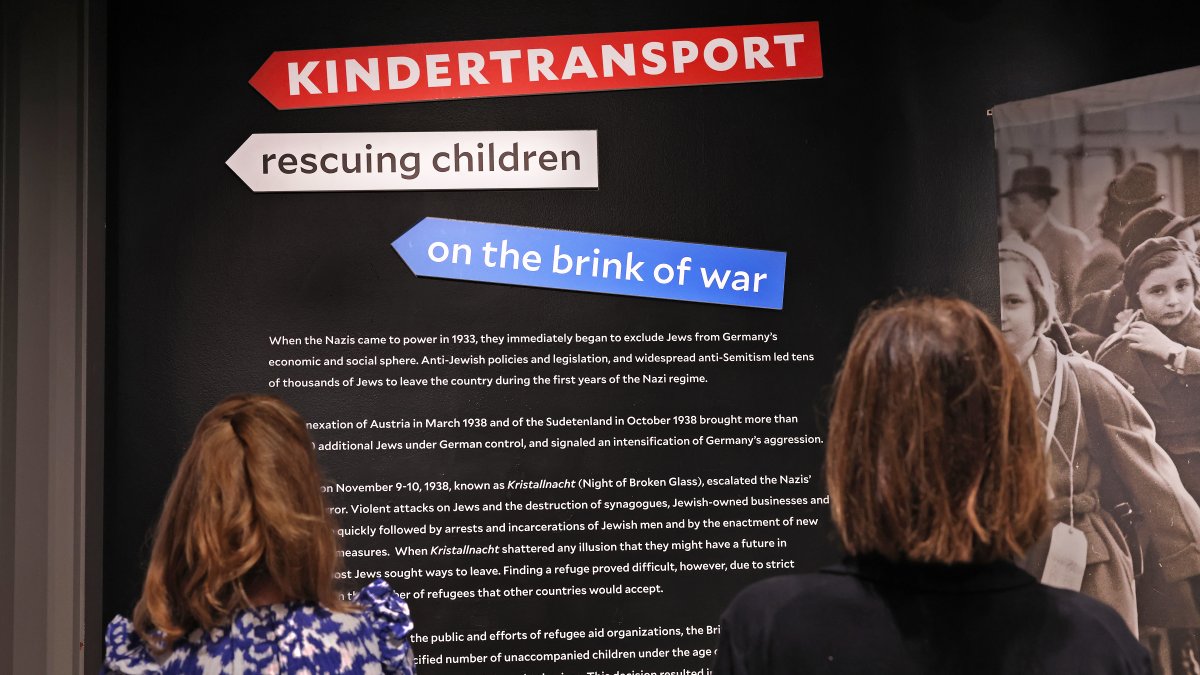
Shortly before World War II began, British citizens realized Jewish families were in danger and launched an effort to save as many children as possible. The historic effort known as Kindertransport, the people who made it possible and the children saved are the subject of the Dallas Holocaust and Human Rights’ current special exhibition, Kindertransport – Rescuing Children on the Brink of War, now on view through Feb. 15.
“It speaks to the power of individuals. People from all different religious groups in Great Britain worked together to convince the government to pass this act to let an unspecified number of children in,” said Mary Pat Higgins, the museum’s President and CEO. “Because of their efforts, in a nine month period, almost 10,000 children were spared.”
The Dallas Holocaust and Human Rights Museum
The Dallas Holocaust and Human Rights Museum
The British people and refugee organizations pushed the British government to expand immigration quotas to allow Jewish children to flee the looming war.
From Nov. 9-10, 1938, the Nazi regime instigated a wave of terror throughout the Jewish community in Germany and Austria, burning more than 1,400 synagogues, vandalizing Jewish-owned businesses, breaking into Jewish people’s homes and assaulting, imprisoning and killing Jewish people. The event was immortalized as Kristallnacht or Night of Broken Glass, and it signaled a horrifying reality about the looming war for Europe’s Jewish population.
“It was inevitable,” Higgins said. “After Kristallnacht, it became clear the Jewish people were not safe, and they needed to get to safety.”
Thanks to the efforts of British individuals and refugee aid organizations, the British government eased its immigration quotas to allow an unspecified number of unaccompanied minors under the age of 17 to enter Great Britain from Germany and German-annexed territories. British citizens agreed to sponsor the children, providing care and education while they were separated from their parents.
The Kindertransport story is not simply a European event. This exhibition highlights the stories of five survivors who eventually made their homes in North Texas: Leonore “Lola” Braunsberg Eldodt, Berthold “Bert” Romberg, Margarete “Magie” Romberg Furst, Charles Schwarz, and Susanne “Susie” Levy.
“They were saved because of the Kindertransport. They and their family members would not be with us if not for these people bravely standing up to their government and saying, ‘We have to change our immigration quotas to save these children,’” Higgins said.
The Dallas Holocaust and Human Rights Museum
The Dallas Holocaust and Human Rights Museum
The exhibition features letters between parents and children.
The exhibition tells the story of the Kindertransport through personal artifacts and survivors’ testimonies, from the parents’ wrenching decision to send their children to Great Britain to the survivors’ post-war life.
“For me, the most important part of the Kindertransport is trying to imagine what these parents were going through,” Higgins said. “There are statements talking about that decision and there are letters from parents to their children and from children to parents that help us understand that. I think they were all incredibly brave, the parents and the children.”
One of the suitcases in the exhibition might have been as large as the child carrying it.
“One of them is really big. It just makes you think the parents were trying to send them off with as much as they possibly could because that was all their worldly possessions at that point,” Higgins said.
Most of the Kindertransport children’s parents were murdered during the Holocaust. The North Texas survivors describe how they built a new life.
“We are learning constantly from the survivors of the Holocaust and of other genocides about the incredible power of resilience, how they were able to go on with their lives, have the courage to move to a new country and really completely start over and live the American Dream,” Higgins said.
The exhibition also explains the failure of the Wagner-Rogers bill, a measure that would have allowed 20,000 unaccompanied child refugees from Germany into the United States. The bill’s failure reflects the American anti-immigrant sentiment during the 1930s.
“Our museum is dedicated to teaching history to try to bring about change today, to help people understand from the mistakes and successes of the past,” Higgins said. “It helps us think about events today by understanding our history.”

The Dallas Holocaust and Human Rights Museum
The Dallas Holocaust and Human Rights Museum
Personal artifacts tell the story of the Kindertransport.
During one of the darkest chapters of human history, this exhibition shows that ordinary people can shine a light.
“There are not enough positive stories from the Holocaust, but there are so many. Our hope is to help people understand what can happen if people stand up for other individuals and if they do work hard to bring about change, amazing things can happen,” Higgins said.
Learn more: Dallas Holocaust and Human Rights Museum