
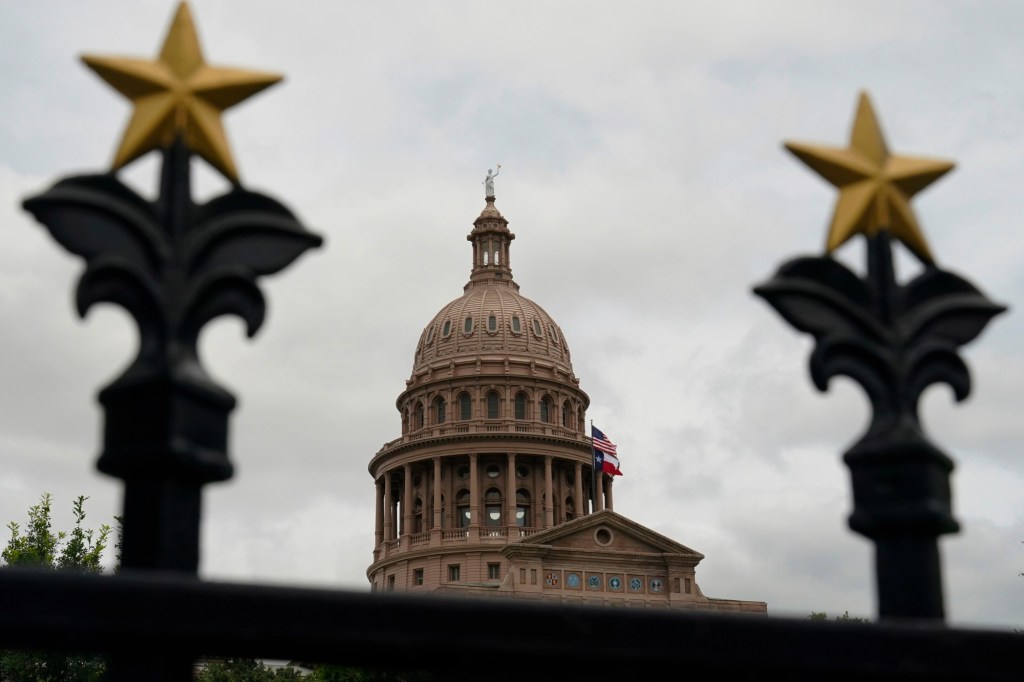
The showdown over Congressional maps in Texas has landed before the U.S. Supreme Court.
On Friday night, Justice Samuel Alito granted the state’s emergency application for an administrative stay. In a post on “X”, Attorney General Ken Paxton said this temporarily stops the injunction filed by two federal judges in Texas earlier last week that blocks the state from using its new maps approved by Texas Republicans over the summer. Instead, the judges ordered the state to use the existing Congressional districts drawn in 2021. Republicans had hoped the new maps would give them five extra seats in Texas. The Supreme Court will review the lower court’s decision.
Lower court order
In the majority ruling issued Tuesday, Judge Jeffrey Brown, a Trump appointee, said, “Substantial evidence shows that Texas racially gerrymandered the 2025 map”, which violates the Voting Rights Act of 1965. The ruling also cited the U.S. Justice Department letter from July to Governor Greg Abbott.
“In the letter, DOJ threatened legal action if Texas didn’t immediately dismantle and redraw these districts, a threat based entirely on their racial makeup. Notably, the DOJ letter targeted majority-nonwhite districts. Any mention of majority-white Democrat districts, which DOJ presumably would have also targeted if its aims were partisan rather racial, was conspicuously absent.”
The case not only made national headlines for this ruling, but also for the scathing dissent written by the third judge, Jerry Smith, who sits on the 5th U.S. Circuit Court of Appeals. He blasted Judge Brown for not giving him enough time to prepare his dissenting opinion, and he rejected Brown’s conclusion.
Smith said, “The resulting dissent is far from a literary masterpiece. If, however, there were a Nobel Prize for Fiction, Judge Brown’s opinion would be a prime candidate..”
Smith went onto say, “The main winners from Judge Brown’s opinion are George Soros and Gavin Newsom. The obvious losers are the People of Texas and the Rule of Law. It is unfair to the Texas voters who are having a map implemented by their duly elected legislature overturned by a self-aggrandizing, results-oriented court.”
Governor Abbott condemns ruling
Governor Greg Abbott condemned the majority ruling when CBS News Texas asked him about it at a campaign event in Frisco on Thursday.
“There was zero evidence that any map-drawing decision was made based upon race,” Abbott said. “The only people who were eligible to even be able to submit evidence on that were members of the legislature whose intent was the only intent that mattered about what was contained in those maps. Those in the legislature who testified said race played no role whatsoever. It was all about politics, which is legal.”
“Second, know this: the judge who wrote that opinion was just reversed last year by the federal court of appeals. In that judge’s last decision about redistricting, he got that decision wrong. He got this one wrong also.. I feel very confident the Supreme Court is going to take this case and once again overturn Judge Jeff Brown for a wrong ruling on redistricting.”
Republican State Representative Katrina Pierson of Rockwall, told CBS News Texas that the federal judges who wrote the majority ruling didn’t take into account the legislative process. “It seemed the court really overstated race and understated politics. The opinion to me, misreads the motivation of the 2025 maps and ignores the legislative process. It sounded like to me like they were focused more on what the federal government was saying, not necessarily what the legislature actually did. And I think that’s where people are getting lost in the translation. We just simply redrew the maps based on political performance.. and I think the Supreme Court will sort this out.”
Democratic members of Congress react to ruling
Democratic members of Congress from North Texas are among those who celebrated the ruling. Representative Julie Johnson, D-Farmers Branch, said, “I totally agree with the court. You know, what the Republicans and Greg Abbott did in Texas to seeking to disenfranchise voters of color was egregious, and the court clearly agreed with that. This opinion is sharp, and it is clear, and it is concise.”
Democratic Representative Marc Veasey of Fort Worth said, “I feel like we’re on good legal grounds here. So, I feel confident, but you know I’m going to be again cautiously optimistic in watching what the Supreme Court says.”
Democratic Representative Jasmine Crockett of Dallas said, “I’ve always made it clear that this was racial, and I know that some people want to run away from the race element, but the law protects it. We know that our Constitution recognizes and protects it.”
Democratic State Representative Nicole Collier, of Fort Worth, praised the ruling. “It is a victory today because it validates what the House Democrats and so many Texans have been saying about these hastily drawn maps. It’s very clear that they were drawn to disenfranchise, to harm the people of color, the voters of color, and that’s exactly what the court recognized. They saw through this ruse by the Republican-led legislature. They used the information that they received against them to show that these maps were drawn to harm Black and Brown voters.”
Collier said she is not surprised Republicans filed an appeal with the nation’s highest court. “Texas is a majority-minority state. So, when you try to draw lines, rig the lines in your favor, you are going to disenfranchise voters of color… Let’s be real, the fight is not over.”
Timing is crucial ahead of March primary
From the beginning, timing has been crucial because the maps need to be in place because candidates have to file their campaign paperwork in time for the March 3rd primary.
On August 29th, Governor Abbott signed the redistricting bill into law after it passed in both the House and Senate. Then October 1st-10th, the three-judge panel held a hearing on the maps after they were challenged by dozens of groups, including Democrats, LULAC and the NAACP.
On November 8th, the filing period began for candidates who are running in the March primary. Ten days later, on November 18th, last Tuesday, the majority ruling blocking the new maps came out. Congressional candidates who were waiting for that ruling, so they knew which districts to run in before they filed, have until December 8th to do so.
Congresswoman Johnson and Congressman Veasey said they will run for re-election in their respective districts. Congresswoman Crockett told CBS News Texas that she is strongly considering running for U.S. Senate, but that if she doesn’t, she will run for re-election in her district. Crockett said she is waiting for internal polling results and hopes to make a decision by Thanksgiving.
More from CBS News