
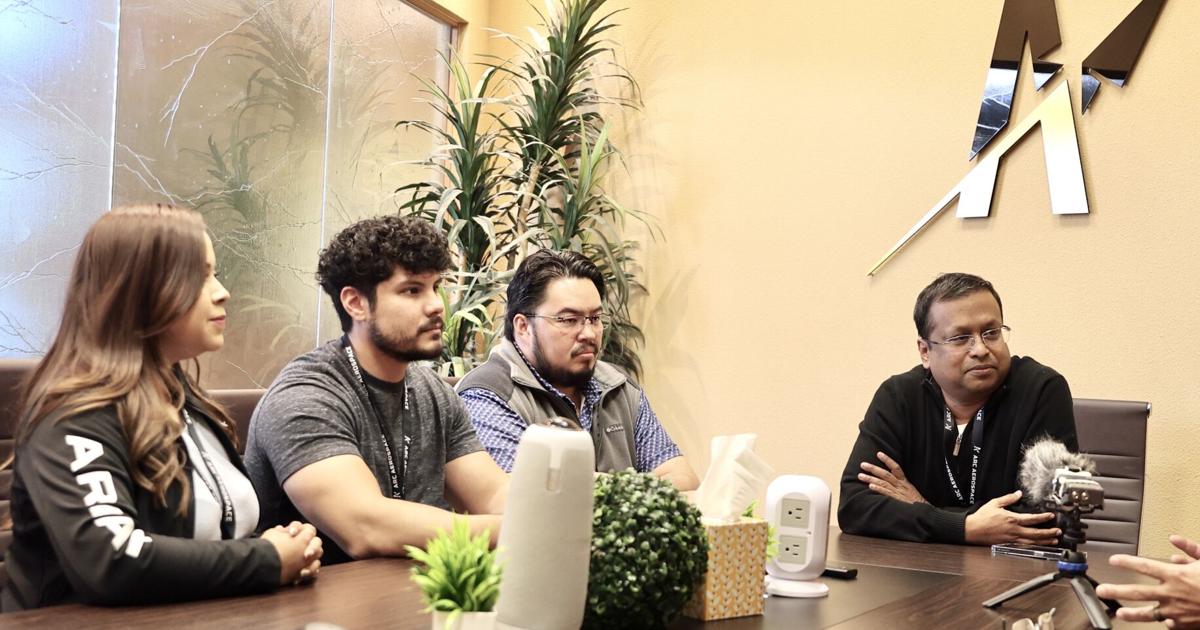
On a recent Monday in a Westside building complex, Ahsan Choudhuri sat at the head of a long conference table with about a half dozen employees who have joined his new venture, an El Paso-based aerospace and defense technology company.
Nearly all of them are in their 20s, have an air of quiet confidence and have been handpicked by Choudhuri for a single quality – indefinable by some, but recognized immediately by the former UTEP aerospace engineering professor.
“The most important vibe that you sense, something that’s special to El Paso, is the work ethic of the community that I grew up in over the last 25 years,” Choudhuri said. “There is no match for that.”
“They don’t have everything given to them. Every little thing in their life, they have had to achieve it,” he added, casting friendly glances at the young people surrounding him. “That’s my students, and that’s El Paso.”
His reference to them as “my students” is more than rhetorical. All except one of his 30 or so employees are either UTEP graduates who were under his academic tutelage or are finishing their degree at the university.
It wasn’t long ago when Choudhuri – the architect of UTEP’s expanded aerospace initiatives – was ousted from his position as head of the school’s Aerospace Center.
Accused of authoring “potentially incorrect statements” on a lucrative National Science Foundation grant, Choudhuri had the integrity of his work publicly challenged – a charge he adamantly disputes – and he was demoted.
Despite Choudhuri bringing major technology grants and gaining support from elected leaders in El Paso, UTEP President Heather Wilson, with backing from the UT System Board of Regents, remained adamant that Choudhuri had to vacate his position as associate vice president of the Aerospace Center.
Since retiring from UTEP in December, Choudhuri has thought deeply on his time at the university, finding pride in the opportunities he made available for students in this historically disadvantaged region.
“I took kids from El Paso ZIP codes and put them into the aerospace and defense industry, as shining stars,” he said.
Choudhuri has primarily focused on building his new company – ARC Aerospace, founded in July 2024 – and has actively avoided making any public comments about his exit from UTEP.
Choudhuri, 54, recently sat down with El Paso Inc. to talk about his new company, his thoughts on leaving the university and his vision to bring El Paso to the forefront of national defense technologies.
Q: How would you describe your new company? What is it doing, and how does that serve national defense?
It is trying to tackle a very complex problem that our nation is facing, and it has two overarching paths.
One is our ability to produce cheap defense systems. These are drones, and these are tactical missiles, both. Unlike those very expensive missiles, our missiles are under $10,000 and will be built in El Paso.
We brought in something that I have been really working on, the digital metaverse.
Everything we do in this company is done first digitally. Everything has a digital “twin” for us. We are pioneers in using digital twin technology and digital infrastructure to produce systems. With our systems, we can produce and make systems digitally first before we ever bend a piece of pipe. That allows us to move faster.
Second, we also built a lot of artificial intelligence capabilities. We’ve been blending the digital twins with artificial intelligence, plus the robotics.
Our robotics are not like other industrial robotics. These are cognitively intelligent robots. It acts like humans.
And do you know what’s the name of my robots? It’s called Diana.
Q: After former UTEP President Diana Natalicio?
We celebrate Dr. Natalicio’s legacy. It’s called the Diana Cognitive.
Q: How is your company funded?
The company is founded with my personal wealth. So I provided all of the initial money.
This company doesn’t take VC (venture capital) funding.
I decided from the very beginning that I would do this differently. At this point, I don’t want any of that external funding. This is funded by governmental work right now, a lot of government contracts.
We have a lot of my own money in the company, initial infrastructure.
Q: Explain the connection between the modern warfighters out in the field and the technology being developed by your company.
Things have changed. The future war will be different. It will be fought with drones. It will be fought with low-cost defense systems, autonomous systems. All the work I have done in the last 25 years, I really need to convert it to support this new war doctrine, something different.
And that’s the birthplace of ARC Aerospace. It is not replacing research and development. We do a lot of technical development, but we don’t do basic research. We only do technological development.
That directly converts to a system that the Army, Marines and all others can use.
Q: When you first started at UTEP in 2001, what was your goal?
The goal was to do something big, something meaningful for all the students around. When I was interviewing, I met a few students and they said, “We want to pursue aerospace. We want to do this, but we have no facility. Come here and help us to do that.”
And then 9/11 happened the same year, and everything was really difficult for me. I had trouble getting funded the first year. At one point, sometime in November or December 2001, I thought maybe I had made a wrong decision. I have no lab space. There’s no laboratory that I can build.
Q: When you started to feel those reservations about maybe making the wrong decision, what was going on at that time?
It was a lot of struggle, not having funding.
At the same time, I had students who were always attached to me, and they showed up in my office, and I said, “I have no money.”
They said, “If you leave, our dream goes with you. You are the only thing we have.”
They said, “You have to promise that you will stay.” And they were convincing, and I said, “I will stay and I will try my best.”
Q: So the program was building up. How did things proceed?
In 2014, I started working with my friend, U.S. Rep. Veronica Escobar. She was concerned that graduates were leaving the region. She said, “You’re graduating them, but they’re not here.”
So I started to get into the economic development work. I got two major grants. Those types of grants never happened in El Paso – the Build Back Better, the NSF engine grant. El Paso never would get those things.
It happened because we told the story about a community that needs opportunity.
Q: Matching technology with El Paso’s economic development, that seemed to be a successful formula. How did that push begin?
That started in 2014. It was mainly pushed by Veronica.
We did a lot of grants together. We got the EDA grant, all of the slow build up, all those things necessary to attract people here.
What Veronica and I primarily worked on was to create the necessary infrastructure and ecosystem here that companies are interested in. In the beginning, I was trying to recruit some big defense contractors. Pretty soon, I realized that that would be a difficult task.
Defense companies, 70% of the things they buy are from the outside, and they integrate, so there’s a big supply chain. So then I realized that if I can build the supply chain here, it’s the same impact.
I started to work with a lot of small and medium-sized manufacturers. All my proposals with the Build Back Better, or NSF, were designed to support local manufacturers, taking them to a level so that they can compete.
And to be honest, they were very, very good at doing that. Using the academic strength that I had, the talent I had here, and unleashing them to support local manufacturers is a recipe that you need to grow this community.
Q: And how successful was that formula?
We were starting to get very, very successful before all those nasty things happened.
Q: You are referring to your demotion from UTEP and leaving the university. How disruptive was it when the UTEP situation happened?
It was disruptive, seriously disruptive, in many ways. It was hugely disruptive for a few months, definitely trying to figure out what was next.
Q: Can you elaborate on what was going on at that time, with the NSF issue?
Most people like me would have just walked out of El Paso and gone somewhere else. But whoever was doing all those things miscalculated my resolve.
When I was doing the NSF grant, there were like three levels of review. First is the written proposal, then the actual site visit, and there are two days’ worth of site visits. You would not know how hard that site visit was.
Every day, they looked at every little thing. They all participated in those site visits. The NSF didn’t give me a grant based on just the proposal. There were three different site visits.
So all that nonsense saying, “Oh, there’s something wrong with the proposal.” There were two levels of review after that, so that bull—- doesn’t go anywhere.
At the end, they took me into a small room and said, “It does look like this idea, this vision, is centered around you. What if you leave?”
The NSF, the lead NSF reviewer. Very simple, plain question, “It does look like you are the centerpiece of it, and if you leave, it falls apart.”
So I told him, “How can I satisfy you that I’m not leaving El Paso?” I called my wife and I said, “Why don’t you send my will?”
So she sent my will, and I told the NSF, “Look what it says. It says that I need to be buried in El Paso. I don’t think I can give you more guarantee than that.”
I told him that “even when I die, I have to be here.” So, I guess we got the grant.
Q: If I can take you back to your frame of mind when the issues with UTEP arose, and your demotion. It seems, correct me if I’m wrong, that you did not anticipate that.
It would be wrong to say I was not anticipating it. There were a lot of issues since the Build Back Better grant.
I didn’t have much support from the leadership. Part of me was very naive to not anticipate that, and that’s my fault.
It was hard for me. I’m an academic. I’m not a politician. This whole thing was handled like a political campaign. You know, going to the media and all the other stuff.
But in the three weeks after that, I decided my mission had not ended.
Q: At that point, you knew you were going to leave UTEP?
Q: So you arrive at that conviction, that your mission has not ended. Your mission then became what?
A couple of things happened. Sometime at the end of May, I sat with myself, after all the initial trauma was over. I sat with myself and said, “What is my first priority?”
My first priority is my students. That’s been the No. 1 priority all my life. I was trying to understand what’s going to happen to them.
Q: How did it feel stepping away from what you built at UTEP?
I was sad sometimes, yes, losing my baby. But I got another baby.
And having all those people come with me, almost all came with me here, I’m much freer to do things I want to. I spend a lot of time with them every day, and so it is the same level of excitement.
Our Defense Department partners are very, very excited. So we are very well regarded in the Department of War circuit right now because of the talent pool we have, and our ability to produce things so quickly.
Q: Talk about the transition from UTEP to the private sector.
It was a good run for 25 years at UTEP. But in the last few years, I’ve also been thinking about how to exponentially increase the impact.
And ARC Aerospace is the reflection of that.