
Hundreds of Dallas residents are engaging with the process of zoning reform as the city pursues modernization of the land use part of its development code. Who said Dallasites weren’t invested in the future of their city?
Over the past few months, the Planning & Development Department (PDD) has been meeting with stakeholders and hosting public engagement sessions to get feedback on its initial code diagnostic, which identified onerous zoning hurdles and outlined some rough recommendations to both simplify the code and implement ForwardDallas 2.0.
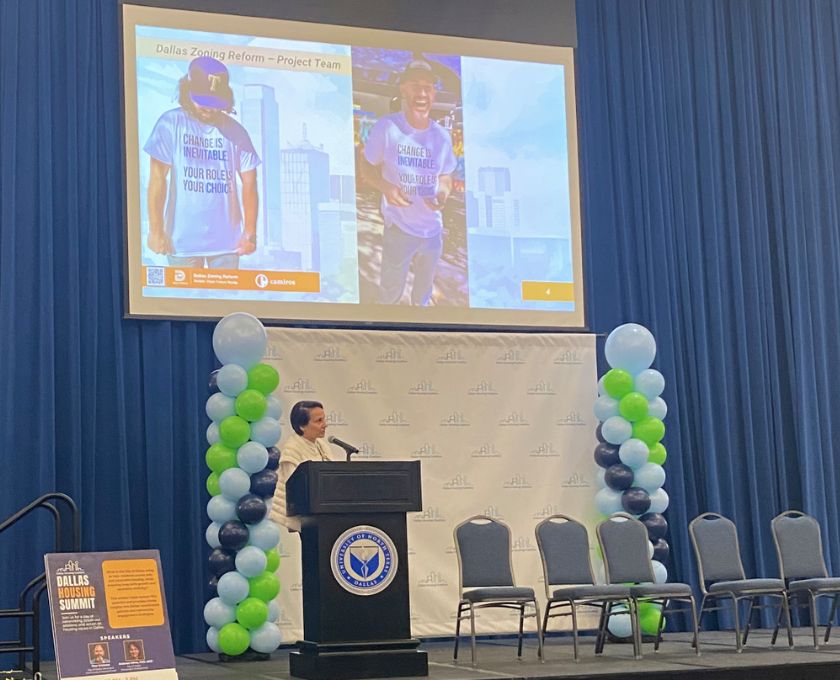 Planning & Development Deputy Director Andreea Udrea at the Dallas Housing Coalition’s 2025 Housing Summit
PDD Deputy Director Andreea Udrea, speaking at the Dallas Housing Coalition’s 2025 Housing Summit on Friday, said that the current code is outdated, having been basically fleshed out in the 1960s and only tinkered with in the 1980s.
She pointed to the proliferation of planned development districts (PDs) as evidence of the need for significant zoning reform.
“[A PD] is something that is its own code. It’s not even the base code,” Udrea said. “It’s something that is so customized that you have to do it in order to make it work because the market is not aligned with the code that is there right now.”
In addition to simplification, officials hope zoning reform will make it easier for developers to deliver “missing middle” housing amid the city’s ongoing affordability crisis.
Recently, PDD published a large batch of written comments it received from residents and stakeholders expressing their thoughts on zoning reform. As one might expect, they reflected the deep divide and tension over how Dallas should continue to grow and what it would mean for single-family neighborhoods.
Some commenters said they were concerned about duplexes, triplexes, or ADUs being introduced to single-family zoned areas, fearing they would alter neighborhood character. They also cautioned against eliminating the residential proximity slope (RPS), which limits how high a structure can be built based on how close it is to single-family residential. The diagnostic suggests scrapping it.
Officials argue that RPS flies under the radar, complicating multifamily and commercial projects for developers who find themselves surprised by the “invisible infinite slope” generated by single-family districts.
“I would bet you money that if somebody wants to do Burj Khalifa or some very high-rise downtown, they would not be able because of RPS,” Udrea said. “It’s hidden out there. Nobody knows of it. It goes back to: we have to have a clear and simple code.”
Critics in the written comment claim RPS should be simple enough for developers to calculate, arguing it protects single-family residents’ privacy and limits light pollution.
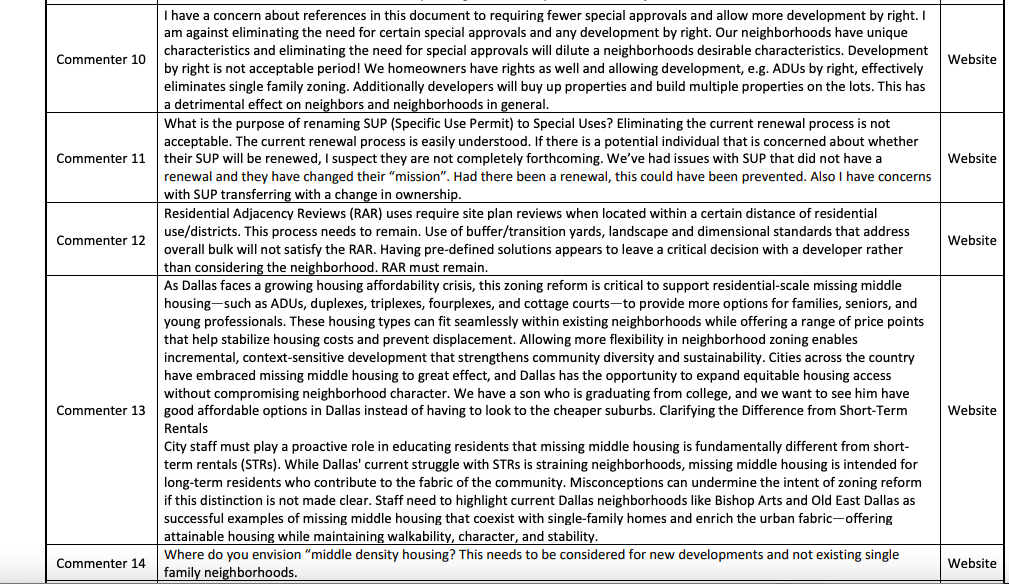 Zoning reform comments. Credit: Planning & Development Department
“This existing rule protects [single-family] zoning from being overwhelmed by large developments. It’s vital for preserving neighborhood character and by giving residents some input when big developments are proposed immediately adjacent to them,” wrote one commenter.
Now, it’s worth noting that many of the comments were in part or wholly copy-pasted. Assuming the commenters are unique Dallas residents, I’d chalk this up to unity of purpose. The most vocal opponents of ForwardDallas 2.0 were deeply skeptical of increased density encroaching on traditional single-family neighborhoods.
Another recurring theme is potentially losing the relative negotiating power of PDs, RPS, and special use permits, which empower officials to strike a balance between the desires of developers and neighborhood residents.
That being said, there were certainly comments speaking to the complicated and prohibitive character of the existing development code and its consequences for housing.
“As a Dallas realtor, I see firsthand how our outdated zoning code limits options for buyers and renters, drives up prices, and makes it harder to build the neighborhoods residents are asking for,” one commenter wrote. “Many of my clients want homes that are affordable, low-maintenance, and close to amenities — but current zoning makes those choices rare or impossible in much of the city.”
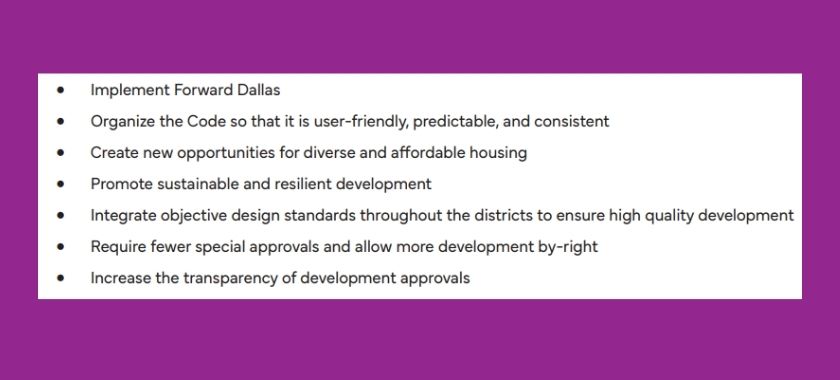 Zoning reform goals. Credit: Planning & Development Department’s Code Diagnostic
Udrea said the diagnostic should be treated as a set of recommendations based on what staff has seen that works in other cities and what needs to be corrected in Dallas.
“I don’t want anybody to think: ‘oh, we have a plan, it’s already written, and we know what to do.’ We don’t,” she said. “This is what we think needs to be done, and now you come and tell us. That’s why it’s so important for [residents and stakeholders] to stay engaged.”
The city will not continue to just patch over the current code — it needs a new one, she said.
“We’re going to write a new zoning ordinance to make it clear, to make sure that we start a new chapter.”