
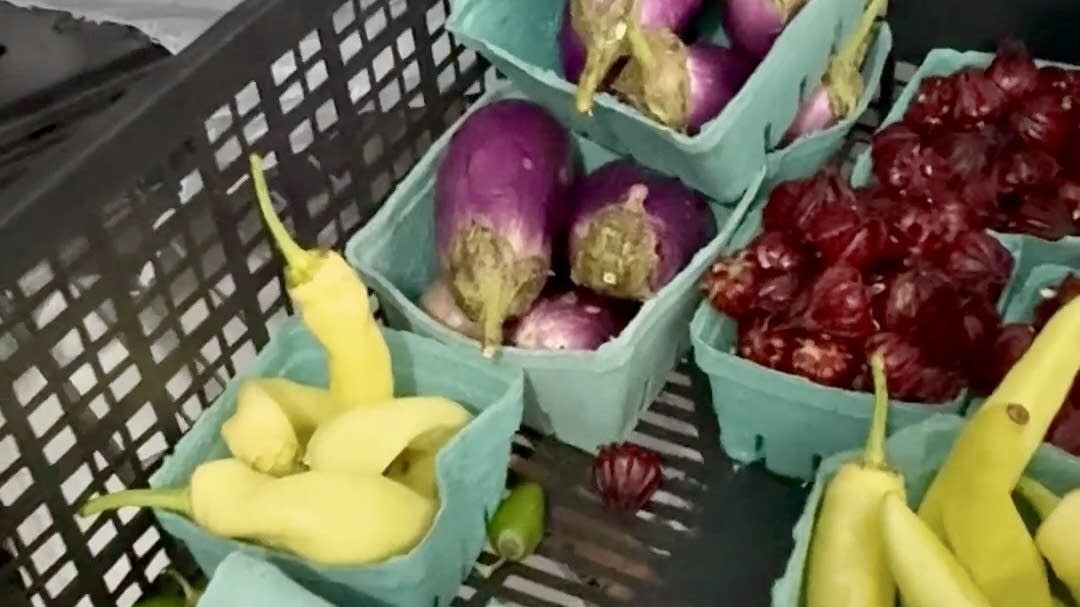
Even on the city’s hottest, most humid summer days, Toto Alimasi is tending to his less-than-an-acre farm off of Highway 90 in southwest Houston. The hot weather isn’t too much different from back home.
“To farm here, it looks like back home — only back home, we have only two seasons,” he said.
Home, for Alimasi, is the Democratic Republic of the Congo. It’s the second-largest country in Africa, located smack dab in the middle of the continent. The country provides much of the world’s cassava, a starchy root vegetable which Alimasi also grows in Texas.
Wearing a bucket hat and red button-down, Alimasi walks among the hibiscus, okra, cucumbers and other plants. He doesn’t mind spending most of his day in the field.
“We cannot feel alone when we are in the bush … we talk with the plant,” he said.
Back home, the agricultural sector provides jobs to more than 60% of the Congolese, though most is subsistence farming — growing food for your own family.
“In Congo, I had cows. I was farming. I was a teacher, and I was (an) activist of human rights,” Alimasi said.
Over the past 30 years, the Democratic Republic of the Congo has been decimated by war that has killed some 6 million people. Conditions remain challenging.
“In that human rights, I have problem. We flew from Congo to Uganda, Uganda to Houston,” he said.
After fleeing his home, Alimasi came to Houston in 2011 through a refugee resettlement program — a program that has since been mostly halted by President Donald Trump.
After arriving in the U.S., Alimasi was connected with a nonprofit called Plant It Forward, which was created to help refugees learn to farm in Houston.
Now, Alimasi runs a farm with his wife. Together they have adjusted to farming the four seasons here in Houston — it’s a full time job for them. While running a small-scale farm isn’t lucrative, it’s been enough to pay their bills.
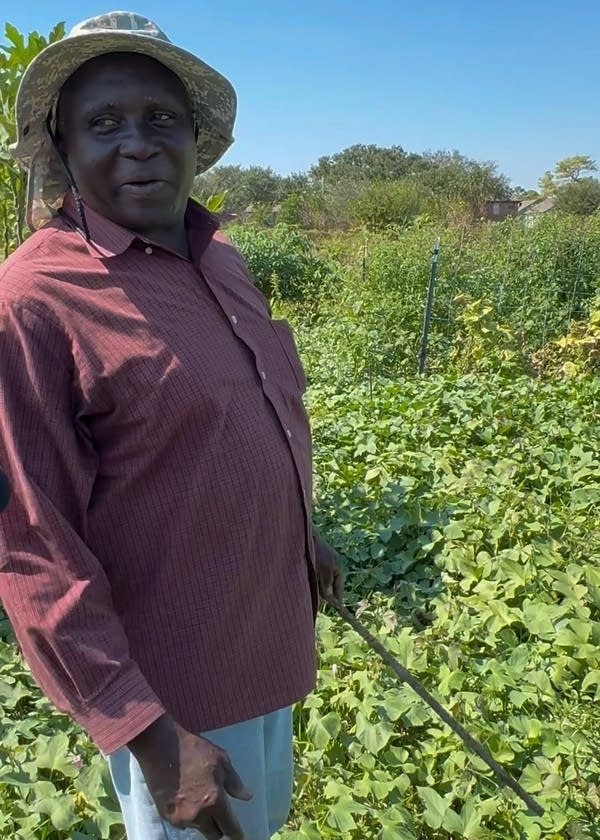
Alimasi and his wife are small-scale farmers in southwest Houston, Texas.
Emily Macune/Marketplace
“We sell to the farmers market and our big customer is Plant It Forward,” he said.
Plant It Forward buys a lot of produce from Alimasi and other refugee farmers, and sells it to wholesale purchasers, like the Houston Food Bank.
But this year, the Trump administration ended the Department of Agriculture funding that food banks used to buy produce from Plant It Forward’s farmers and other local, small-scale growers. It has left food banks with less produce — and farmers like Alimsasi without buyers for their crops.
It’s a problem that’s top of mind for Plant It Forward’s CEO Nirjhor Rahman. The nonprofit is undergoing a major overhaul right now to help keep farmers like Alimasi in business. Demand for Plant It Forward’s food box program has dwindled since the pandemic. Then food banks lost the funding to buy from local farms, which is how Plant It Forward was able to sell up to 70% of their wholesale produce.
“Unfortunately, that program was supposed to get renewed, it didn’t get renewed, and so that’s been kind of a scramble to replace it,” he said.
Historically, Plant It Forward’s farmers worked independently. The nonprofit would buy from farmers and offer support, but the organization wasn’t always strategic or centralized about maximizing revenue as a collective. Now, it’s looking for new buyers and shifting to a more cooperative model.
“Can we come together and can we prioritize which produce to grow based on what the market demands are?” Rahman said. “If one farmer is very good at one particular crop, let them do more of that and let the other farmers do less of that.”
Plant It Forward is also trying to expand their educational mission beyond refugees, working with schools and formerly incarcerated people. And they want to help farmers get special certifications that would allow them to sell to new buyers, like cafeterias.
Houston-area chefs are another potential market for Plant It Forward farmers. Board member and Trinidadian chef Keisha Griggs has been buying from refugee farmers for years. Previously, she created a dinner series called Black Chef Table, which featured meals by Black chefs and growers.
“So all the food, the meat, the honey, the eggs, came from African American farmers or immigrant farmers that are located here in the city, and chefs from all over the country came in and we did dinners,” she said.
That’s when her relationship with Plant It Forward took off.
Every week she’d shop around for fresh ingredients from farmers. She did pay a little more for the produce, but she said the real challenge was being able to regularly find the amount of vegetables she needed that week.
“It was the accessibility and the consistency”, she said. “I don’t know I can get it on every Tuesday my five pounds of whatever.”
She was able to make time to shop from different small farms each week for her Black Chef Table dinners. But that’s not realistic for most chefs.
“When you’re running a business, you don’t have time to do that,” she said.
That’s why it’s critical Plant It Forward becomes more strategic about what their network of farmers grows: so they can offer the quality and quantity a restaurant needs.
“Having the consistency to that model is where that process will shine,” Griggs said.
Now she’s asking industry peers to try working with farmers more intentionally. At a recent meeting of Houston chefs, she pitched Plant It Forward farms as a place chefs can source things like herbs for mocktails.
Griggs said chefs were interested — if the farmers can deliver the produce consistently.
She said she’s hopeful more of the food that makes up Houston’s international culinary scene can be grown locally. But organizational change and growing food ecosystems takes longer than a harvest season and farmer Toto Alimasi has produce he needs to sell now.
This year, he can’t count on the food bank. He fears what this means for his business.
“If the food bank cannot come back, we are afraid of how we will continue. Because the food bank was our bigger customer for our product, the market cannot finish it all,” Alimasi said.
He’s not sure what he’s going to do — he’s not selling enough produce right now to cover his mortgage.
“Now we suspect if the food bank cannot come, we are losing our time,” he said.
Related Topics