
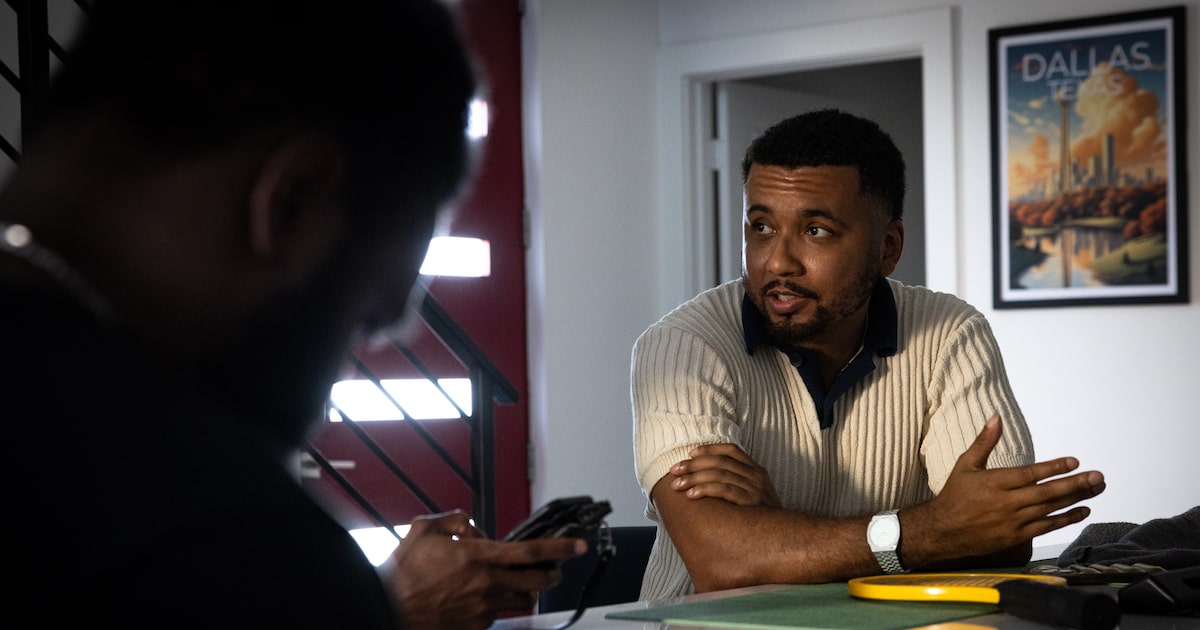
On Merlin Street, duplexes have taken root in a South Dallas neighborhood once called Jeffries-Meyers.
The homes here are modern and owned by 30-something residents, all first-time homebuyers.
They’re young, live near Fair Park and are minutes from downtown. They’re also emblematic of the obstacles to affordable housing in Dallas, particularly on the south side. The neighborhood is part of a city program that aims to sell land to developers at a discount, allowing them to build and sell homes at a price the average resident can afford.
While the new residents are achieving their dream of homeownership, they face myriad problems, including those stemming from inadequate infrastructure and zoning issues in southern Dallas.
Political Points
In David Awonaike’s home, ceiling lights flicker every time a faucet is turned. For Wesly Bienaime, an issue in a land survey has led him to move his fences not once but twice after two separate neighbors said his property line was inches onto their property. The exercise cost him nearly $2,500 per move.
Linoshka Rivera, 28, who lives across from Bienaime, had issues with flooring throughout her home, and this came after a nerve-wracking period when the Dallas County Appraisal District sent her a tax bill that covered both units in the duplex she lives in.
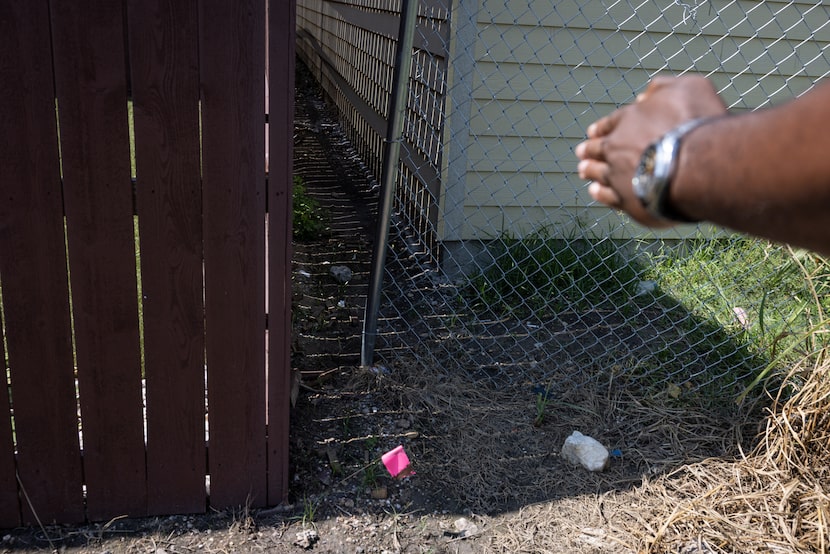
Wesly Bienaime explains that he had to move his backyard fence about 6 inches inward to comply with a 2.7-foot easement at his newly built South Dallas home on Sept. 8, 2025. Bienaime said the fence was built outside of the property boundaries and he was forced to remedy the issue after disputes between the builder and warranty company.
Angela Piazza / Staff Photographer
Bienaime, who moved to Dallas from Boston and saw his home’s proximity to downtown and Deep Ellum as a smart investment, had puffy floorboards after water seeped in and a backyard that flooded every time it rained. He blamed not only the builder but the city’s lack of oversight. To add insult to injury, a neighbor behind his property is building a massive home a hair’s breadth away from his own.
“And Dallas let him,” Bienaime said, referencing the area’s zoning.
The homeowners have been back and forth with the developer, Scottie Smith II, who said he’s committed to fixing the issues he can, but there are pending infrastructure issues in the neighborhood, and he’s trying to get to the root of the problems. Smith is working to convert 16 vacant lots in the community into affordable housing for homeowners who fall in the realm of 80% to 120% of the area’s median income.
For five years, Smith, who has grown into a community leader, has faced his own challenges while pushing the city to invest in a neighborhood once called the “worst neighborhood in America,” according to The Dallas Morning News’ archives. The foremost concern is suspected issues with Oncor’s power lines and small transformers, which Smith says are causing electrical issues in homes.
In February, The News reported the city was slow to approve documents that could help Smith finance and complete his projects. Smith is part of a strategy deployed by cities across the country — partnering with nonprofit developers to build affordable housing where other private developers would not go.
It’s harder to raise capital for developing vacant land in historically underserved communities. There could be unknown development costs related to missing sewer and water lines, as well as contamination remediation.
Thor Erickson, director of housing and community empowerment, told The News in September that officials had been working with Smith to finalize the remaining financial documents.
“We should ultimately anticipate finishing up our phase of the project by April of 2026. It’s not the ideal situation, considering we’ve been at this and waiting around for quite some time,” Smith said in a recent interview.
But in the time Smith spent waiting for legal documents and pushing to complete his project in the past year, Awonaike, Rivera and Bienaime moved into new homes on Merlin Street. All are stakeholders in a collective frustration of growing a neighborhood that’s been waiting for change.
Issues abound
Awonaike, 32, who purchased a home in September last year, and Rivera, who was the first to move to the street, bought homes on property sold by the city to Smith and his nonprofit, Dallas Housing Foundation, through its land-transfer program.
Since the development also received federal funding incentives and has requirements to ensure the city contributes to the production and maintenance of affordable housing, residents who qualify for the homes must maintain their homestead for a period of time, or they have to repay the loan to the city.
Awonaike, who’s in the real estate business himself, said he noticed issues within the first week. After a thunderstorm, his roof started leaking. He contacted Smith, who fixed it, but it’s the ongoing electrical issues that have challenged Awonaike’s faith in the developer.
“That could be like a safety hazard, right?” Awonaike asked amid flickering lights as he turned the faucet to get hot water.
Smith said he had been playing phone tag with Oncor representatives for months. In a recording, Smith can be heard pleading with an Oncor representative to send help to the neighborhood as homeowners’ frustration mounted.
“As the leader of the company, everything falls back on me,” Smith told The News. “I recognize that I’m the face of the organization. Nobody knows any of the contractors that we hire to do certain things,” he said.
Smith said it was hard for him to know the types of issues his buyers had because he wasn’t privy to all the conversations his contractors had with the residents.
“When they started testing things, those issues weren’t happening,” he said. “It’s not until a buyer moves in and actually starts to utilize those systems in everyday fashion that we recognize, OK, there might be something bigger going on, which we did find out that there was something,” Smith said.
Smith believes the flickering issues at Awonaike’s and his neighbors’ houses were caused by Oncor’s power lines and transformers, which were unable to handle the load from additional development. City officials, too, said they were aware of issues with Oncor’s utility lines.
“We have Oncor come and check the meters. They say the meters are fine. Then we have to take it a step further and go to the power lines or transformers. That’s what we did. But when you have an issue like that, what happens is people get frustrated,” he said.
Oncor officials, meanwhile, say there’s nothing wrong with their equipment. “Our team was aware of the issues reported by the customers within that community. They have also been responding directly to many of those customers,” Oncor spokesperson Kerri Dunn said.
“Ultimately, we have thoroughly investigated our equipment, and we’ve determined with really high confidence that we’re not currently experiencing any issues on Oncor’s point of delivery.”
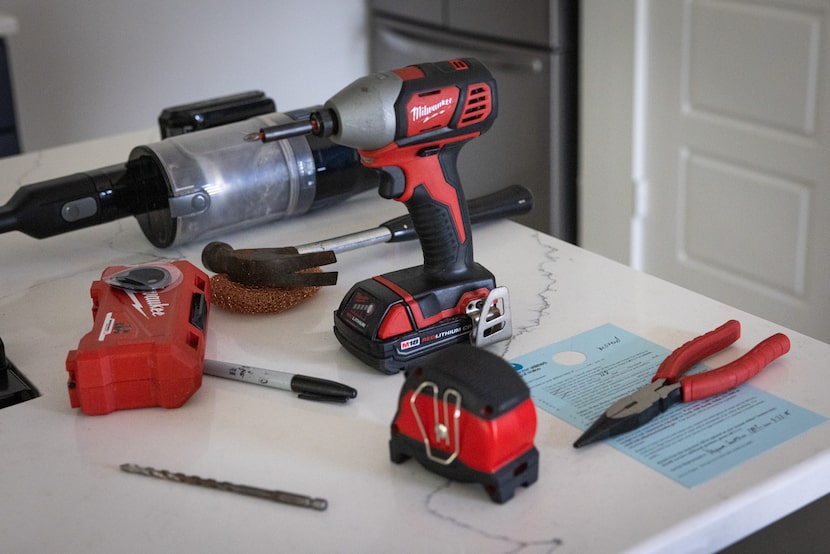
Tools rest on Wesly Bienaime’s countertop in his newly built South Dallas home on Sept. 8, 2025. Bienaime said he’s had to remedy multiple construction issues with the home like replacing vinyl flooring that became warped after rainwater flooded his home.
Angela Piazza / Staff Photographer
But none of this has brought comfort to the homeowners. Bienaime, who said the group of residents considered seeking legal advice, wanted his community to grow. Meanwhile, Rivera feared the setbacks she experienced may deter other prospective residents from giving Jeffries-Meyers the chance it deserves.
“We want to be able to move on with our lives, and not really have to deal with all of these issues,” Bienaime said.
Erickson, the housing director, told The News in September that housing inspectors conduct a final review in order to release the dollars promised by contract. “Separately, the City’s Building Inspections Department provides the developer a Certificate of Occupancy (CO) for each home,” he said in a statement listing the ways the city checks for quality.
The road ahead
Unlike other developments across the city, Jeffries-Meyers is unique because the project is not just a collection of one-off lots within a neighborhood. Drug houses, violent crime and poorly maintained apartment complexes plagued the neighborhood in the 1980s.
The city eventually demolished the worst offenders, and today the area is a large expanse of mostly vacant parcels either privately owned or sold through the city’s land-transfer program, which sells tax-foreclosed properties for less than market rates.
The neighborhood sits close to Fair Park, nestled against a DART railroad yard, and borders the Martin Sprocket foundry, which makes mechanical parts.
“For this price, you can’t get all your check boxes crossed,” Awonaike said. “I didn’t like the fact that there’s a bridge behind my house and there’s this little industrial area, but this is my first house. This is a start. I can deal with this. I’m young; I don’t have kids.”
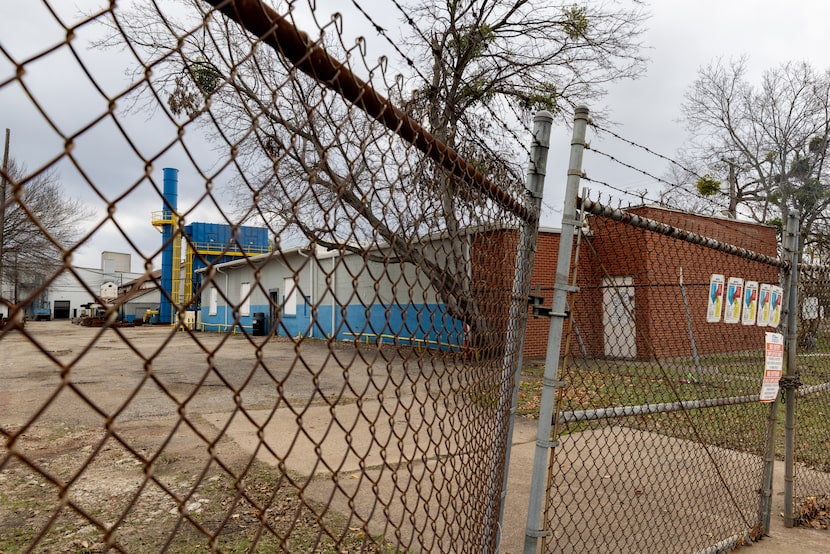
The Martin Sprocket & Gear foundry is seen in the Jeffries-Meyers neighborhood of Dallas on Dec. 24, 2024.
Azul Sordo / Staff Photographer
Still, heavy-load trucks barreling down Jeffries Street prompt questions of what the foundry’s adjacency to potential homes could mean for the residents who are starting to show up in the neighborhood. ForwardDallas, the city’s land-use guide, sought to prevent residential and industrial development from occurring next to one another to reduce potential health risks.
In 2021, years before any of the homeowners set their sights on the community, the city began an initiative to revitalize the neighborhood. Officials removed the homeless encampments in the area and greenlit a new environmental study. The study still needs a final review, but city officials said it was almost complete.
Ken Smith, part of the Revitalize South Dallas coalition, questioned why it has taken the city nearly six years to encourage housing in the area. He said community developers and residents could benefit from appointing someone to manage the project.
A team or an individual could oversee all the departments involved in revitalizing the area, Smith suggested. The housing department is charged with overseeing the construction of the homes. The Office of Environmental Quality is working to assess the environmental conditions of the neighborhood. Code compliance is also on the lookout for possible violations.
“And that’s what happens with all these projects. You get a golden objective. It has to go through eight departments. Who’s in charge?” Ken Smith said.
Dallas does not have enough affordable homes to drive down costs. While the greater Dallas-Fort Worth area has added nearly a million new residents over the last eight years, the city’s housing supply has only grown by 5%, according to a housing needs assessment released in September last year. City officials said more than 7,700 homes, most in southern and central Dallas, could see deed provisions to maintain affordability expire by 2033.
Smith, the developer, also led the creation of the South Dallas-Fair Park area plan to protect the neglected area and its longtime residents from displacement. Now, he is trying to help grow a new planned development district through community input.
The tensions are not lost on him. The buyers of his initial homes are not happy with the continuing issues. Residents in the newer properties he’s sold do not have the same issues, Smith said, but he’s pushing through. Smith said he’s not going anywhere.
When reached in November, Smith said he had let go of contractors who had contributed to the issues.
“One of the realities is buyer’s remorse,” Smith ruminated. “Did (the issues at homes) happen? Yes. Are we apologetic about it? Absolutely. Are we going to address it? Yes, because these are the types of things that people who are growing a business, who are growing in the community, that’s what they do.”