
When people think about affordable housing, what often comes to mind is housing subsidized by federal or local programs. The reality is that subsidized housing typically makes up a small share of what people can afford.
Around 75% of affordable rental housing nationwide is considered naturally occurring affordable housing, or NOAH, according to Geoff Smith, executive director of the Institute of Housing Studies at DePaul University. These are rental units that are affordable for any number of reasons: age, location, condition or even because of the altruism of a landlord.
In Dallas, that percentage in 2022 was 80%, according to the Child Poverty Action Lab, a local nonprofit focused on increasing economic mobility in the city.
But it might not stay that way for long.
Breaking News
Dallas is facing an affordable housing shortage — one that will likely only become more acute because market pressures are decreasing the number of NOAH properties available. Once affordable homes are now out of reach for many renters.
NOAH is, by definition, not rent or income restricted, so it is vulnerable to pressures such as gentrification. If a landlord sees that their neighborhood is becoming desirable for higher income people, Smith said, they might choose to raise rents. Or, he continued, long-term owners of units that have been affordable for the last several decades may choose to sell their properties to institutional owners such as private equity firms, who might remodel and increase rents to generate additional profits.
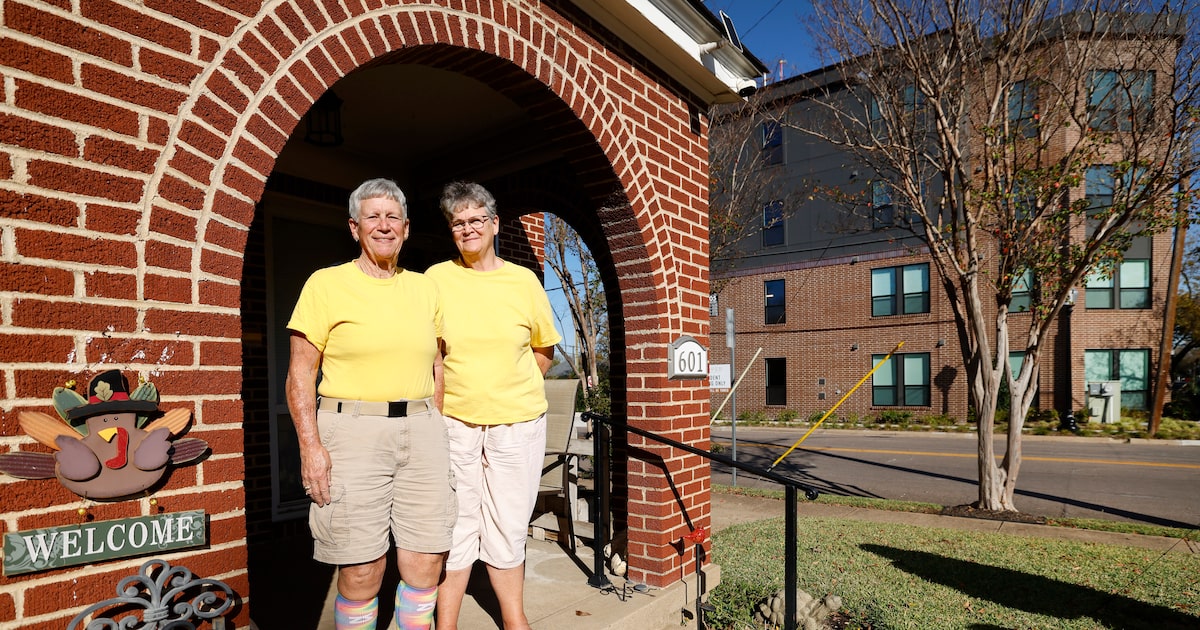
Owners of NOAH tend to be smaller, family-owned businesses. In the Bishop Arts area, a local family — the McDonalds — had owned and operated apartments for close to a century, with some of them being passed down through the generations. Many of the properties they had owned, such as a series of apartments on the 500 block of West Eighth Street, were considered NOAH.
“Our relationship with residents was very close, simply because we lived right there; they could reach us at any time for any problems.” Ninette McDonald said. “And many of them were very very long term, so we got to know them quite well. We didn’t raise our rents very much either; it just didn’t seem right, so people stayed a long time.”
Growing up, McDonald said she and her siblings were trained by their father in everything from building, painting, pouring concrete and roofing. They didn’t hire any jobs out. These days, McDonald said, this is no longer the reigning business model.
“There are very few people, individual owners who have maybe one or two properties and have had training to learn how to do that, but people, I’d say 40 and under, have no concept on how to pour concrete or lay sheetrock and texture it and paint it and all that,” she said. “So they end up hiring out and that drives their prices up.”
Ninette and her sister Marguerite sold their properties in 2016, after a lifetime of work in the industry.
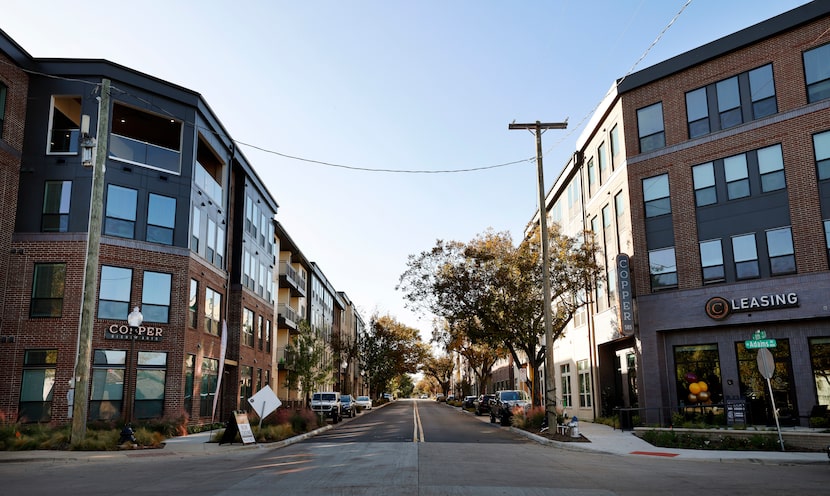
The Copper Bishop Arts apartments line W. Eighth St between Llewellyn and Adams, Dallas, November 21, 2025. Sisters Ninette and Marguerite McDonald sold their aging family apartments in 2016, which were recently redeveloped into the Copper.
Tom Fox / Staff Photographer
After properties that were once considered NOAH have raised their rents, Smith said, there is not a good mechanism to create new affordability in the same neighborhoods without significant levels of subsidy because land and labor is so expensive.
Dallas could lose 98% of its NOAH properties by 2035, according to CPAL. Finding ways to preserve it before it becomes subject to market pressures is critical, though state and local tensions are making this increasingly difficult to achieve.
The state of rental affordability in Dallas
Forty percent of Dallas renters make up to 50% of area median income (an average measure of income that accounts for household size). That means the city needs to offer 115,000 affordable units to meet this population’s demand, per an upcoming CPAL report on rental housing needs. Dallas has 69,000 units that are affordable to these residents, meaning it is 46,000 affordable units short.
Last year, CPAL reported that this number is projected to increase to 76,000 in the next decade, driven primarily by the loss of NOAH.
The result, said Ashley Flores, the Chief of Housing at CPAL, is that many people will be “overspending on housing to keep a roof over their head.”
In 2024, about half of Dallas renters were housing cost burdened, meaning they spent more than 30% of their household income on rent and utilities, according to U.S. Census data. Over the last two decades, the overall proportion of all Dallas renters that are housing cost burdened has remained relatively constant.
The day-to-day impact of being cost burdened is vastly different depending on how much a household makes.
Dallas’ lowest income households spend the majority of their income on housing, said Flores. On average, she said, an extremely low income household of four, making about $31,000, spent 78% of its income on housing in 2023.
“They’re left with about $567 a month to cover all their other expenses — food, health care, diapers, child care, and so on,” Flores said. “So folks have a home to go to, but they might be spending much more of their budget on housing than they would, than they should be, or would like to be, you know, given their other expenses.”
For a family of four with two adults and two children, $567 was enough to cover less than a fifth of monthly spending on necessities such as food, transportation, child care and medical care in 2023, according to the MIT Living Wage Calculator. Cost burdened households face not only economic hardship, Flores said, but also mental health distress.
“We know that distress can have a detrimental effect on children,” she said. “Long-term exposure to housing cost burden for kids is associated with lower academic achievement or behavior challenges.”
Related
 What needs to change?
For Flores, one of the most critical issues facing the rental market in Dallas is the preservation of affordable housing units. This includes both subsidized housing and NOAH. In the last half a decade or so, Flores said, NOAH has become particularly vulnerable given the trend of increased rents in the city.
It was this problem Smith’s team at the Institute for Housing Studies looked to help policymakers take on last year with their Preserve NOAH project. The team conducted a clustering analysis to group the largest metropolitan areas in the nation together by how similar their housing markets were. It was the team’s goal, Smith said, to inform policy conversations across the country by giving local housing advocates information on NOAH preservation programs.
“There are a range of different market conditions that really are important to understand in order to inform the development of strategies that might be responsive to these markets,” Smith explained. “The strategy in Chicago may not be useful to someone in Dallas, because the housing stock is very different.”
The team’s analysis placed the Dallas-Fort Worth metro’s low- and moderate-income housing market in a group of cities characterized by their recent new development and large recent declines in the share of rental units that were affordable.
Available on the Preserve NOAH website is a database of programs working to keep NOAH affordable across the nation. Two organizations in Charlotte and Austin, which have housing markets similar to Dallas-Fort Worth’s, are employing a surprising strategy to preserve NOAH in their communities: social impact private equity funds.
‘Show up to the knife fight with a knife.’
Social impact private equity funds — backed by private investors — operate like traditional private equity firms, but with one key difference: They keep rents affordable, even while prices in the surrounding neighborhood are going up. Armed with the speed and discipline that the private sector is known for, these social impact private equity funds can compete with institutional investors to purchase a NOAH property right when it goes on the market, on a timeline that local government and nonprofit organizations can rarely meet.
“Dallas and Charlotte and Nashville have literally been one of the most popular real estate investments in the last decade,” said Mark Ethridge, co-founder of Ascent Housing, which runs a social impact fund in Charlotte. “You’re competing with everybody, and you have to really be able to show up to the knife fight with a knife, so to speak, to get the deals done, and that’s what we’re able to do.”
Once these social impact private equity funds buy NOAH properties, they then use tools such as property tax exemptions and deed restrictions to keep NOAH affordable. Investors earn modest, single-digit returns on their investments, over a much longer time period than traditional private equity.
“Every dollar we raise is used to preserve affordability for working families, teachers, first responders, and others who earn too much to qualify for subsidized housing but can’t afford market rents,” said Monica Medina, president and CEO of the Texas Housing Conservancy, a social impact private equity fund with properties in Austin and Dallas. “Unlike traditional private equity funds that buy, reposition, and sell properties for short-term gain, our fund is designed for long-term stewardship.”
Because social impact private equity funds offer returns on investments, they can be an attractive option for institutions that want to — or need to — give to social causes.
Investors in TxHC’s fund tend to be banks, foundations and mission-aligned institutions, Medina said. Banks and foundations, according to Ethridge, are full of “untapped potential” for the philanthropic world.
Without public subsidies such as property tax exemptions, social impact private equity funds just can’t work. They require the cooperation of public institutions.
In the state of Texas, this cooperation is increasingly difficult to come by, according to David Ellis, who heads the TxHC’s acquisition efforts in D-FW. Texas House Bill 21, which passed in May 2025, established more stringent requirements for organizations looking to receive property tax exemptions.
The state’s goal was to curb exploitative practices where developers would receive full property tax exemptions yet provide “no rent reductions, local approval or community benefit,” per a Senate press release. But the bill has made it more challenging for organizations like the TxHC whose goals are to preserve, not necessarily create, affordability to execute their preservation strategies.
In Dallas, NOAH preservation also faces hurdles. As compared to Austin, where the TxHC’s work started, Ellis said, Dallas is less receptive to deals that would reduce their property tax revenue. The city’s focus, he said, has instead been in creating new affordability by building new units or rehabilitating existing housing.
If new developments receive property tax exemptions, Ellis said, the optics are that “you’re not taking that much off of the tax rolls,” since the land they stand on would have been vacant otherwise.
Private equity is not the only solution to the city’s affordability shortage — and it isn’t the whole solution. Building more housing that is not necessarily meant for low-income renters can also help reduce upward pressure on NOAH, according to Alex Horowitz, the director of the Pew Charitable Trust’s Housing Policy Initiative. Housing, he said, “works like an escalator.”
“When more housing comes online, those higher income residents can move out of middle income neighborhoods, back into higher income neighborhoods,” Horowitz explained to attendees of Dallas’ second annual housing symposium. “Those middle income residents can move out of low income neighborhoods back into middle income neighborhoods, and, all of a sudden, low income renters who were being displaced, who were being pushed into homelessness, no longer have to compete for their own homes.”
Despite the potential of new development to help curb NOAH loss, Ellis said that “the tools that the city of Dallas has to carry out an affordability preservation strategy for NOAH properties have been dramatically impaired.”
In August 2025, Dallas’ Department of Housing and Community Development merged with three other departments to become the Office of Housing and Community Empowerment — a move that cut $6.2 million off the city’s budget. Several months prior, the city had launched the Housing Action Plan, which outlined specific strategies Dallas would undertake over the next five years to address its affordable housing shortage.
The action plan had identified specific areas across the city with historic disparities in investment to focus its support, primarily in council districts 7, 4 and 8. This includes neighborhoods such as South Dallas, The Cedars, Cadillac Heights and University Hills.
The plan included preservation as one of its key pillars, with a goal to preserve affordability for 6,450 housing units — subsidized and unsubsidized. It also included targets to form partnerships with non-profits and other organizations across the city, work with landlords who own NOAH and to actively monitor NOAH properties for threats to affordability.
The city said it is reevaluating this plan in the wake of the merger.
Ultimately, the purpose of private solutions such as social impact private equity is to buy time for the government to catch up, Medina said. While Dallas works to balance departmental restructuring with its commitments to provide its residents decent and dignified living spaces, private initiatives can help keep existing affordable units in the market.
“The future of affordable housing,” Medina said, “isn’t purely public or private. It’s collaborative, blended capital models that align incentives across sectors.”