

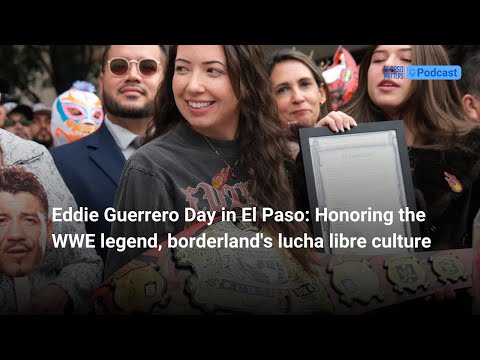
How the legacy of El Paso icon and WWE champion Eddie Guerrero lives on
Diego Mendoza-Moyers: It’s the early 2000s, and a red sports car pulls up to the Don Haskins Center in West El Paso.
Emerging from the vehicle is Eddie Guerrero, the former superstar who, at the time, held the U.S. WWE championship belt, as he parades down the steps of the arena while adoring fans cheer intensely for the hometown hero.
For many who have any sort of ties to El Paso, the moment still evokes some level of pride, even 20-plus years later. Here is the Don Haskins Center, a cherished but modest arena, hosting a world-famous wrestling champion in his hometown before facing off with a young John Cena, who would later become a worldwide star in his own right.
That was in August of 2003. Just over two years later, Eddie Guerrero died suddenly – and tragically – in Minneapolis at 38 years old.
Almost 20 years later, the city of El Paso proclaimed November 18 as “Eddie Guerrero Day.”
City Hall was packed recently with Guerrero’s family and fans, some of whom were wearing lucha libre masks and others holding wrestling memorabilia. But everyone was beaming with pride in the packed city hall chambers over the celebration of one of El Paso’s biggest stars and sources of inspiration. And Guerrero’s legacy lives on, as the city’s lucha libre scene persists with the help of other local wrestling stars, like Cinta de Oro.
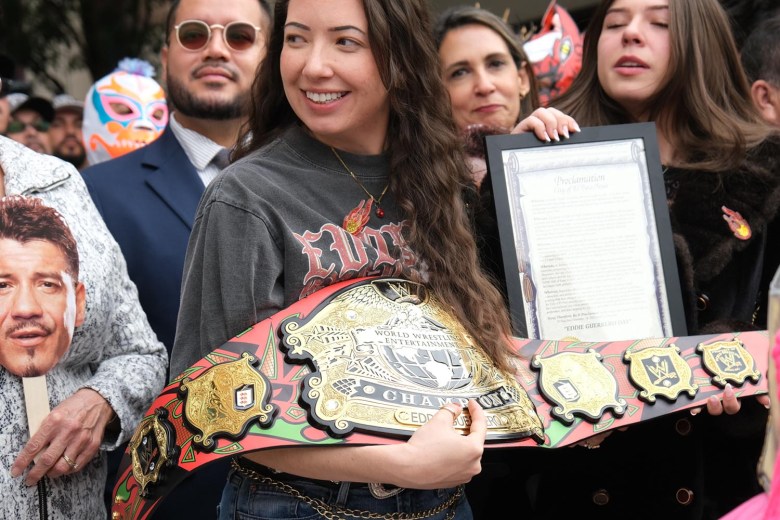 Sherilyn Guerrero, daughter of Eddie Guerrero, holds her father’s World Wrestling Entertainment championship belt. (Brandy Ruiz/El Paso Matters)
I’m Diego Mendoza-Moyers, a reporter with El Paso Matters, and in just a moment, I’ll be joined by Pablo Villa, El Paso Matters assistant editor and WWE superfan, to talk about Pablo’s profile on Eddie Guerrero and about the broader wrestling scene in El Paso today.
Before I talk with Pablo, I want to mention that this El Paso Matters Podcast episode is brought to you by our podcast title sponsor, Tawney, Acosta and Chaparro, truck crash and injury attorneys. Their team of local, seasoned trial attorneys are ready to help if you’ve been injured in a crash.
We’re also sponsored by the Greater El Paso Association of Realtors. If you’re looking for a realtor or for a property to buy or rent, visit elpasotx.com.
And you can sign up for our free newsletter and read our reporting on lucha libra and a lot of other topics at our website, elpasomatters.org. And while you’re there, you can also sign up for the inaugural El Paso Matters 9.15K run on December 7. Registration for the run is open through December 6th.
Now, onto our conversation.
Pablo, thanks for taking some time to talk with me.
Pablo Villa: Pleasure to be here, Diego. Thank you for having me.
Diego: So, I thought this is a really well-written story on Eddie Guerrero and sort of the broader culture of wrestling and lucha libre in El Paso, and you talked to a lot of people for it. So, I want to ask you a few different things, but just to start, curious what it was like at City Hall on the proclamation of Eddie Guerrero Day, and just curious how this all came together, I guess?
Pablo: So, I’ll talk about the City Hall event in a moment. But, if I may, I want to take you back a little bit to my childhood, right?
I grew up in the 1980s down in Segundo Barrio. And some of my most cherished memories are of walking over here to the civic center with my older cousins to watch WrestleMania events, right? We watched WrestleMania III, that was the Hulk Hogan-Andre the Giant event. We watched WrestleMania IV, that was Macho Man Randy Savage beating Ted DiBiase for the heavyweight title.
So, those are just things I enjoyed as a kid, right? At the same time, being from El Paso, we also got to watch a lot of lucha libre events, right? And in those days, that’s long considered the golden age of WWE, or what was known as WWF back then. And I think wrestling looked much different, right, whether you’re watching it on the big screen here at the civic center or in the mats over here in the parking lots down in Segundo where we used to go. On the one hand, you had the WWF, which featured these really big, burly dudes, your Hulk Hogans, your Macho Mans, your Ultimate Warriors, who were big and impressive and performed these feats of strength in the ring.
But when you go to these lucha libre matches, they look far different, right? There’s a lot more athleticism involved, a lot more acrobatics, a lot more high-flying antics, those kinds of things. So, that’s sort of the interesting dichotomy I grew up with when it came to wrestling, right? And I enjoyed both sides of it. As I got older, you could see that, I guess, those things started to merge a little bit more, at least in terms of athleticism, right? The WWE wrestlers suddenly started gaining more athleticism. They started doing more high-flying things. And you fast forward all the way to this year, to 2025. In the spring, the WWE acquired Triple-A, which is the Triple-A Lucha Libre in Mexico, right? It’s sort of their largest lucha company.
And I think what that represents is the fact that the Mexican influence, or the lucha libre influence on the WWE has come to a point where they just want to – they want that to be a part of what they do, right? They want that to be part of their identity. I mean, I just think that represented a really cool moment for us to sort of take a look at what lucha means, not just to this community, but to the world at large, right?
And, so, that’s kind of really what was the impetus for this story. And I started looking into it, and it just so happened that this was the 20th year since Eddie Guerrero’s death. And when the announcement was – and they’ve been working on it since the summer, and I can get into that in a little bit – but when the announcement came that they were going to have an official proclamation, it just gave me sort of the perfect reason to really delve into this, right?
FAMILIA AND FANS: Eddie Guerrero’s legacy lives on as El Paso prepares a citywide tribute
And, so, actually being there at City Hall for the proclamation was really special because you saw fans of all shapes, sizes, age groups. It was just really cool to see them all come together and really support an El Pasoan who really made a big name for himself, but also someone who, yes, in the ring, he sort of had his character that was just outlandish and, cheated and lied and all those kind of things to get ahead. But at his core, he was just a really consummate gentleman, right? And I mean, I got to meet him a couple times back when I was coming up in college and all those things. But, to a man, like, when you hear people talk about their experiences with Eddie, everybody says that he was just a really kind-hearted, humble, caring individual who carried himself with a lot of class and was always willing to give any El Pasoan a moment, right, for just to spend with him and just enjoy, right?
So, going to City Hall for that proclamation was just cool to see so many people that had those same experiences with him. And they all got to celebrate him, right, for one day. And it was really special to have a couple of his family members there, particularly his two daughters. Well, he has three daughters, but two of the daughters were there. And to share in that moment. And both of them exuded just, really, they were really, their hearts were warmed, right, by the outpouring of love that the community gave them. So, it was really just cool to see. It was just the, for me, it was the perfect culmination to this story that I worked on.
Diego: Yeah. And it seemed like it was jam-packed with all sorts of wrestling fans and fans of Eddie and family and all that kind of stuff, right? I don’t think I’ve ever seen the city hall that packed, so it was kind of interesting to see this big spectacle to honor Eddie.
Pablo: Yeah, I mean, as you mentioned, there were hundreds of people there easily. I mean, and normally, as you’ve been to City Council meetings, when there’s proclamations, they usually call in the group to take a picture in front of the dais with the mayor and the council members. They couldn’t do that for this one, right? That’d be too many people. So, they sent everyone outside into that plaza right by City Hall to take the picture and have that moment captured, you know, on film. So, just really special.
And city Rep. Deanna Maldonado-Rocha is the one that put this together, right? And it’s in the story, but just to kind of recap it: So, she was working over the summer to try to figure out a way to honor Eddie on the 20th year of his death. And there were ideas that were being thrown out there, you know, renaming a park, renaming a street, those kinds of things. And she wants to do those things.
She expressed to me that those are things that she still wants to work on. But in the meantime, one of the quick ways to get this recognition out there was to issue a proclamation, which is what she did. And they worked on that through the summer, as I mentioned. And the date that they picked was important because he died November 13th. Proclamation day was November 18th. So, it was just kind of a nice date for them to be able to do this.
Diego: Yeah. So, for those of us who didn’t grow up watching wrestling like myself, I guess can you kind of share, like, how big of a star was Eddie Guerrero back in the day, right? And just kind of some context on what he meant for wrestling. And obviously I mentioned he held a belt, but how big of a star was he? And I wonder if you remember when he descended down the steps of the Don Haskins Center back in 2003?
Pablo: So, I mean, you mentioned that I’m a superfan to an extent, right? And it’s true. I mean, I’ve come in and out of it a little bit through the years, but of course I remember when Eddie was – I mean, first of all, he has a pedigree, right? I mean, his father, Gory Guerrero, was a prominent wrestler in his own right here, in Juárez and in Mexico. So his name was already sort of well-known. And so he went through the circuit, right?
PHOTOS: ‘Eddie Guerrero Day’ proclamation and celebration
He went through WCW, climbed the ranks up to the WWE. And he just had it, you know? I mean, you talk about guys, you talk about it in other sports, right? They have the physical attributes. But it’s when they actually go out and perform that they have this intangible quality, right? And sometimes you can’t put a finger on it. And, I think, to an extent, you can’t really do that with Eddie either, because he was a heel, right? He was a bad guy. And he went about things in the ring in that kind of way, right? Where he did some trickery things to try to win and get ahead on opponents.
Diego: That was the lie, steal, cheat thing?
Pablo: That’s the lie, cheat, steal, right? It was part of his entrance song and all that, right? I mean, it was just his persona. It was who he was. And those aren’t necessarily good qualities to possess, right? But he carried himself with those qualities in the ring, and he did them well. But he just did them with some sort of this really cool mix of bravado, charisma, and it spoke to people, right? And not everyone can do that, right? Some guys are bad guys and they’re reviled, right? But Eddie was a bad guy who people loved, right? And it was just special.
And I do remember the – so, I actually did attend the event at the Haskins Center in August of 2003. I was up in the rafters, right? And I remember it was a Thursday night, right? It was a Friday SmackDown show, so they aired it later. But when you’re in the arena, you can’t see what’s going on outside. And, so, the whole sports car thing, I didn’t see until afterwards when they broadcasted the show. But I just remember, the arena was already just raucous, knowing that he was coming, right? Because his music was playing. And if you’ve ever been to a WWE show, that you can’t hear the announcers, right? But I don’t think you would have been able to hear them anyway that night when his entrance was coming, because it was so loud.
And then he actually appeared up at the top of the arena coming in through one of the tunnels. And it popped off even more, right? It was just crazy to see him walking down. And he had just won the U.S. Championship, as you mentioned. He actually beat Chris Benoit in the tournament. So, Eddie Guerrero was the first WWE U.S. champion, and that title still exists today. But he was the first one to hold it. And he made his way down to the ring to sort of, it was sort of a celebration of him winning the title, right? And he came down to the ring and kissed his family members who were sitting ringside and all those things. And he just started sort of expressing his love letter to El Paso that day.
And you can still see the clips if you want to online. But as he’s doing that, out comes a young John Cena, right, who’s going to retire here pretty soon in the next few weeks. But John Cena comes out, says some really disparaging things about Hispanics. And Eddie took it to him, right? And to the delight of the entire crowd. It was just a really cool night, right, just to see a hometown hero come home and continue to express his love for El Paso, which he had already done throughout his career. But it was just, it was a special moment for sure.
Diego: So he was, would you say, a real worldwide star at the time in his heyday back in the 2000s?
Pablo: Absolutely, absolutely. I think, and I mean, he continues to be, right, long after he’s left us. He was just, like I said, a guy who had the right mix of it. I mean, for lack of a better term, he just had it. You know, he was so well-liked, and people the world over just really enjoyed what he did, the way he carried himself and his ability to entertain.
Diego: So, it was interesting to get a little bit more familiar with Eddie as a character and some of his backstory and obviously some of the tragedies involved there. But one of the things that stood out to me from your story was the other characters that you introduced and you interviewed for the story that highlighted to me like the real legacy of wrestling that’s existed in El Paso and continues to exist beyond just Eddie, right?
And, so, I’m curious if you could just kind of talk about some of the other characters you interviewed. I know there was a local guy, Marty Snow, kind of, just a local lucha guy, but then also Cinta de Oro, who was a WWE wrestler for some time, right? Just curious if you can kind of talk about some of these other characters in the wrestling world of El Paso.
Pablo: Yeah, El Paso has an interesting place in wrestling history. I mean, there are so many big names that come out of here that aren’t necessarily people you would think would be from here, right? There was a guy who went by the stage name of Brother Love, who managed some pretty big wrestlers in the 90s. He’s actually, he was actually born here, right? And, so, Cinta de Oro is another guy.
So, I actually – I’ve known Cinta for many years. I wrestled in high school at the same time that he did. He’s from here. He wrestled at Burges High School. He actually won the state championship back in 1996. And he was a very accomplished lightweight wrestler, right? And he went on to a brief college career before he turned back to lucha, which is, when I talked to him for this story, he told me that’s really all he ever wanted to do.
His upbringing really reminds me of myself. He actually grew up in the same place in Segundo Barrio. He attended elementary and middle school down there before he got out to Burges High School. But, he talked about watching lucha matches in parking lots and garages and these dingy arenas. And he loved it, right? I mean, it’s not necessarily that he was looking for stardom, according to him. He just wanted to do it, right?
And, so, once his amateur wrestling career was over, with the real stuff, he wanted to do the not-so-real stuff, right? And he did that. He joined up with a company in Juárez and did that for several years before he got his break, right?
Cinta is one of those guys who’s, I mean, when you compare him to Eddie, Cinta never reached that level of stardom, but athletically, like, he was a very gifted guy. I mean, he was far more gifted, I think, than Eddie was, because he could do those high-flying things and those really acrobatic things. And he was a whole lot of fun to watch. And, so, when he wrestled in the WWE, he wrestled as a character named Sin Cara, right, without face. And he actually – this is sort of a story for him throughout his career, right?
He initially wrestled, and we have a mask right here that belonged to El Místico, who was a wrestler in Mexico. So, Cinta de Oro actually registered that name here in Juárez first, way back when he was starting up in his career. But the name was actually registered already to someone else. So, they had to actually fight for that title, right? And Cinta ended up losing that, had to cede the name to the person who actually carries it now.
Same thing in WWE. He wrestled as Sin Cara. Someone else wrestled as Sin Cara. They had to fight for it. And he actually ended up losing the name as well. So unfortunately, he keeps losing out on his names, right? But then he wrestled in the WWE as a character named Hunico. And then he did that till about 2019.
He was actually the grand marshal for the Thanksgiving Day (parade). So, Thanksgiving is this week for us. But in 2018, Cinta de Oro was the grand marshal for our Thanksgiving Day parade. So, it kind of shows you the level of stardom that he carried.
And since he left WWE, he’s constantly, he always talked about giving back to his community whenever he was done, right? I mean, he did that throughout his years in WWE. And now that time is finally here, he opened a lucha academy in Segundo Barrio, Cinta de Oro promotions, right? And, so, he teaches classes down there to people who want to learn the ropes, so to speak. And he’s doing really well with that so far.
And you mentioned Marty Snow. So, Marty is a really young kid. He’s in his 20s, graduated from UTEP with a psychology degree, works in health care, right? But just loves this stuff, right? And he does – I mean, he would love to be a WWE star someday.
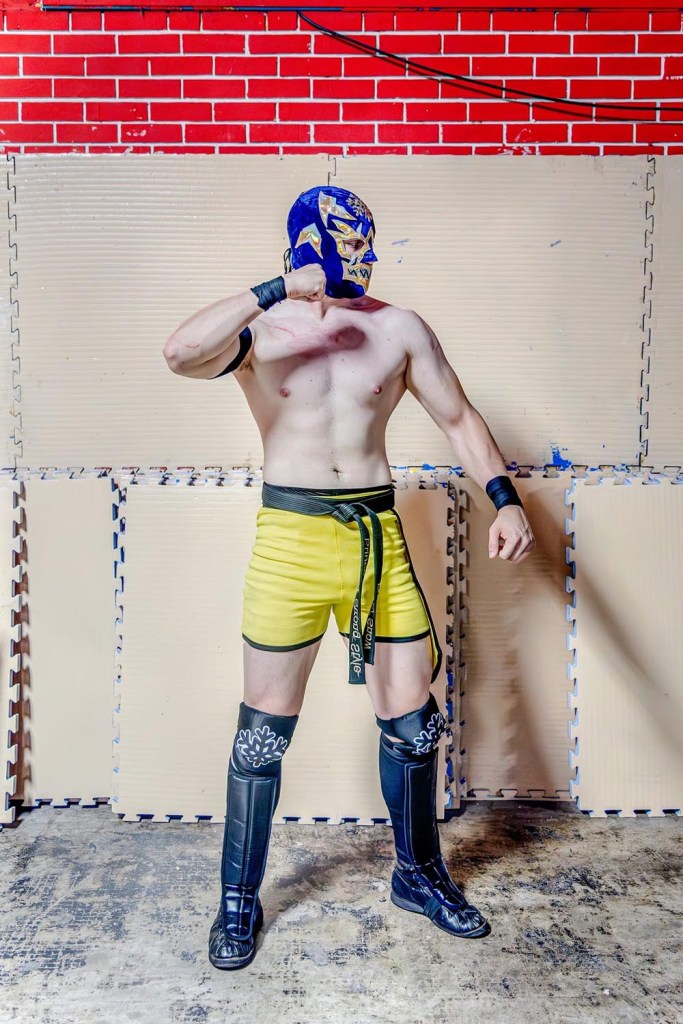 Local wrestler Marty Snow of Delgado Promotions grew up moving between El Paso and Juárez, and says lucha libre’s blend of performance and identity has guided his path in the ring. (Courtesy of Marty Snow)
But he does recognize the fact that he might not get there, or that it’s going to take a whole lot of work to actually get there. So, he’s not someone who necessarily does it for the stardom, but he does it for the love of the game, right? And, so, he is a wrestler for Delgado Promotions, which is a wrestling outfit here in Central El Paso. And there’s a number of these around town, right?
There’s Nation of Wrestling out in Horizon. There’s Lucha League, which you’ve seen them do a lot of the shows here in El Paso, like at the Sal y Límon Festival and other special events like that. All these guys, and girls, they do it for the love of the game, right? They do it just because they love what it represents. They love the fact that it’s something that represents them, their culture, and allows them to showcase the athletic skills that they have, right? And, so, they all say the same thing too, more or less. It’s just an opportunity for them to showcase who they are and what El Paso’s about. And they get to do it in front of people and allow them to sort of enjoy a night out, right?
And, so, it was fun talking to all of them because they all have so many similar answers. And they all, of course, have great things to say about Eddie and what he represented to the community.
Diego: Yeah. And it’s interesting to hear about these different characters.
I wonder how you would describe the lucha and wrestling scene in El Paso now, maybe relative to decades past, right? Obviously, you talked about the new lucha academy that opened relatively recently. And, so, I’m just curious how you would characterize the scene in El Paso today? And I’ll just share a quick anecdote. I was at the Dia de los Muertos Festival in Juárez a few weeks ago, and there were all these altars for famous Mexicans. And one of the ones that there were multiple altars for was the Blue Demon, who I hadn’t heard of before, but this old wrestler. And, so, it seemed like there’s – that was decades ago that he was, I guess, active and famous – but it seems like there’s still the real culture that maybe exists.
READ MORE: ‘Cassandro’ film depicts trailblazing borderland luchador
We had the film “Cassandro” that came out recently, another kind of local wrestler. But, again, that was kind of in the past. And, so, I wonder how you would characterize the state of lucha and wrestling in El Paso today?
Pablo: It’s interesting because I just think lucha has had this really sustained popularity in the border region, not just El Paso, but all along, South Texas and on into Arizona and so on. So, lucha has almost a 100-year history, at least 80 years. And we don’t have to get into the entirety of the history here, but historically, when lucha arrived in El Paso, it really was a really great way to entertain yourself, right?
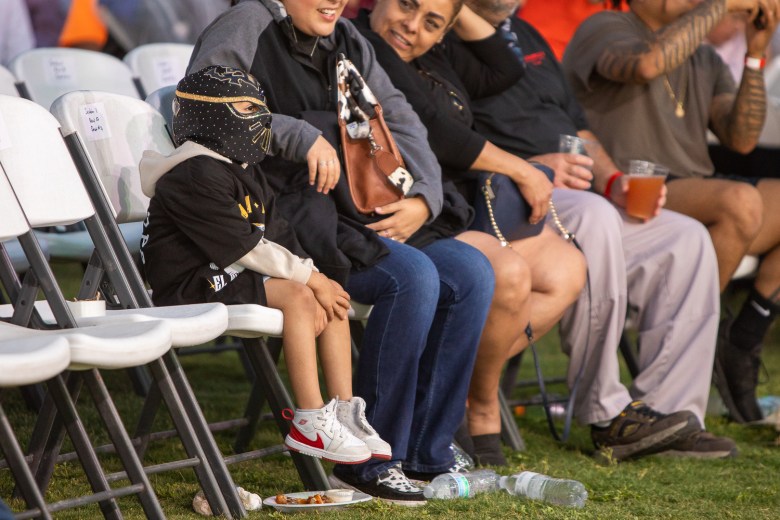 A small Cinta de Oro fan waits for the start of a lucha libre event at Ascarate Park, Sept. 6, 2025. (Corrie Boudreaux/El Paso Matters)
There were, if you think of El Paso back in the 19th century, turn of the 19th century, and heading into the Depression era and all those things, a lot of things happening here, just commerce-wise, right? The railroad was getting built, the industry was booming, skyscrapers were getting built here Downtown. And all those people that were here from all kinds of places needed something to just to, they needed some entertainment. And lucha was a really big thing that helped with that, right? Because these shows could pop up anywhere and at any time, right?
And, so, I really think that helped ingrain it as part of what is offered here. Some places are known for their circuses, some places are known for their concerts. I think El Paso sort of became known for its lucha, right? And Juárez, of course, as well. So I think the fact that became such an ingrained part of who we were back in the 20th century has helped it continue to be who we are now, right?
And, so, I don’t think the popularity has ever diminished. I mean, it ebbs and flows in terms of profile, but I think you’d be hard-pressed to find a weekend on the calendar dating back 80 years where there’s not some sort of lucha event happening around here. And, so, that’s just carried forth now.
SEE ALSO: How a new generation is reclaiming Segundo Barrio’s mural tradition
And there are so many organizations around town that offer that to you, right? And, so, you can – Delgado Promotions has wrestling every Friday. Cinta de Oro’s school has performances every month down at the Boys and Girls Club in Segundo. Nation of Wrestling has events here and throughout the region, West Texas, Southern New Mexico. Lucha League, like I said, they tend to do events at these cultural or community events that happen, right? I mentioned Sal y Límon. They do things at the history museum, so on. So it’s just part of who we are, right? And I think it’s going to continue to be part of who we are into the years ahead.
Diego: Yeah. And also, to that end, I mean, there’s the mural of Eddie Guerrero at Lincoln Park, kind of by the Spaghetti Bowl, right? And you mentioned that there’s maybe an effort to redo that. So, I’m wondering what you can tell us about this effort to, I guess, redo or update that mural and kind of revive this image of Eddie near downtown?
Pablo: Yeah. So, you mentioned Lincoln Park. And, so, there was a mural done, I believe it was 2018 or 2019. And that was to honor the Guerrero family, right, at large. I mean, Eddie is, of course, sort of the centerpiece of that. But he has family members who all wrestled as well. Chavo Guerrero Jr. is his nephew, who’s still in the WWE right now. He serves a backstage role, but he’s in the league right now, and you never know if they might call him up and make him do some in-ring stuff, right? But yeah, so the mural is on one of the pillars there at Lincoln Park, and it depicts him and his male family members. It also depicts his wife and two of his daughters. The third one might get her face on there at some point soon.
But, so, there are fundraising efforts. One is being led by a gentleman named Chris Rocha. And he has a GoFundMe page up right now. He’s actually sort of the one who started the whole process for the proclamation to happen, right? I wouldn’t say he’s the lead of all this, but he is in talks with the Lincoln Park Historical Association, who’s led by Hector Gonzalez. And Hector helped get all the other pillars painted over time, right? And an artist he’s working with, his name’s Gabriel Gaytan. Gabriel painted a bunch of the other pillars that are there now. And during the city council meeting, during the proclamation, they actually shared a mock-up of what they want the pillar to look like one day. And if you’ve ever been out there, you’ve seen them, right? They go all, they’re like these T-shaped pillars that support the overpass, you know, the flyover. And a lot of them are completely painted, right?
And currently right now, the Eddie Guerrero mural is about 7, 8 feet tall. What Hector presented at the city council meeting would be a mural that covers the entirety of that thing. The cost of that is in the area of $10,000. I mean, I assume that’s just paint and labor. Right now there’s no concrete plan as to how they’re going to make this happen, but I think, or at least I hope that the City Council proclamation to sort of galvanize the community and hopefully they can work with, either the public or some organizations who want to assist to help meet that end. But, yeah, I mean, I think the plan is to take that current mural and just expand upon it to really give a meaningful tribute to one of El Paso’s favorite sons.
Diego: Yeah. And just, we’ll end here, Pablo. I appreciate this time. So, as a longtime wrestling fan, I just want to hear in your words what you would say to somebody who goes, you know, “why do you like wrestling? It’s fake or it’s sort of predetermined” or those kinds of things that you hear about WWE or lucha or whatever wrestling. I just wonder, I’m curious in your words, like you said, I mean, your fandom goes back decades. What would you say to somebody who’s saying, “Oh man, that’s all just fake. Why do you like it?” What would be your response?
Pablo: Well, I mean, to those people that say (that), well, you’re not wrong, right? Yes, it is scripted. But I think inherently, as human beings, we all like stories. I know for me, I think back to my days in elementary school and some of my favorite times in class were when the teacher would call you down to the carpet with the numbers and the letters on it and read you a book. You know, just she would turn the page and make voices and all those kinds of things.
I love stories, right? And I think we all do. I think we all get them, whether we watch TV shows or movies or go to stage plays or go to comedy shows. Whatever it is, we all like hearing stories. And to me, wrestling, lucha, is just another form of storytelling, right? And I think what I admire more about or what enhances it for me is the athletic ability that’s involved, right? Because not only are these guys or these men and women, they’re not just in there playing characters and they’re making you revile them or like them or love them, whatever. But they’re also doing it while throwing each other around, right? And, so, that adds a whole other element to the storytelling for me that I really enjoy.
So, I think that’s what it is. It’s just they allow you to escape, right? Whether you’re reading a book or watching a show, you get to escape for those few moments that you’re engaged in that, right? And that’s all wrestling is. It’s just a way for you to latch onto something that you like, and follow them as they go through their trials and tribulations to try to succeed.
And on a personal level for me, I mean, I have two young boys, and my wife and I have really enjoyed watching them start to gain this love of wrestling. Part of it’s because of me, right? I understand that. But we got to go to a WWE Raw show in October to Dallas. It was one of the best times they’ve ever had, and it was just a joy for me to watch them, just their eyes light up as all these guys are walking out. And it was just, that’s really cool to see, right?
So, I mean, I think it’s also a form of storytelling that allows you to evolve with it, right? I mean, I mentioned watching it as a kid, and I liked it for the reasons I did back then, but they’re different now, right? And, so, I think that’s what I would tell people is: yes, it’s fake. I mean, I think we know that, and I think the WWE acknowledges that. They came out with a documentary on Netflix that sort of pulls back the curtain on the things they do. So, yeah, that’s not a secret, in the least.
But I think what makes it fun is just the fact that these are characters that have qualities that are the same as any other protagonist, antagonist in any story, right? And the fact you get to follow that just makes it a whole lot of fun, right? So, I mean, I would just tell people like, “Look, we all like to hear stories. You just pick your poison and let everyone else enjoy the one they have.”
Diego: Sure. And one thing that your story kind of illuminated for me was the alter ego that people take on. And it’s this whole spectacle and the bravado of the wrestlers going in there to put on a show. And rather than whether it’s all scripted or not, it’s all about, you know, putting on a show and taking on these characters and doing these performances for people just for the love of it. And, so, that was kind of a little bit eye-opening for me, kind of thinking about the the position of wrestlers that when they put that mask on, it’s like, hey – maybe, you mentioned Marty Snow, maybe he has just a regular day job, but then you put that mask on and you enter kind of a different persona, right?
Pablo: Yeah, that’s exactly it. And, I mean, Marty would tell you the same thing, right? And he actually, just to close on this, Marty is actually, his storyline currently involves him trying to be an affront to lucha and he dislikes wearing the mask, right? He only wears it because he has to, right? And, so, the fans don’t like him because of that, because he’s not respecting the game, right? So it is fun. It is fun to just see these guys just take on this role that they aren’t in real life, right? At least not, they’re not, presumably they’re not, right, these evil people. But they have fun going in there and performing this and giving you a good time.
Diego: Yeah, it’s interesting. So, it was a good story to kind of,show the world of wrestling and kind of some of the interesting artistic elements of it, I guess, here in El Paso particularly. But anyways, we’ll leave it there, Pablo. I appreciate you kind of sharing your fandom with us and for your profile on Eddie and kind of sharing his story. And hopefully, we’ll see if some money gets raised for a new mural or not. But anyways, we’ll follow that. But appreciate you taking some time to chat with me about wrestling, Pablo.
Pablo: All right, thank you, Diego. And hopefully we get a new fan in you. Survivor Series is this weekend, so we’ll go watch that together.
Diego: Sounds good.
Related
LISTEN: EL PASO MATTERS PODCAST