
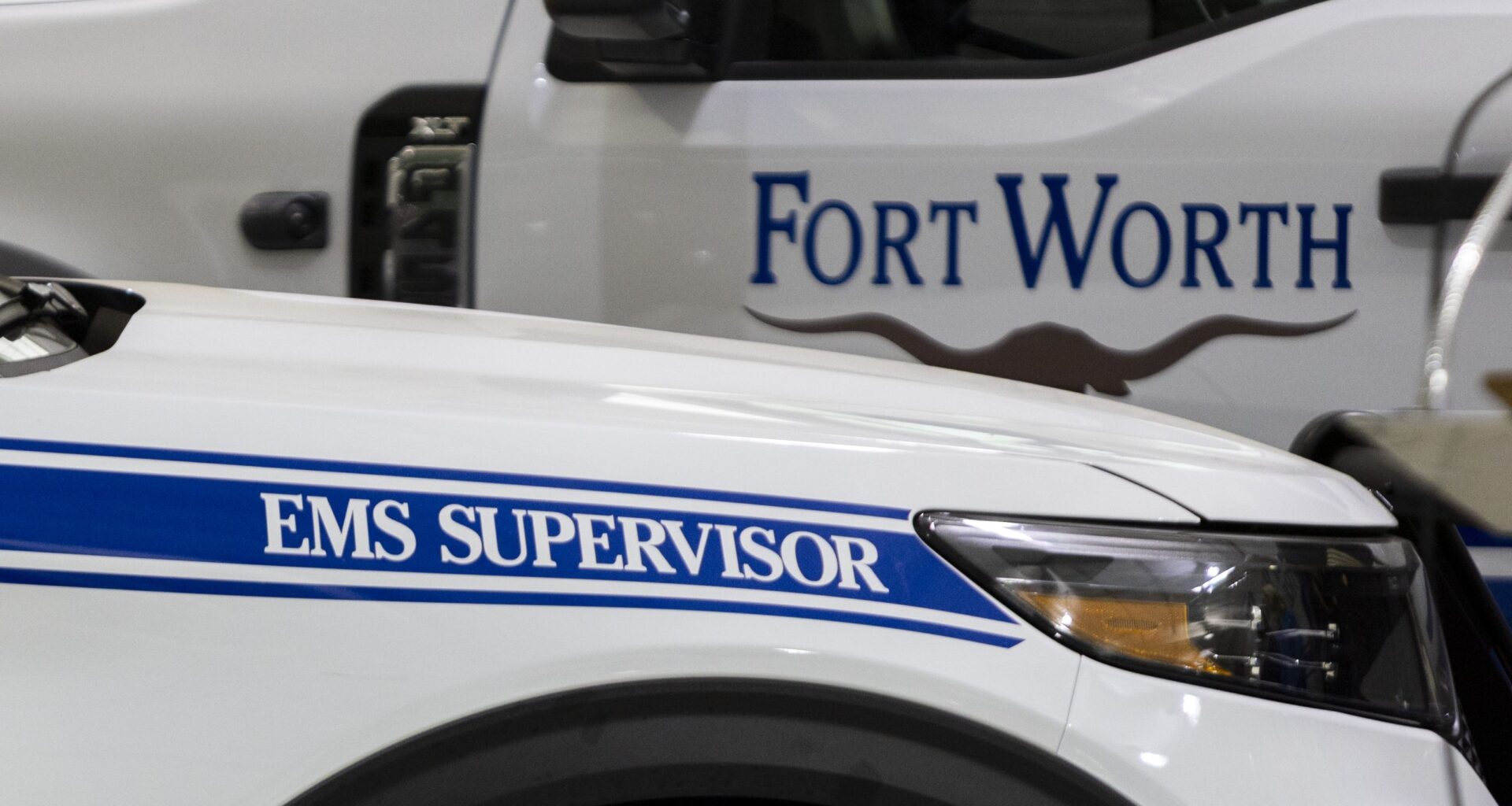
Almost five months after launching, Fort Worth’s emergency medical services continue to work toward improving ambulance response times, remaining minutes away from targets.
City Council wants the EMS branch, which began operating under the fire department July 1, to respond to 90% of emergency calls in under 8 minutes. Since starting, the new department saw 90% of its calls fall under 11:09 minutes according to records obtained by the Report.
These times are about 30 seconds slower than those reported by MedStar, Fort Worth’s former third-party ambulance provider, in the year before the city took over its operations, according to city estimates.
Response times reflect the time between the first ambulance’s dispatch and its arrival on scene. In October, when Fort Worth’s fire chief suddenly resigned over alleged disagreements about firefighter safety with the firefighters’ union, the union leader said the chief failed to recognize acceptable on-scene times for EMS and fire response.
Fire department officials maintain that the lagging response times are temporary growing pains as first responders get used to new systems and leadership fine-tunes procedures. Already, they’ve rolled out some changes in an effort to improve times, such as having ambulances dispatched from locations across the city rather than from one central spot.
“It was never meant to be a quick ‘July 1, boom, the light switch has been flipped, and now everything’s gonna change,’” fire department spokesperson Craig Trojacek said. “The light switch has been flipped, but now we’re figuring out what we can change to improve it.”
Response time averages for all high-priority emergency calls over the four months sit at 6 minutes, 43 seconds. The 90th percentile is the time which 90% of calls fall under.
The city initiated the creation of its EMS system after a consulting firm found MedStar was financially unsustainable and too inefficient to keep up with Fort Worth’s population growth and increased demand.
The takeover transition took about two years, and it’s since been publicly applauded by City Council as having gone smoothly, even amid former Fire Chief Jim Davis’ resignation.
Since ambulance operators, police officers and firefighters are now all city operated, they are able to be managed under the same dispatch and communication systems.
This should streamline and speed up emergency response, said Dr. Jeffrey Jarvis, a former MedStar official who now works for the city. Jarvis is Fort Worth’s medical director and oversees medical practice within the city’s first response systems.
He said more responders and resources showing up at an emergency scene directly lead to higher rates of survival. So, having firefighters and EMS training and working in coordination should lead to an overall better service for those in need.
Achieving those expected improvements requires “more of a marathon than a sprint,” Trojacek said, noting that it takes time to identify and fix systemic weaknesses.
“We’re really doing a lot of good things and improving but, from the outside looking in, it doesn’t look that way,” Trojacek said.
The city’s EMS branch costs about $89.2 million annually. In this fiscal year, about $65 million of that will be covered by expected revenue from billing insurance and patients. Another $1.7 million will come from the 14 smaller cities around Fort Worth receiving the ambulance services.
That leaves the city covering the outstanding $19.5 million.
Does your city receive Fort Worth’s ambulance services?
Fort Worth provides EMS services to the following cities, which pay Fort Worth depending on their usage.
Blue Mound
Edgecliff Village
Forest Hill
Haltom City
Haslet
Lake Worth
Lakeside
Richland Hills
River Oaks
Saginaw
Sansom Park
Westover Hills
Westworth Village
White Settlement
At the time of publishing, the fire department had only audited October’s response times, meaning they’ve double-checked that the first responder’s self-reported times are accurate. Its 90th percentile was 11:02 minutes.
When EMTs respond to a call, they are supposed to track when they are “on scene.” Occasionally, some forget or run into connection issues, leading to inaccurately reported response times, Davis told the Report in August.
An audit of response times could reduce reported times by an estimated 45 seconds to a minute, EMS admin officer Heath Stone told the Report.
Stone is confident the response times will improve as the fire department works to fill vacant EMT positions and streamline practices — things they could only start doing after the July transition, he said.
As an example, he pointed to the new practice of dispatching ambulances from all 45 fire stations across the city. Until Nov. 1, ambulances were dispatched from one central location.
Also this month, 92 new single- and dual-role first responders graduated from their classes to fill the ranks, Trojacek said. That means more help on ambulances, which can improve response times, he said.
It took several months to fill new jobs, as applicants need to go through paperwork, licensing and training, he added.
“We can’t just say we need 45 more people, and we’ve got 45 more people,” he said. “It’s months to get to that point to have that test, and then months to process that test, and then months for those people who want to do the process to get their certifications.”
Jarvis said he’s proud of how Fort Worth approached the transition as more of a “merge” with MedStar than a “hostile takeover.” Preserving some of MedStar’s culture and staff within the city was important to the branch’s success, he said.
Over 600 former MedStar employees, mostly EMTs, joined the fire department.
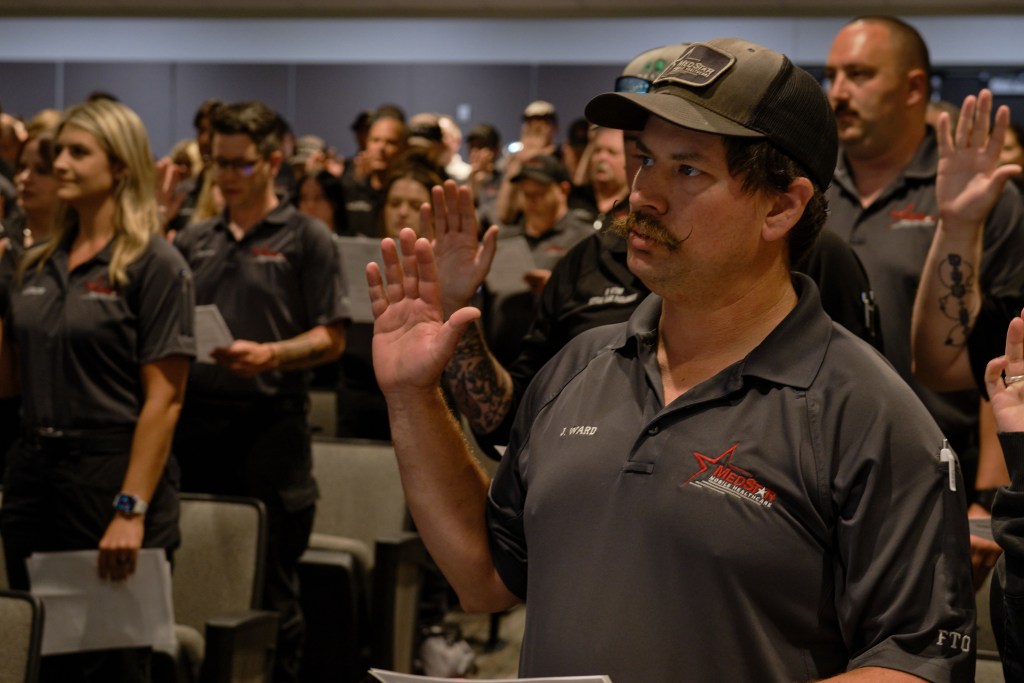 MedStar employee James Ward is sworn into the Fort Worth Fire Department on May 23, 2025, at the Bob Bolen Public Safety Complex as the city transitions to providing in-house emergency medical services. (Drew Shaw | Fort Worth Report)
“When you take two different families and make them one, there are some growing pains, but we’re working through those,” Jarvis said.
Jarvis made the transition to Fort Worth because he’s optimistic that it will, eventually, serve the communities well.
“We have an opportunity to do this right and be a model for how fire-based EMS — and how EMS in general — can really serve their communities well,” he said.
Drew Shaw is a government accountability reporter for the Fort Worth Report. Contact him at drew.shaw@fortworthreport.org or @shawlings601.
At the Fort Worth Report, news decisions are made independently of our board members and financial supporters. Read more about our editorial independence policy here.
Related
Fort Worth Report is certified by the Journalism Trust Initiative for adhering to standards for ethical journalism.
Republish This Story

Republishing is free for noncommercial entities. Commercial entities are prohibited without a licensing agreement. Contact us for details.