
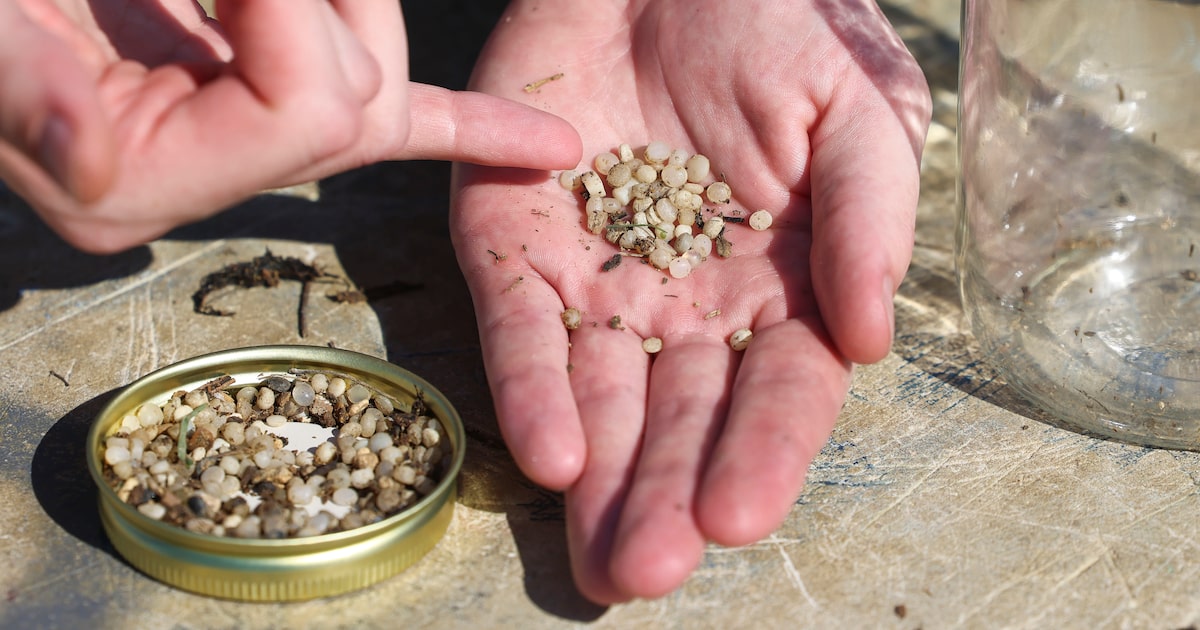
On a recent sunny afternoon at Mi Familia Park in Grand Prairie, a handful of volunteers crouched down to get a better look at the shoreline.
Some squinted their eyes as they scanned the dirt, skimming it with their hands.
“Did I pick one up?” Jackie Garza excitedly asked, extending her palm upward.
Ian Seamans, a City Hall advocate with nonprofit group Environment Texas, picked the tiny object up between his pointer finger and thumb and gave it a squeeze.
Breaking News
“Yep, that’s a nurdle,” Seamans said. “They can be hard to see at first because they look like tiny pebbles.”
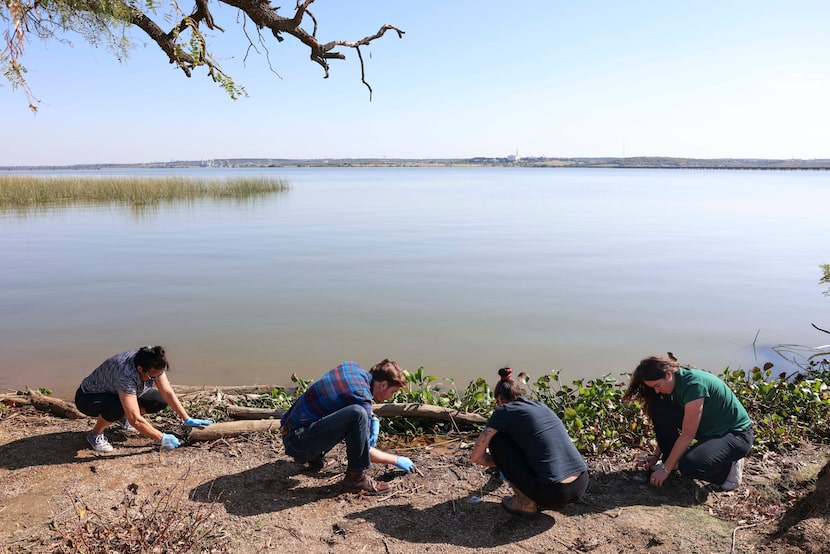
Dina Maldonado (from left), Ian Seamans, Jackie Garza and Cypress Toomey search for nurdles as part of a statewide nurdle hunt on Friday, Nov. 7, 2025, in Grand Prairie.
Shafkat Anowar / Staff Photographer
Seamans had been out to the park on Mountain Creek Lake a few times before in search of these “nurdles.” The lentil-sized plastic pellets — often smaller than 5 millimeters in size — are the raw material used to make plastic products like grocery bags and water bottles.
“It’s virtually impossible to get them out of the environment any way besides by hand,” Seamans said.
In addition to spending time picking up larger litter and learning about the impacts of pollution, the volunteers collected nurdles that washed up from the lake, as part of Environment Texas’ statewide nurdle hunt.
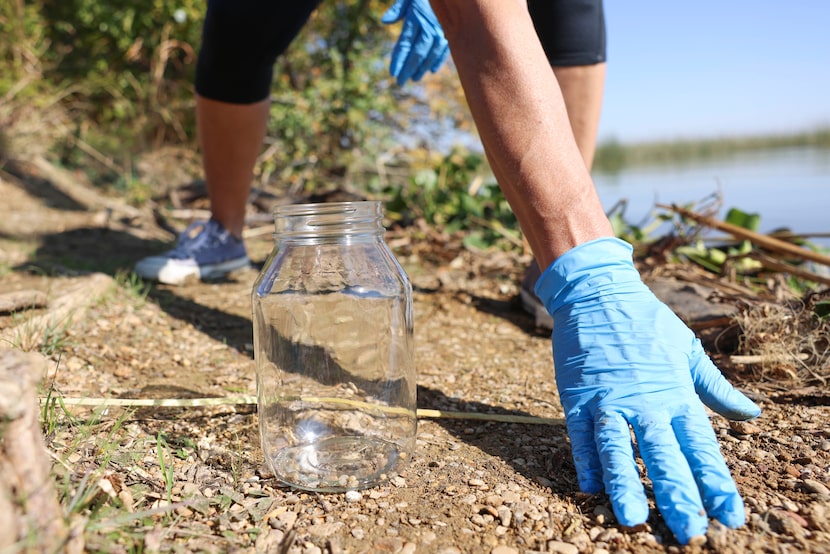
Dina Maldonado searches for nurdles as part of a statewide hunt on Friday, Nov. 7, 2025, in Grand Prairie.
Shafkat Anowar / Staff Photographer
Though this type of plastic pollution has mostly made headlines for its impact in coastal communities, nurdles are found in inland areas, like Dallas-Fort Worth.
“In Texas, volunteers have already collected millions of these pellets from our waterways by hand in an effort to quantify how many of these are being released into our environment and where,” Seamans said.
“Usually, these pellets are lost at manufacturing facilities, in transit or at the plastic product manufacturing facilities that they are delivered to.”
He said things like a dropped bag, a leaky shipping container or a loose cap on a rail car can lead to large spills of the plastic pellets.
Earlier this year, about 1,100 volunteers across the globe participated in an International Plastic Pellet Count, described as a citizen science effort to quantify the extent of this kind of pollution.
More than 49,200 pellets were collected at more than 200 sites across 14 countries, 29 U.S. states and Washington, D.C.
Of the roughly 42,000 objects logged in the U.S. during the effort, Texas sites reported the highest counts by far, with 23,115 pellets.
Though researchers say nurdles are the second largest source of primary microplastic pollution globally, this type of pollution is mostly untracked and unregulated, Seamans said.
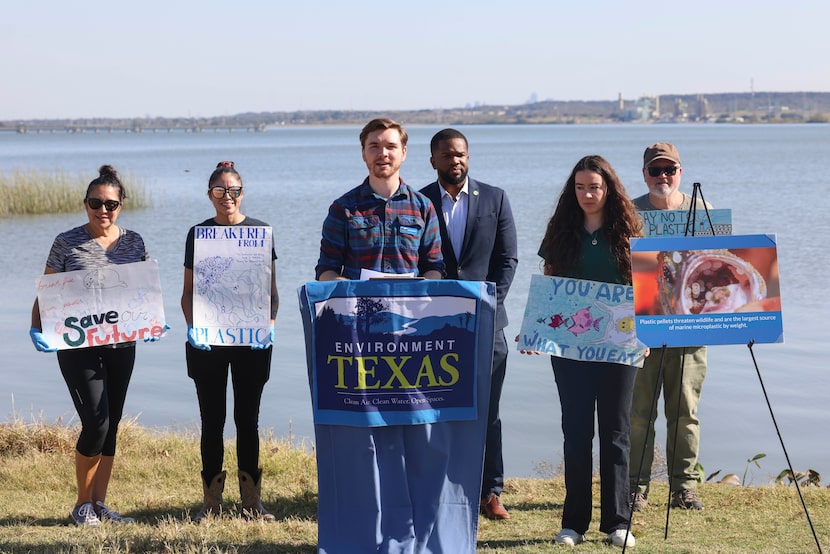
Ian Seamans (center) leads a press conference after a search for plastic pellets at D-FW locations as part of a statewide nurdle hunt on Friday, Nov. 7, 2025, in Grand Prairie.
Shafkat Anowar / Staff Photographer
Cypress Toomey, a campus organizer with TexPIRG Students, said it’s critical to protect waterways and the environment from plastic pollution. They can break down into smaller pieces, eventually entering the food chains and harming the health of humans and wildlife.
Both Seamans and Toomey called for action from officials, including wanting the Texas Commission on Environmental Quality to set limits on plastic pellet pollution, the creation of a statewide microplastics task force, and a push to reduce plastic production across the state.
“We can’t recycle or clean our way out of this problem,” Toomey said. “The only real solution is to stop it at the source.”
This reporting is part of the Future of North Texas, a community-funded journalism initiative supported by the Commit Partnership, Communities Foundation of Texas, The Dallas Foundation, the Dallas Mavericks, the Dallas Regional Chamber, Deedie Rose, Lisa and Charles Siegel, the McCune-Losinger Family Fund, The Meadows Foundation, the Perot Foundation, the United Way of Metropolitan Dallas and the University of Texas at Dallas. The News retains full editorial control of this coverage.