
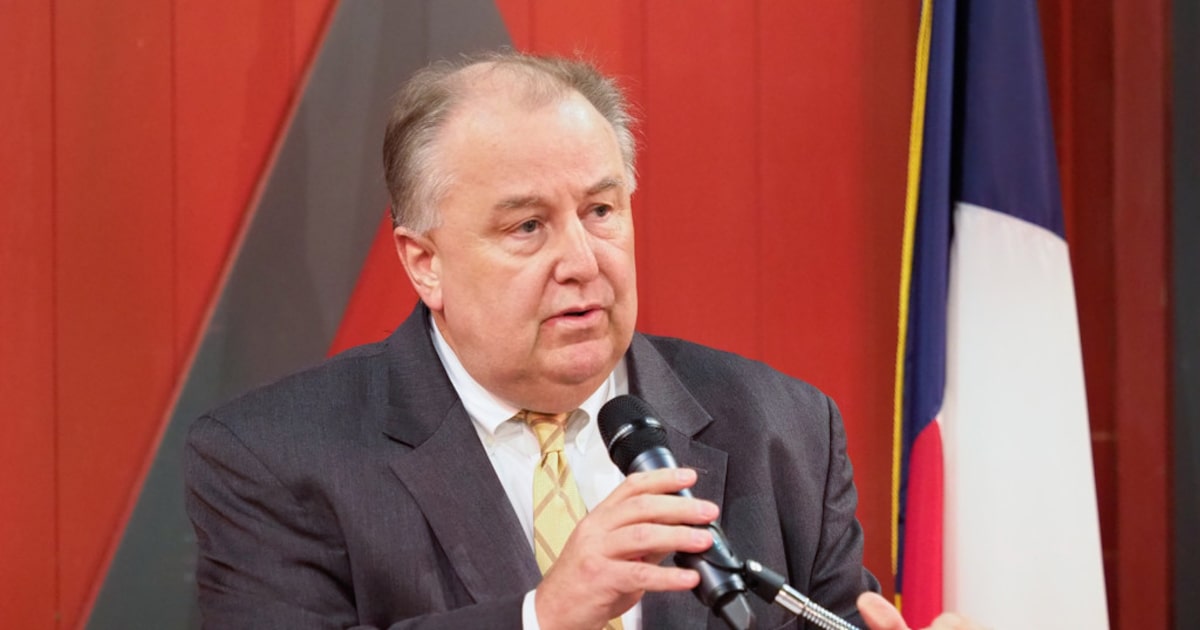
Michael Morris has long been recognized as the region’s top mobility planner. After 35 years as director of transportation for the North Texas Council of Governments, Morris has played a major role in identifying the transportation needs and priorities for the Dallas-Fort Worth area. The Dallas Morning News recently spoke with Morris about how his staff is making preparations and plans to handle traffic congestion in a fast-growing region.
You say we are in “a transitional place.” What does that mean in terms of transportation needs and what does that mean for North Texas? Give us a bird’s-eye view.
We’re in a transitional place. We’re leading the nation in population growth. If we hadn’t built the public-private partnership, known as (tolled) P3 managed lanes, we would be in a really horrible situation. But my job is to look 20 years into the future. We don’t get the luxury of just looking out the window. And we’ve got four million more people coming to the region. So we have to act like there’s four million more people coming to the region. So you have to basically try to tap a legislator on the shoulder and say to him or her, ‘Look, you know, we’re the ones that are creating the economic growth. The urban regions are creating economic growth for the state. Why can’t we simply adequately fund them to keep the tremendous growth mitigated as best we can from the congestion, air quality and safety standpoint.’
And then the second point of transition is, you know, you’re not going to do everything on the back of the roadway system. We are going to have to develop more efficient ways of moving people that don’t consume the land with our major freeway improvements, because, you know, we’re running out of land for those improvements. And we don’t, necessarily, we don’t like going up in the air. Our region doesn’t build elevated projects. In fact, we’re trying to do the opposite. We’re trying to tear down the elevated projects. So during this transition there has to be a better balance. What I mean is a better balance with land use, a better balance with development in our central cities, a better balance with walking and biking, a better balance with transit.
Breaking News
Yes, roadways are important, but the transition that we have to focus on, and this is a hard lesson to understand. We’re going to have to balance across a whole set of transportation modes if we’re going to maintain this leadership position, attracting economic growth.
What were your legislative priorities for the 2025 session?
There’s probably two major items.
On the roadway side, it’s pretty straightforward: Give us our fair share of the revenue or give us the tools that we’ve had before to be able to build our roadway system with public-private partnerships. And the basic principle is that the regions that are being asked to handle all the growth and therefore deal with air quality, safety and congestion should be given the revenue to mitigate the externalities that happen with this growth. And obviously Dallas-Fort Worth at 1 million people every seven years is certainly that.
The second balance to the teeter-totter is transportation revenues for Class 1 railroad grade separations (this relates to building overpasses or underpasses to address dangerous and congested road-level crossings) and regional rail for our transportation authorities. The basic principle is once you get 8 million people, which we would hit, and the new mobility plan is planned for 12 million people, you’re going to have to do more on the regional rail side.
Have we gotten our fair share?
Some years, you get your fair share, but other years, you may not get your fair share because you’re at the mercy of the decisions of the five commissioners at the Texas Department of Transportation.
In 2024, I think we did well. In a partnership with TxDOT, a project was funded to improve U.S. 380, which passes some of the far northern suburbs of the region that include Denton, Little Elm, Frisco, Prosper, McKinney and Princeton.
Roughly a decade ago, Texas voters overwhelmingly passed a pair of constitutional amendments that have injected an estimated $6 billion a year for transportation funding. Those funds may only be used for constructing, maintaining and acquiring rights-of-way for public roadways other than toll roads.
Have the constitutional amendments that Texas voters passed in recent years helped North Texas?
Tremendously. Some of the projects benefited from that and I am going to focus on the eastern side. The Southern Gateway Project aimed to rebuild and widen Interstate 35E south of downtown. The 635 East Project in Garland and Dallas is nearly complete. That’s a major, major change. We’ve been 25 years trying to fund that project. So that project is under construction. U.S Route 380 and Spur 399 in Collin County just got funded last summer (2024) so you won’t see that construction [immediately]. That’s a $2 billion program. (Note: U.S. Route 380, a major east-west highway in North Texas, stretches from Greenville to the New Mexico border. The multibillion dollar expansion includes widening existing roads, reducing congestion and enhancing mobility through Frisco, McKinney, Princeton and Farmersville.) A good example in Rockwall County would be the Interstate 30 project across the lake, and then another good project in Kaufman County is U.S. Route 80/180. Those are good examples of revenue from Propositions 1 and 7 where we had projects ready to go and those projects either have been completed or are under construction.
Are we in need of a project that we haven’t received funding for over the last five years from the Legislature?
We don’t want the Legislature to fund specific projects but when you look at the legislative program, it’s pretty simple. Fund the urban regions because they’re the ones that are handling all the increased congestion. And if you’re not going to fund the urban regions, give us the tools, give us the public-private partnerships so we can work with the private sector to fund our projects like we did 20 years ago.
Any other priorities that you would like to emphasize perhaps in a perfect world?
We would like to see fair share allocation of funds, reintroduction of public-private partnerships and support for high-speed rail from the business community.