
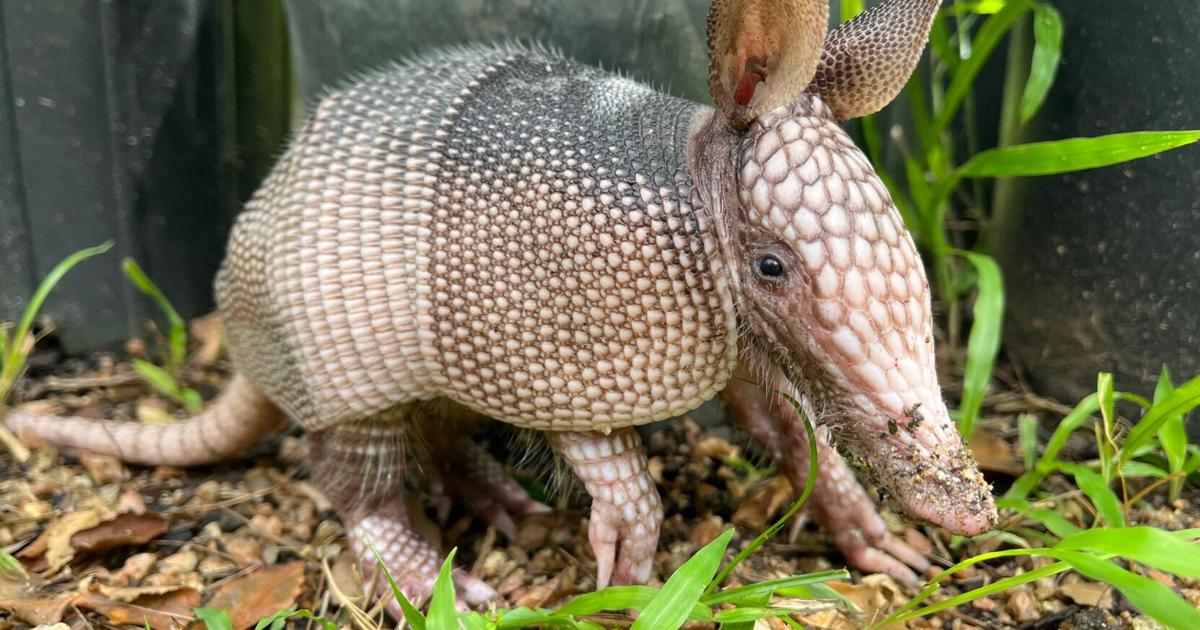
If you’ve noticed more armadillos scuttling through the Houston Arboretum & Nature Center lately, you’re not alone.
Tiffany Ritter, Education Director at the Houston Arboretum, confirms that staff and visitors alike have observed a notable increase in armadillo sightings over the past several years. This year brought particularly encouraging signs: three different groups of baby armadillos, called pups, which Ritter says “is not that common.”
A Story of Resilience
While the Arboretum doesn’t conduct official population monitoring, Ritter attributes the apparent rebound to a period of relative habitat stability following years of environmental stress and construction disruption.

An armadillo mother and baby looking at the camera at Houston Arboretum (photo by Kelsey Low, courtesy of Houston Arboretum)
The severe 2011 drought resulted in the loss of 55% of the Arboretum’s tree canopy, leading to extensive dead timber removal throughout 2012 and 2013. Combined with sustained master plan construction, conditions were less than ideal for the sensitive animals, who prefer quieter surroundings.
But it was the back-to-back floods of 2016 and 2017, including Hurricane Harvey, that likely impacted the population most severely.
“They really like to nest along streams, so all along the bayou, all along our ravine,” Ritter said. There’s a high probability that with all of the floods we experienced back-to-back, there was maybe even a high mortality.”
Since 2020, however, conditions have been relatively stable, giving the population time to bounce back.
When to Spot Them
Though armadillos are technically nocturnal with crepuscular tendencies, meaning they’re most active at dawn and dusk, visitors report seeing them throughout the day. Ritter says this behavior is normal and depends on weather conditions.
“Anytime after about three o’clock is a good time to go armadillo watching,” she said.
In summer, hot and dry conditions force insects deeper underground, requiring armadillos to spend more daylight hours foraging. In winter, the cold keeps them burrowed overnight, so they emerge during warmer daytime hours to search for food.
Armadillos eat insects and, through their burrowing, keep soil aerated and healthy (photo by Girish Tembe, courtesy of Houston Arboretum)
The species found at the Arboretum is the Mexican long-nosed armadillo, recently reclassified from the broader nine-banded armadillo designation. These creatures have remarkable hearing and smell — they can detect insects six inches underground — but very poor eyesight.
One of their most fascinating traits: armadillos always give birth to identical quadruplets, either four boys or four girls.
How to Be a Good Neighbor
For visitors hoping to observe these armored mammals, Ritter emphasizes one critical rule: keep dogs on short leashes.
“Very sad to say, we found two different armadillos this past spring and summer where it was obvious that they had been attacked by a dog,” she said. Even extendable leashes can spell disaster, as attacks happen quickly.
Observers should maintain distance, take photos from afar, and never attempt to touch or pick up armadillos. While they can carry leprosy, transmission requires eating their flesh — simply touching them poses minimal risk to people with healthy immune systems.
Ecosystem Engineers
Beyond their charm, armadillos play an important role in the Arboretum’s ecosystem. They consume large quantities of insects and help keep soil loose and healthy through their burrowing, especially in the sandy soils along stream corridors.
“If you have gardens, they may be digging up your mulch, but they are eating the pests that you don’t like,” Ritter noted.
For residents interested in tracking armadillo sightings, Ritter suggests using iNaturalist.org, a community science website where observations from individuals worldwide help scientists monitor changes in wildlife populations and behavior patterns.
For now, these prehistoric-looking animals appear to be thriving, much to the delight of trail-goers who pause to watch them dig and snuffle along the paths.
The Houston Arboretum & Nature Center is located at 4501 Woodway Drive in Memorial Park.