
This story was produced with support from the Education Writers Association Reporting Fellowship program.
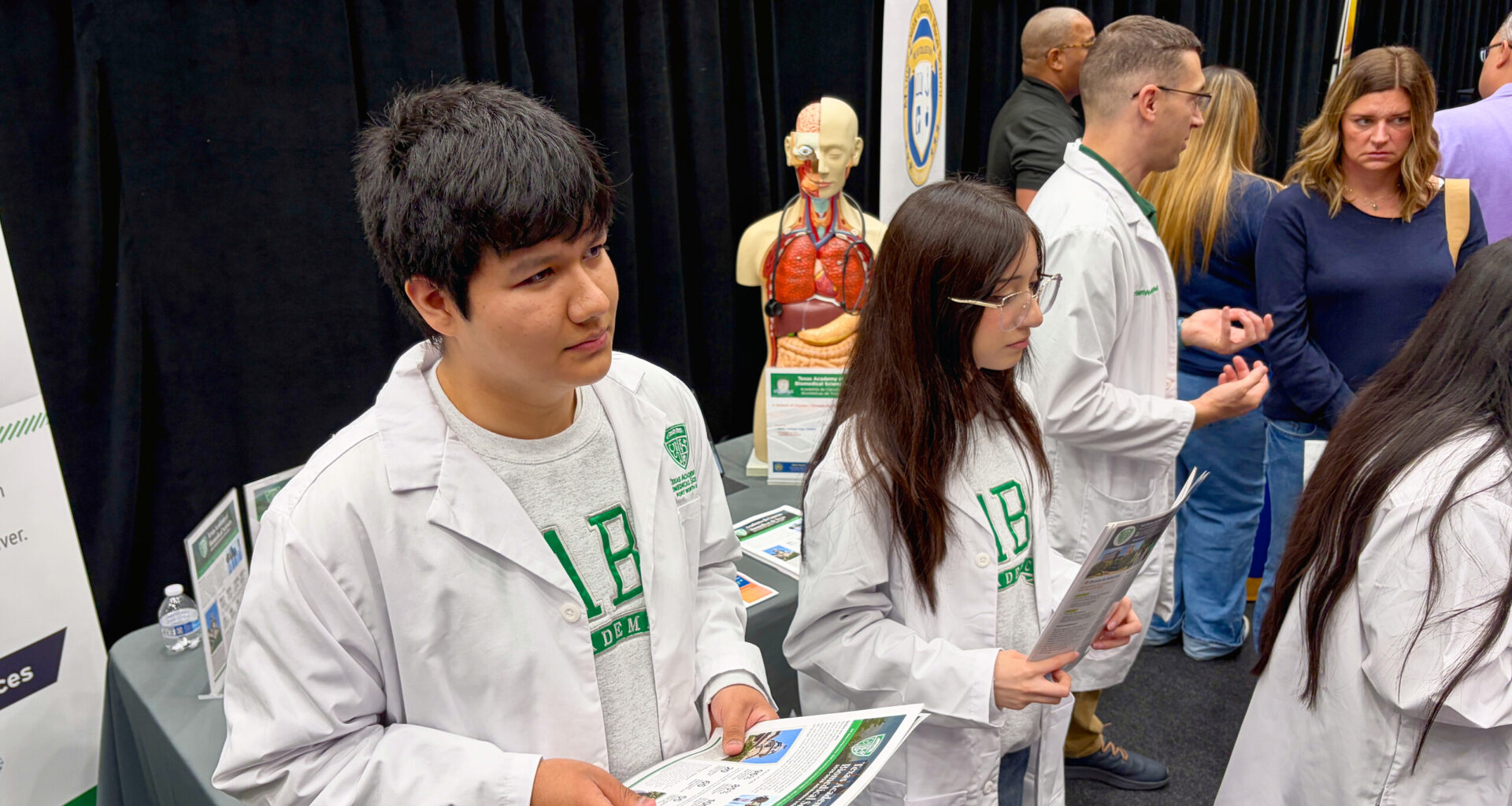
Roberto Perez’s bright white coat stood out among the crowd of Fort Worth families inside the Wilkerson-Greines Activity Center as their eighth graders explored high school options.
On a recent Saturday, the Texas Academy of Biomedical Sciences senior worked the crowd to explain what his school offers: labs where teens learn how to measure blood pressure, work alongside nurses and physicians, and classes on Tarrant County College’s downtown Fort Worth campus.
No prerequisites. No fee. Just an application into a lottery.
A few students stopped for information before moving on to explore other options. Getting middle schoolers — including Latino and Black boys — interested in medical careers is a challenge and engagement must start before the eighth grade, educators say.
Students eyeing specialized programs often need advanced classes in the sixth grade so that they are prepared for college-level courses in high school. A seventh-grade career class is necessary so they know their options. FWISD wants to introduce students to careers even earlier than middle school.
The cascading preparation for a medical career often limits who enters the field. Meanwhile, too few men of color are entering medicine at a time when demand for doctors, nurses and other careers is climbing in North Texas. But sparking an interest among young boys is hard because of cultural perceptions around these caregiving jobs, according to national research.
Plus, adolescents aren’t looking that far ahead into their futures.
Educators say getting middle school students interested in the field and keeping them on track with focused, accessible and free programs — such as the Texas Academy of Biomedical Sciences — helps.
Students and families walked by Roberto as he stood in front of his school’s table. He remembered being a middle school student when he first became interested in the Texas Academy of Biomedical Sciences.
He asked around to learn more about how his desired career in medicine would be a straight shot through the academy.
Roberto’s family supported his aspiration. That was all it took for him to toss his name into the lottery for the high school.
“My family wanted me to do this, to work in the medical field,” he said. “They didn’t have the opportunity to do that. Seeing me doing this makes them proud.”
‘They’re just trying to get through middle school’
Eighth grader Antonio Chavez stood in line reviewing potential options for high school at the recent fair on school choice.
Lynne Charles, FWISD’s director of school choice and enrollment, walked up to Antonio and asked him which campus lotteries the 13-year-old wanted to put his name into. TCC South? Trimble Tech?
“Have you ever thought about going into the medical field?” Charles asked.
“No. It’s not interesting,” Antonio said. He wants to be an engineer.
Middle school is the most important time for students, says Victoria Allen, a doctoral nursing program candidate at Belmont University in Tennessee researching how to get more men of color in the field.
That’s when children are figuring out who they are, what they are good at — and not.
So if a student doesn’t see himself as good in science or math, that idea sticks and he will most likely avoid STEM careers later in life, Allen said. Perceptions solidify.
Getting students to understand the importance of middle school is difficult, said Natalie Young Williams, an education advocate and former president and CEO of the Tarrant To & Through Partnership. Kids are focused on the priorities in front of them: friends and classes.
“The hard part is how do you start in middle school talking to students about who they are, who they think they are going to be in 10 years when right now they’re just trying to get through middle school,” she said during a recent Fort Worth Report panel on preparing the city’s workforce.
Middle school boys may not be interested in a medical career because of how adults sell the idea to them, Allen said.
The American Institute for Boys and Men recently found jobs in medical fields rely on interpersonal skills. Research cited in the institute’s report notes that men may be less likely to have such traits than women. However, the report found men are interested in other care work such as firefighting or policing.
“You can’t just focus on, for example, nursing is healing and serving. With men, give them specifics like critical thinking, teamwork and bonding,” Allen said. “There are differences between females and males, and that’s OK — that is a beautiful thing. Now let’s think through ways that we can engage both.”
That could mean meeting teens at sporting events or even the gym to help them see connections to the medical field, she gave as an example.
Recruiting students
The Texas Academy of Biomedical Sciences struggles to attract boys, according to administrators. About 3 in 10 students are boys.
Teen boys are a harder sell than girls, said Brian Wooddell, a post-secondary success specialist who recruits for the campus.
Boys often want sports and skill-based classes, such as welding, that the school doesn’t offer. Though students can play sports at their neighborhood campus, boys tend to want a more traditional high school experience, he said.
Wooddell tailors his message so middle schoolers learn that the medical field is more than scalpels, syringes and sutures.
“I can take anything you want to do, and I can make it medical,” he said. “What about biomedical engineering? What about programming the computer that runs a surgery robot? That speaks the language that my male students in eighth grade are looking for.”
Fort Worth ISD has medical programs at three other campuses that offer varying experiences for students, said Robert Wright, career and technical education director.
The Texas Academy of Biomedical Sciences plunges students into the world of medicine as they earn up to 60 college credits or an associate degree. Programs at North Side, Trimble Tech and O.D. Wyatt high schools offer medical-related certifications, dual credit or associate degrees.
FWISD’s offerings are not new. For decades, North Side had a magnet program for medical professions and today teaches students how to care for older adults. Trimble Tech has a long history of preparing students for careers immediately following graduation.
The jump start on college in high school saves money for families, who do not pay for tuition, textbooks or other fees. About 1 in 10 FWISD students earn dual credit. At the Texas Academy of Biomedical Sciences, almost all students do.
In 2025, Texas lawmakers expanded high school career pathways so students who choose not to attend college can still be career ready, according to nonpartisan public policy group Texas 2036. More than 6 in 10 jobs in Texas require a degree or credential.
FWISD’s efforts could go a long way toward equipping more graduates with credentials that will lead to jobs in the medical field, officials hope.
“It does lower the bar of accessibility so for a student who may have thought, ‘Oh, I want to be a doctor, but my family doesn’t have the money,’ the district can provide that pathway,” Wright said.
‘This is what you can be’
Exposure to the field is the biggest barrier for students, Wright said.
Not having someone in the family working in medicine — or even with a professional degree — often means a student doesn’t know what jobs are possible for the future.
“When students don’t know what their opportunities are, they don’t have proper representation in their community to show, ‘Hey, this is what you can be,’” Wright said.
Only 11.3% of Texas physicians are Latino and 6.3% Black, according to the Texas Medical Association.
In Fort Worth, Black students account for 20% of students while Latinos make up 65% of the school district.
FWISD offers classes about career and technical programs starting in seventh grade to guide them toward a desired pathway, Wright said.
Still, that may be too late for students.
So last year, the district gathered elementary, middle and high school leaders, counselors and teachers to explore ways of introducing career options earlier, he said.
That could be placing a nook in classrooms or libraries stocked with information about career, college and military readiness or hosting more career days that bring professionals to campuses to discuss their jobs.
“All these options could be used at lower grade levels to help parents and kids know what’s coming,” Wright said.
Such changes could lay the groundwork to make choosing a future career, particularly in medicine, easier once kids like Antonio get to the eighth grade.
Back at the school choice event at Wilkerson-Greines, FWISD’s Charles didn’t give up on encouraging the middle schooler to consider medicine, leaning into the teen’s engineering interest.
“I don’t know,” Charles said to Antonio. “I hear a medical mind in there a little bit myself, thinking about taking apart something, fixing and making it better.”
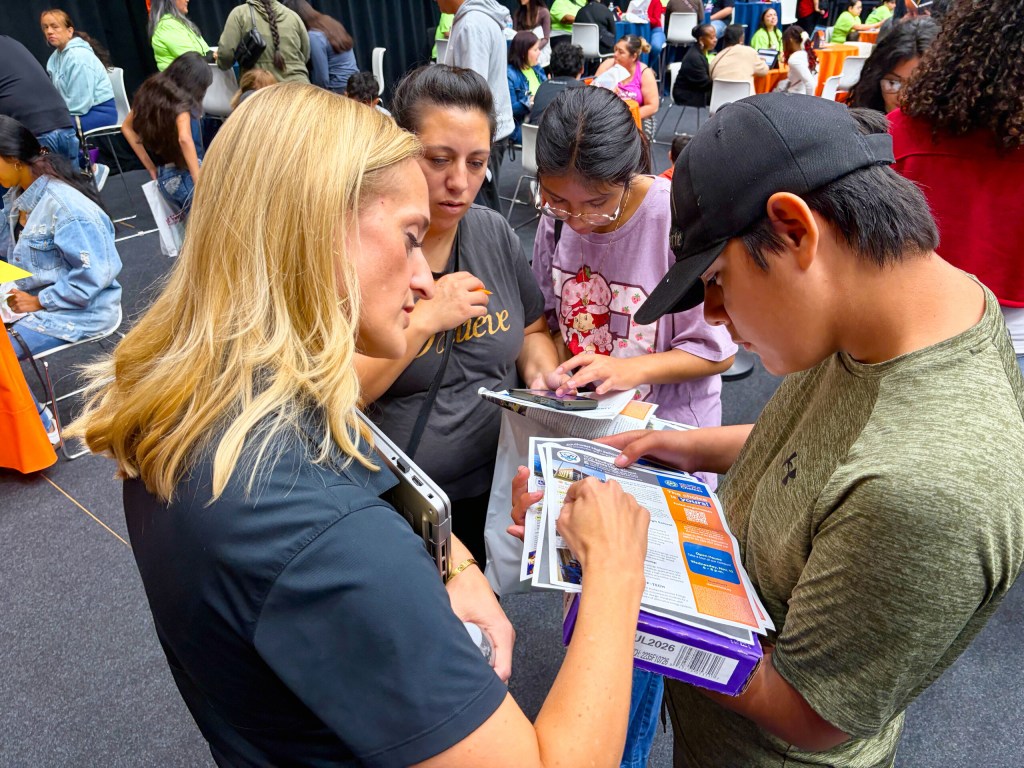 Eighth grader Antonio Chavez listens to Lynne Charles, director of school and enrollment, review available classes at TCC South/FWISD Collegiate High School during Fort Worth ISD’s Choices Expo on Nov. 8, 2025, at the Wilkerson-Greines Activity Center. (Jacob Sanchez | Fort Worth Report)
‘Because I’m prepared’
Roberto, the Texas Academy Biomedical Sciences senior, will be the first person in his family to attend college. Nursing is his dream so he can help his community, the teen said. Serving patients brings him joy.
He wants to attend Texas Christian University or the University of North Texas to complete his bachelor’s degree.
“Once I’m in college for nursing, I won’t be scared, terrified or nervous because I’m prepared,” Roberto said.
The school doesn’t limit students to lectures — it puts students into real-world situations such as visiting nursing homes and caring for older residents, he said.
Roberto sees firsthand every day how few students like him are in his classes. He knows there is a disconnect between what young men want and misconceptions about the medical field.
His advice?
“It’s not all just medical,” he said. “There are different things that you can do, so don’t be scared.”
Jacob Sanchez is education editor for the Fort Worth Report. Contact him at jacob.sanchez@fortworthreport.org or @_jacob_sanchez.
At the Fort Worth Report, news decisions are made independently of our board members and financial supporters. Read more about our editorial independence policy here.
Related
Fort Worth Report is certified by the Journalism Trust Initiative for adhering to standards for ethical journalism.
Republish This Story

Republishing is free for noncommercial entities. Commercial entities are prohibited without a licensing agreement. Contact us for details.