
Universally acclaimed as contemporary theater’s foremost playwright, Sir Tom Stoppard is dead. He died at his house in Dorset, England, November 29, 2025, at the age of 88. Broadway and London’s West End will go dark in his honor.
Knighted by Queen Elizabeth II in 1997 for his service to literature, Stoppard, born Tomás Sträussler in Czechoslovakia, was the recipient of countless awards: five Tony awards for Best Play (Rosencrantz and Guildenstern Are Dead [1968]; Travesties [1976]; The Real Thing [1984]; The Coast of Utopia [2007] Leopoldstadt [2023]; a Best Screenplay Academy Award for Shakespeare in Love, three Olivier Awards, amid numerous nominations.
When the Nazis invaded Czechoslovakia in 1939, his family fled to Singapore where his father’s employer, the Beta shoe company, had a factory. His father was the company doctor. In 1941, as the Japanese approached, his mother, brother, and Tomas relocated to India. His father, who stayed behind, was killed when the ship on which he attempted to escape was bombed. In 1946 after his mother married Kenneth Stoppard, an English officer, the new family moved to England. “I put on Englishness like a coat,” he would later say. “I’m a bounced Czech,” he quipped.
Eschewing university, he started his career as a newspaper reporter, then as theater critic. He published an early novel – one of his major flops and wrote constantly for radio and television. Then in 1966 at the Edinburgh Festival, the real Stoppard was born. His absurdist “serious comedy,” Rosencrantz and Guildenstern Are Dead,” a behind-the-poitiers dissection of Hamlet from the point of view of the two dumb sycophants who are unwittingly charged with the death of the young prince on his way to England, was a smash. In an instant, Stoppard became the fresh new voice of British drama.
He never looked back: screenplays like Terry Gilliam’s bizarrely fascinating Brazil, Spielberg’s period piece Empire of the Sun, Michael Apted’s British spy thriller Enigma; Joseph Losey’s The Romantic Englishwoman; or Stoppard’s great one, Shakespeare in Love. He translated many Czech works, especially by his beloved Václav Havel; wrote the television series Parade’s End; and became a respected Hollywood script doctor with Indiana Jones and the Last Crusade and Star Wars’ Revenge of the Sith. Nothing was beneath him. He loved to write, or lived to write, more like it.
But the stage was his alone. Nobody could touch him for his brilliance, dazzling word play, deep dives into philosophy, chaos theory, fine art, chess moves, rock ‘n’ roll, pre-Revolutionary Russia, political repression, old English garden follies, adultery, quantum mechanics, anything that caught his fancy. Even his lesser works – if that’s even possible with Stoppard, for his minor plays are usually more fascinating than anything else on stage – are intricately structured, intellectually intriguing, and replete with scintillating dialogue that makes us think hard and long. You can’t mistake a Stoppard play, for there’s nothing to compete with it. There’s no play like a Stoppard play.
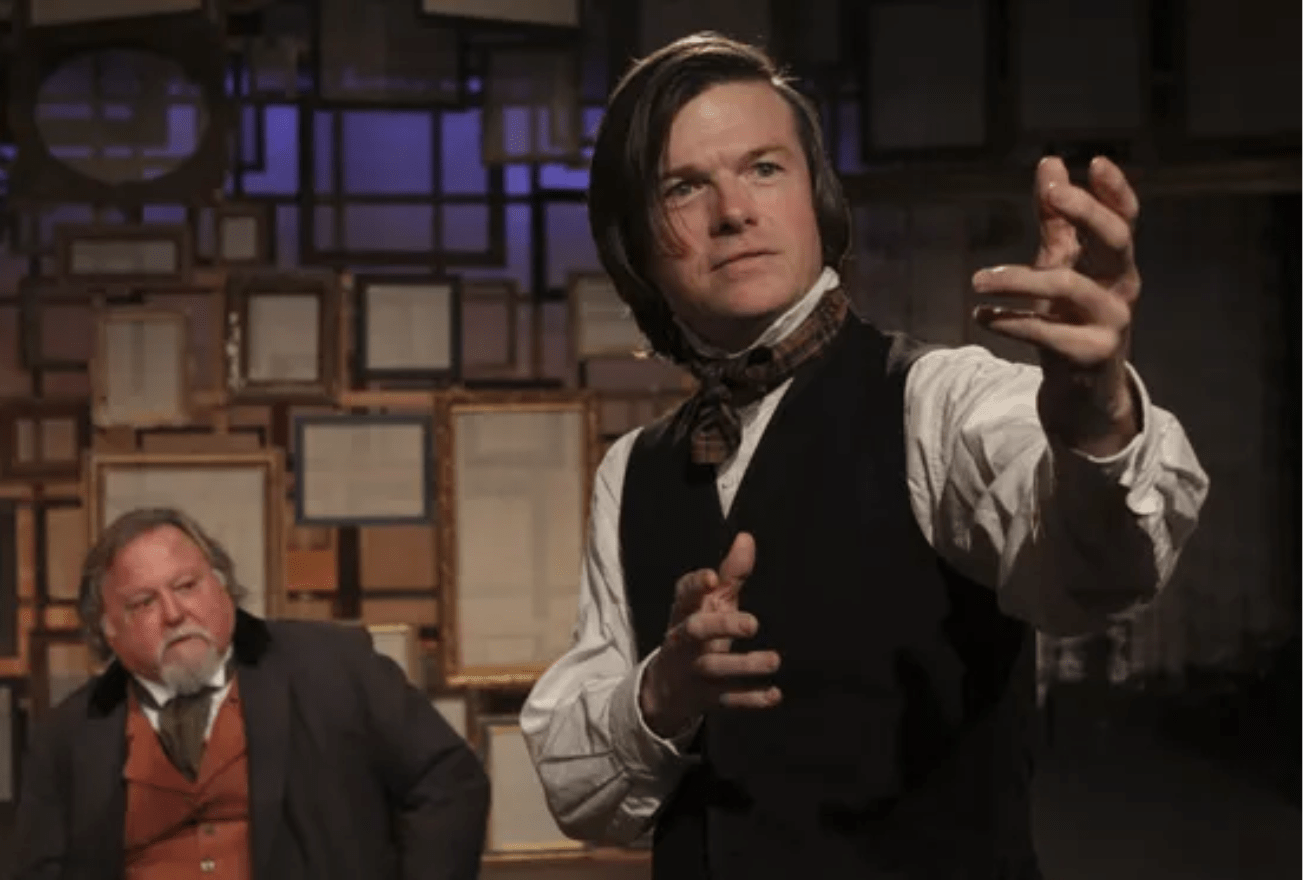
Here in Houston we’ve been blessed by a cornucopia of the best of his best. Main Street Theater and the Alley have performed him with inspired love. At Main Street: Travesties (1977-78); Rosencrantz and Gildenstern are Dead (1980-81); The Real Inspector Hound (1981-82 and 1982-83 and 2021-22); Jumpers (1984-85); The Real Thing (1986-87 and 2013-14); Rough Crossing (1992-93); Arcadia (1996-97 and 2009-10); Hapgood (1997-98); India Ink (1999-00); Night and Day (2000-01); On the Razzle (2004-05); the sublime triptych The Coast of Utopia: Voyage, Shipwreck, Salvage, (2011-12); The Hard Problem (2019-20); and opening in March, 2025, Stoppard’s last and most personal work, the magnificent Leopoldstadt. At the Alley: a pie-throwing Travesties (1998-99); The Real Thing (1999-2000); a superb The Invention of Love (2001-02); Hapgood (2005-06); a rollicking Rock ‘n’ Roll (2008-09).
Stoppard’s been well represented on our stages, and we’re forever grateful for the opportunity to see his work up close and live. He will be sorely missed. His wit, charm, intelligence, sharp tongue, and free-flowing imagination and curiosity are in short supply these days. Yet his plays will always be around to remind us what makes the most enlightened theater. God speed, Tom Stoppard.
This article appears in Jan 1 – Dec 31, 2025.
Related