

Audio recording is automated for accessibility. Humans wrote and edited the story. See our AI policy, and give us feedback.
HOUSTON — Jaqueline Hernandez crouched in front of the fridge in her second-story apartment on the northwest side of Houston, the fluorescent white light glowing over the mostly empty shelves.
Chickpeas, spinach, a box of pasta. That was all that was left from the last grocery store run, and now, she and her boyfriend were running out of cash. The 22-year-old mom works part time — typically between 4 and 10 hours a week — making about $13.50 an hour scanning tickets at an arena stadium and venues around the city.
“We just have to get creative,” said Hernandez, mulling their limited dinner options. That August night, though the air conditioner had sputtered out, they would have a chickpea stew.
Hernandez knows a stable income could be transformative for her family. She’d once seen a different future for herself — in high school she graduated at the top of her class. But the longer she has been out of school and without a full-time job, the harder it feels to get back on track. She’s gotten little relief from the city she has spent her whole life in: The few subsidized child care spots and flexible, high-wage jobs that would help her balance parenting all feel out of reach.
The sprawling swath of Houston has long built its reputation on economic promise. The city touts a booming job market, home to oil titans like ExxonMobil and food distributors like Sysco, and is one of the most affordable major U.S. metros with its cheaper groceries and rent.
And yet new analysis of census data reveals Houston’s economic wins are leaving its youngest residents behind. Since the pandemic, nearly 125,000 young adults in the greater Houston metro area are neither employed full-time nor in school. They may take on short-term or gig work to get by, but it often isn’t enough to escape poverty. Experts call these 16- to 24-year-olds “disconnected,” which means they are cut off from pipelines that lead to stability. At 13.3%, Houston has the worst rate of disconnection of the 25 largest metro areas in the country, according to a report by the economic opportunity research group Measure of America first shared with The Texas Tribune.
Mothers like Hernandez are more vulnerable to the plight: More than 40% of young mothers in the Houston area are not working or in school, four times the rate among young women without children. (It’s unclear how many of those mothers are stay-at-home, by choice.) Hernandez had toyed for a while with the idea of enrolling in college online, but with a 1-year-old baby and another on the way, she decided against it because she worried it would compete with the time and attention she needed to give her family.
“The jobs are here, the talent is here, but too many workers are left on the bench,” said Carolyn Watson, who is the co-chair of the Greater Houston Opportunity Youth Collaborative. “Young adults are the untapped talent pool…and they are trapped in low-wage work.”
While dozens of universities and colleges serve the region, a smaller share of residents have a postsecondary degree here than in other major urban areas. The highest wage jobs that don’t require a bachelor’s degree are in industries like construction and energy, with long and inflexible on-site work hours. That shut out moms: Women with and without children make up just 25% of the employees who fill these higher-paying roles.
One in five Houstonians live below the poverty line, a bigger slice than in other cities, which can make the sticker price of child care inaccessible. The state’s subsidized child care program barely alleviates the burden; tens of thousands of parents sit on the waitlist to get a discount.
City programs to re-engage young adults and offer discounted child care have sprung up, and yet, Houston’s progress lags behind its peers. From 2012 to 2022, the disconnection rate in virtually every major metro area improved, but Houston saw the smallest gains. San Antonio was a close second in struggling to connect young people to jobs.
Texas leaders have made bold commitments to getting young people on the path to power the city economy. About a decade ago, Texas said they wanted 60% of 25- to 34-year-old adults with a postsecondary degree or credential by 2030. Harris County officials have added more subsidized child-care spots using temporary federal relief money, but there’s no long-term funding stream to keep them going. If the state is serious about connecting them to good jobs, experts say it must find a way to reach these Houston parents.
“Texas is not going to achieve that goal without the Houston area,” Watson said. “So let’s just get all on the same page about the urgency of the issue.”
A derailed promise
State leaders have spent the past 10 years trying to get more young Texans to complete a postsecondary degree or certificate. In 2015, just 38% of Texans had done so, a rate that worried Texas leaders because of the demand for jobs that needed some training after high school. The goal was to get that rate up to 60% by 2030.
The state has made steady gains in degree completion but is still 10 percentage points short of its goal with little time left to make it up. As of 2021, about 49% of Texans ages 25 to 34 hold a postsecondary credential. Other states have set similar goals, with the education attainment rate in Florida climbing to 54.5% with a degree or credential in 2022.
“It is an urgent matter for Texas to increase our knowledge and skills to sustain and become globally competitive,” said Woody Hunt, an El Paso businessman, when he helped author the plan back in 2015. “To not do so has serious economic consequences for the state and our citizens.”
School always came easy to Hernandez. She was good with numbers. Growing up, Hernandez was sure college would be her way out of the city . She wanted to be a zoologist and she was on track to qualify for automatic admission at the public universities in Texas.
Then COVID-19 derailed her.
The pandemic was one of the biggest threats to the state’s ambitions. As school closures upended studies for a generation of young Texans, many fell out of school, out of work, or both.
Hernandez was in her junior year of high school when the pandemic hit. As the eldest of three in a single-parent household, she ended up spending more time taking care of her family than studying. That year, she’d start the car engine as early as 4 a.m. to get her mom to work after her mom totaled a car in an accident.
 Jaqueline Hernandez’s baby watches as Hernandez and Evan Arratia shop at a North Houston grocery store. Annie Mulligan for The Texas Tribune
“It was COVID, I was stuck at home. And because I was stuck at home, I was just taking care of kids,” she said. “That’s what my life consisted of.”
Her GPA fell from 4.3 to 3.5. The pandemic pushed her to lean into what researchers call “parentification,” when children are forced to step into caregiving roles at an early age.
“They’re basically parents at 15 or 16, helping siblings,” said Kwon Bill, who works with disconnected youth through Harris County Public Library’s college career and support program, FutureU. “Education is important. But when you start to put everything on one plate, their education will take a hit.”
When it came time to apply for college, Hernandez did not have support to submit her financial aid form. A college counselor promised to help her with questions she was running into, but never followed up. At home, she was peppered with questions from her mother about how she would balance college with helping out with her siblings.
“To me, applying to college was really scary,” she said. “I didn’t know how to apply. I was so stressed out.”
A labor market favoring men
Hernandez got a full-time job right after high school, on the recommendation of a friend, cutting sheet metal for one of the biggest HVAC companies in the world. In one 12-hour overnight shift, as the steel-toed boots pinched at her toes, she’d use a machine press to churn out about a thousand parts and pack them into containers.
An entry-level position at the HVAC company, Daikin Industries, can be a foot in the door to higher wages eventually, but Hernandez only stayed for four months.
Hernandez described physically demanding working conditions, which included 50-hour work weeks, earning $13 an hour. She said her breaks were so short she barely had enough time to go to the Sonic drive through nearby for a meal.
Across the U.S., young men struggle more than women to stay engaged in work and school. But Houston sees a reversal of that trend, with the region’s dominant high-wage industries like construction and manufacturing favoring men. Here, the economy has left young women and moms behind. About three times as many young men than women in Houston fill the “middle skill jobs” Texas leaders tout, which pay well and don’t require a college degree.
Hernandez hasn’t had a full-time job in the four years since. She got pregnant 2 years later, and even when she felt the pressures of feeding an extra mouth, going back didn’t feel like an option. She opted for part-time gig work instead.
Construction and manufacturing jobs demand long hours and on-site work in the outskirts of the city, which women with caregiving responsibilities struggle to make work with the current child care landscape.
“Maybe you’re working in a place that isn’t necessarily where you live, maybe you’re working extremely early in the morning….That can create more difficulties finding child care,” said Sara Estep, an economist with the left-leaning think tank Center for American Progress. “Women are just so much more likely to take on the caregiving roles.”
Other industries in Houston — hospitality and food services, education and health care — all have a larger share of women and lower earnings. And while labor market data shows the region has been adding jobs in those fields, young moms like Tye Buckner have had a hard time getting those roles, too.
At 27, Buckner is a mom to an 8-year-old, a 5-year-old and an 8-month old. She spent nine years cut off from school and work, much of which she spent actively searching for a job in the food industry. Buckner said employers seemed less willing to take her on when she disclosed she had caregiving responsibilities.
She once had a job interview at a fast food restaurant to be a line cook overnight and in the mornings. When she expressed relief that her mom would be able to watch her son during her shifts, the manager’s demeanor changed.
 A Montrose Grace Place sticker decorates the window of Executive Director Courtney Sellers’ office at Kindred Montrose in Houston on Aug. 11, 2025. Annie Mulligan for The Texas Tribune
“That turned them away a little bit. They were like, ‘Well, we need you fully focused,’” said Buckner, who eventually landed on her feet as a chef at Montrose Grace Place, a shelter for homeless youth. “They thought, knowing how young my son was, that I wasn’t going to be able to fully apply myself.”
Buckner did not get called back after that interview. While the job rejections were coming in, she found other ways to get by — babysitting, cooking for people, whatever brought in a little cash.
“I’m not going to lie. It was hard trying to find work,” she said. “To have little money on the side for my kids, I had to find a way….It wasn’t easy, but I knew I had to do it.”
Caretaking and completing degrees
This summer, Hernandez toggled between tabs on her computer. One for Houston Community College, another for the University of Houston. For the first time in years, she felt like she could go back to school.
The years after she quit her manufacturing job were punishing at first. On the nights she wasn’t watching her siblings, she battled with substance abuse. Hernandez then had her baby in 2024, after which she spent the first months as a mom living out of her car. But the 22-year-old had worked her way up.
The Houston area has more than 30 colleges, including some of the state’s biggest institutions. This August, she looked into their accounting programs, all of which seemed to need her to find child care for her son so she could attend the required in-person classes. The community college offered her a discount at its child care center on the main campus. It seemed promising at first, until she mapped out the 40-minute drive each way to get there.
“The money I’d be saving on child care would be the money I’d be spending on gas,” Hernandez said. “In Houston, getting across town is tough.”
Hernandez decided at first her best option for college wasn’t a Houston or a Texas institution at all. It was Penn State Online, which advertised asynchronous classes she could complete at her own pace.
Houston and the surrounding 13 counties, which make up the metro area, have about 465,000 licensed child-care seats, but only 44,000 are subsidized for low-income families, according to an analysis from Children at Risk. That breaks down to 16 seats for every 100 children with working parents. Many providers can’t afford to lower their rates, and parents can’t afford to pay more.
“It’s a market system that does not work,” said Kim Kofron, the director of early childhood education at Children at Risk. “You have child care providers that are on the verge of closing because parents can’t afford current rates, but centers can’t charge less — they’ve got bills to pay. If you don’t have child care to support you to go to work, how do you get those jobs?”
Texas’ child care subsidy program is meant to help working parents, but about 28,000 parents in the Houston area are on the waiting list, according to the Gulf Coast Workforce Board, which helps distribute the subsidy. That’s if you can get past the red tape to qualify.
To get assistance, parents usually have to show proof that they already have a job or are in school. Advocates call it a catch-22 because most need child care to go to work and school in the first place. And if parents receiving the stipend lose their job, they have just 30 days before the state cuts off their benefits.
Harris County Judge Lina Hidalgo, who declined an interview, has tried to fill some of the gaps with a countywide early childhood initiative funded through federal COVID relief money. The programs have expanded access to child care and early learning for low-income families, but that funding is temporary — it runs out in December 2026. Hidalgo has proposed a sales tax as a way to make the funding source permanent, but the proposal failed to pass the Commissioners Court and did not appear on the November ballot.
“It does help families pull themselves up by the bootstraps, but we’ve got to give them the boots,” Kofron said.
And when a parent can secure a seat in child care that is affordable care, they have to figure out how to get there. Houston’s sprawl and limited public transportation system make simple trips across town time-consuming and costly.
Texas is one of the few states that doesn’t give its major cities direct operating funds for public transit, according to Peter Eccles, director of policy and planning at transportation advocacy group LINK Houston. In a city that is so dependent on freeways to get around, he described an uphill battle trying to maintain the limited amount of public transportation that does exist, let alone expanding to the outskirts of the city.
“Our jobs are spread all over the region, and we need robust transit to connect people to those opportunities,” Eccles said. “We need more revenue to run the level of service that would let people take a job or a class that’s otherwise out of reach because of transportation.”
 Jasmin Romano plays with her son at Kids Empire, a play place in North Houston, on Monday, Aug. 11, 2025. Annie Mulligan for The Texas Tribune
For 24-year-old Jasmin Romano, all of this turns choice into calculus. Romano, who’s working on her GED while caring for two toddlers, would like to take an in-person course at Lone Star College.
The child care center around the corner from her house would be most convenient, but that would cost her about $1,500 a month, which eclipses what she earns in a small stipend as a community advocate. She could apply for the subsidy but she knows she likely wouldn’t get it anyway.
Romano doesn’t have trusted family members to watch her kid, so most nights she plans to study after bedtime.
“My free time is when they go to bed,” she said. “But once it hits nine, I either fall asleep or I’m too tired to get anything done.”
The barriers became too much for Hernandez, too. Hernandez had already created a login for Penn State Online when she learned she was pregnant with her second child.
It was enough to set her back to square one in her enrollment journey. Every time she tried to picture logging into classes, the demands of motherhood felt bigger and more important.
The deadline to enroll in the accounting program is January. She’s planning to let the deadline pass by.
”I just thought now was not the time,” Hernandez said.
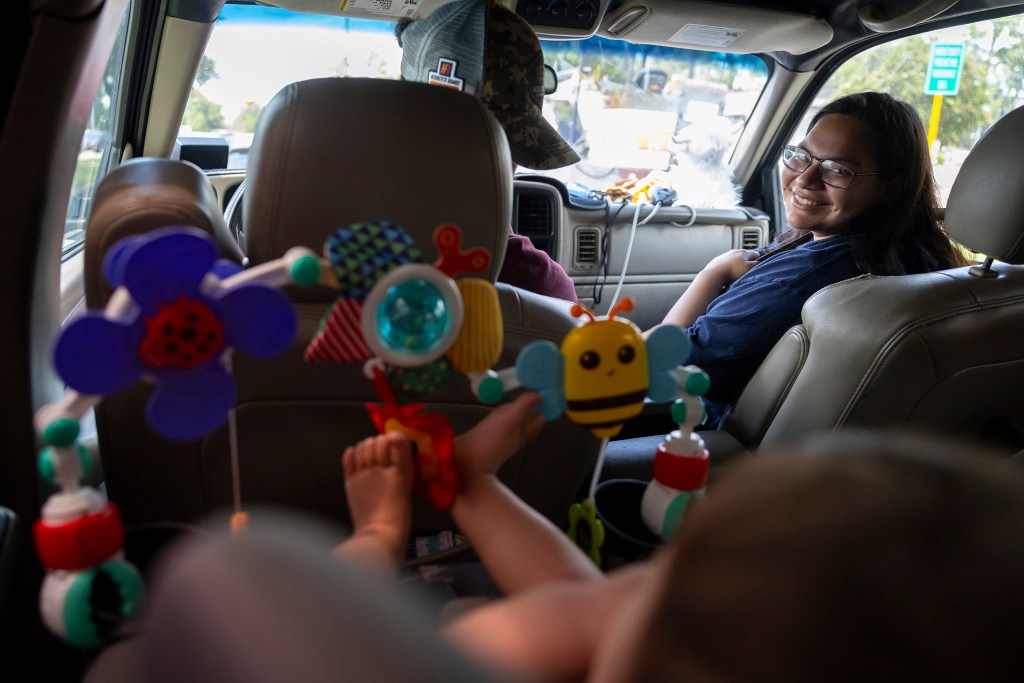 Jaqueline Hernandez smiles at her son during a trip to the grocery store. Annie Mulligan for The Texas Tribune
The Texas Tribune partners with Open Campus on higher education coverage.