
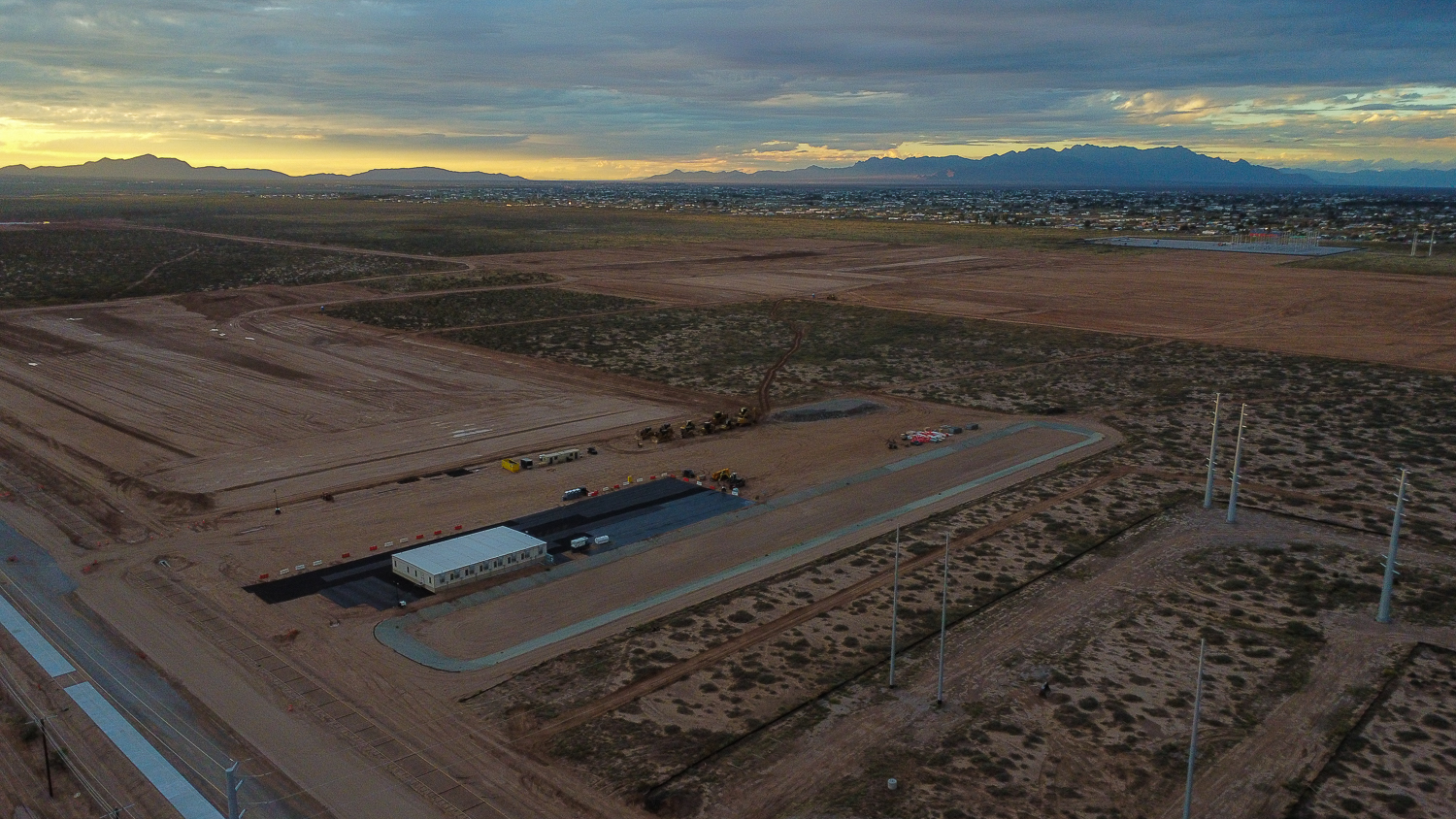
The $1.5 billion data center that Meta Platforms is building on a 1,000-acre parcel in Northeast El Paso will likely use around 400,000 gallons of water per day on average when it’s up-and-running, according to estimates from El Paso Water.
The water supply agreement between Meta and the city-owned water utility permits Meta to use as much as 1.5 million gallons of water per day, although the data center’s actual water usage will depend on how hot it is in El Paso.
“When the temperature is less than 86 degrees, Meta’s not going to use anything” for cooling, John Balliew, El Paso Water’s chief executive, told El Paso Matters.
The data center would likely use the maximum amount of water allowed – 1.5 million gallons per day – if it reaches 117 degrees here, according to Balliew.
“But if you say, ‘OK, what on average does that look like?’” Balliew said. “Even in a hot year, it’s probably, like, 400,000 gallons per day.”
A usage level of 400,000 gallons of water per day would not have put Meta on the top-10 list of El Paso Water’s biggest customers last year.
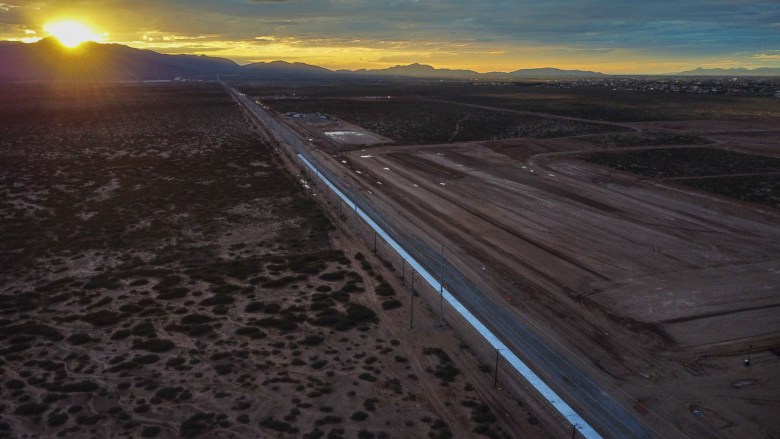 Construction begins on a Meta data center, located between Stan Roberts Sr. Ave. and State Line Road in Northeast El Paso, Oct. 13, 2025. (Corrie Boudreaux/El Paso Matters)
El Paso Electric – which uses a lot of water for cooling at its power plants – was the water utility’s biggest customer by far last year, when it purchased 19 million gallons per day. El Paso Electric used about 20% of all the water El Paso Water supplied to customers last year. Big industrial operators such as El Paso Electric and Marathon Petroleum produce some of their own water privately, but purchase the majority of the water they use from El Paso Water.
LEARN MORE: Meta to build $1.5 billion data center in Northeast El Paso
The other top customers are mostly government entities, such as the federal and county governments. The city of El Paso’s facilities used about 4.4 million gallons per day last year. That includes recreation centers, the convention center and City Hall, among other city-owned buildings.
Other top customers of El Paso Water last year included the El Paso and Ysleta school districts, which purchased an average of 946,000 and 740,000 gallons of water per day, respectively, according to El Paso Water’s most recent financial report.
“If you go back to, let’s say, 1980, 1990, who were the largest customers of El Paso Water? Well, we had ASARCO, we had Phelps-Dodge, we had all these garment finishers … that used more than a million gallons per day,” Balliew said.
“All those people are gone,” he said. “So, if you ask us right now, ‘What is your top 10 list of customers?’ Well, you’re going to see schools and hospitals in there that would not have been in the top 10 back in 1990.”
For comparison, El Paso Water can pump a maximum of 157 million gallons of water per day. The utility on a typical day supplies about 110 million gallons of water to its 223,000 customers.
El Paso Water’s top executives have consistently said they can meet the demand for Meta’s data center.
Still, Balliew said there are limits to the amount of big water users the city can accommodate, in part because of water supply but also because the utility can only pump so much water through its existing network of pipes and water mains.
“Everybody – the county and the city – (felt) that this is a good economic investment for the city. Then we went ahead and did what needed to be done,” Balliew said, referring to Meta’s data center.
“But we can’t do this a lot,” he said. “In Northeast, I don’t think we could do another one.”
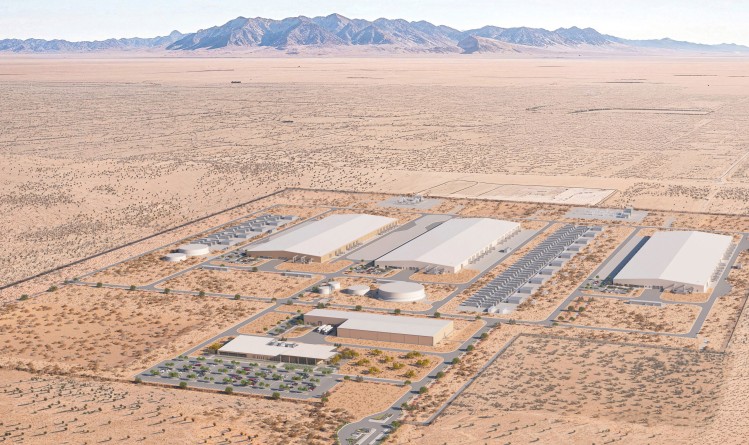 A rendering from Meta depicting the company’s planned El Paso data center. (Meta Platforms)
Meta’s facility – similar to the nearby Project Jupiter data center in Santa Teresa – will house big stacks of computer servers that process information and enable artificial intelligence functions. The developers of both data centers have said they will utilize a closed-loop water system that, during most of the year, will recycle the same water for cooling to transfer out heat from the computer equipment.
Meta declined to comment on this story. In a news release announcing the El Paso data center project, the company said it will “restore 200% of the water consumed by the data center to local watersheds.”
Meta didn’t specify how its water restoration will work in El Paso.
However, the company has partnered with nonprofits to implement projects in other arid communities to offset its data centers’ water use, according to a Meta report on water restoration. Examples include one project in Arizona to convert farmland irrigation systems from flood irrigation to more water-efficient drip irrigation. Other projects, also in Arizona, involve covering ditch irrigation canals to prevent evaporation and lining dirt canals with concrete to prevent seepage and erosion.
PODCAST: We talk about El Paso’s water future with a top executive from city’s water utility
“We are actively working with local partners to identify restoration projects that will also benefit local communities and habitats,” Meta’s news release said. The company said it will work with the nonprofit Dig Deep, which works to provide first-time water service to colonias that lack water or sewer services.
The company has said it will publicly disclose the water consumption figures for its El Paso data center in an annual sustainability report in which Meta shares water usage figures for all of its U.S. data centers.
For its part, the developers of Project Jupiter – including Oracle, OpenAI and Stack Infrastructure – have said that the data center campus will consume about 20,000 gallons per day for the data center buildings, while a dedicated natural gas power plant that will power the facility will also use 20,000 gallons per day. Project Jupiter will receive water from the Camino Real Regional Utility Authority.
These big data centers that technology companies are building in El Paso and throughout the country are “foundational to the broad AI activity, which is having a big impact on the IT tech/cloud world, and expected to have a broad impact on society as a whole,” Andrew Chien, a professor of computer science at the University of Chicago and an expert on the nationwide data center buildout, said in an email. “This is the foundation of the modern/future internet.”
The last generation of data centers built five or 10 years ago used evaporative-cooling technology rather than closed-loop. Evaporative cooling is more water-intensive, while closed-loop systems use more electricity, Chien said.
Closed-loop cooling systems “were widely used for decades, but had fallen out of favor for the largest facilities because the ‘evaporative’ cooling techniques allowed lower cost,” Chien said.
“But it’s proven, so there should be no problem,” he said of closed-loop technology.
READ MORE: Tech giants Open AI, Oracle behind $165 billion data center campus near El Paso
At a student-organized panel discussion Nov. 19 at the University of Texas at El Paso, opponents of the data center development criticized El Paso Water for agreeing to supply water to a data center while the utility has also said it will accelerate costly plans to import water from Dell City, Texas, to preserve the El Paso’s groundwater supplies.
“If they want to import that much water,” said Bill Addington, a rancher in Sierra Blanca and a West Texas environmental organizer, “what business do they have bringing water-intensive industries that use a lot of water?”
“It sets a very bad precedent – I would say a horrible precedent – when you’re talking about an already-stressed desert community,” Addington said in front of a standing-room only crowd on UTEP’s campus.
 A standing room-only crowd at the University of Texas at El Paso listens as opponents of data centers speak about negative aspects of local data center projects such as Project Jupiter in Santa Teresa and Meta’s data center in Northeast El Paso. (Diego Mendoza-Moyers / El Paso Matters)
El Paso Water is undertaking a number of projects to increase the amount of water available for the city. Those projects could ensure El Pasoans have alternative sources of drinking water, especially if the trend of significant year-to-year swings in the amount of water flowing through the Rio Grande into El Paso continues as a result of climate change.
The utility is building the Pure Water Center that broke ground earlier this year and is expected to feed into the city’s drinking water supply by 2028. The plant will treat wastewater from the nearby Bustamante Wastewater Treatment Plant to drinkable standards and re-insert as much as 10 million gallons per day back into the city’s water supply.
El Paso Water is also entering the last phase of its expansion of the Kay Bailey Hutchison Desalination Plant, in which the utility is increasing production capacity from 27 million to 33.5 million gallons daily from 27 million currently.
And El Paso Water recently unveiled a plan to expand a water treatment plant in the Upper Valley to pull water from the Rio Grande for treatment. Currently, the Upper Valley plant pumps up and treats groundwater from the Mesilla Bolson, but the utility has acquired additional rights to river water over the years. So, the long-planned plant expansion is expected to boost the city’s available water supplies by 5 million gallons per day, according to El Paso Water.
Related
LISTEN: EL PASO MATTERS PODCAST