
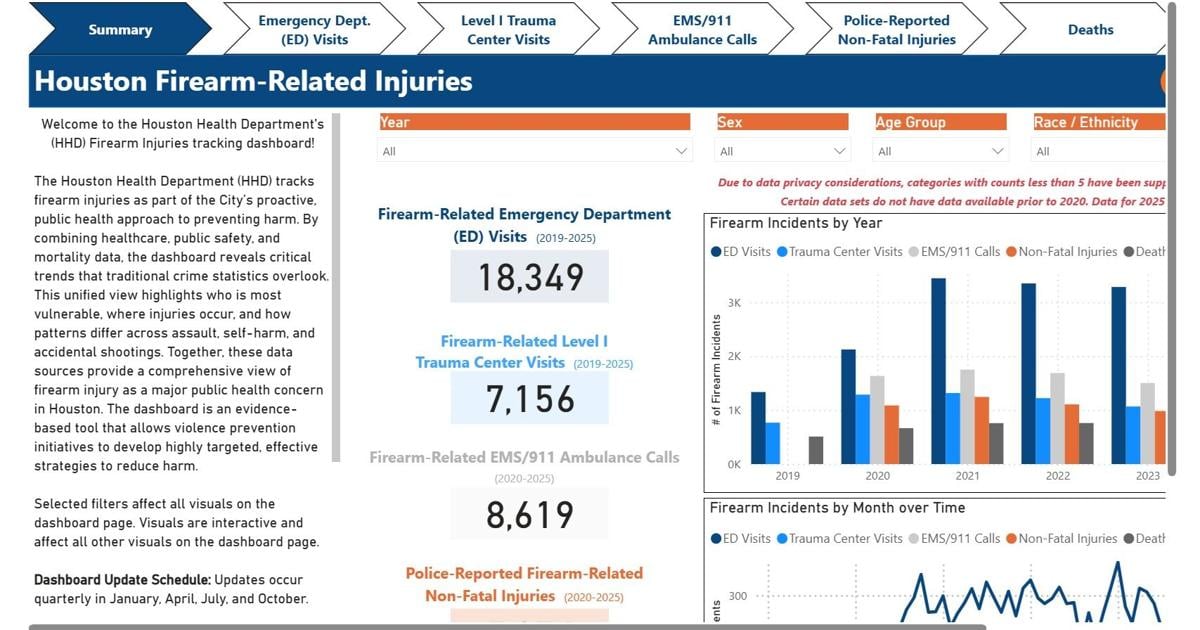
Houston has introduced a first-of-its-kind firearm-injury dashboard—integrating hospital trauma data with police, EMS, and medical examiner records—in an effort to confront rising accidental shootings involving children and young adults.
Council Member Abbie Kamin unveiled SAFEWatch Houston, the nation’s first dashboard to combine Level I trauma center clinical data with emergency response systems. While overall gun-related trauma visits have fallen since 2021, the new tool reveals a troubling countertrend: unintentional shootings among Houstonians ages 0–24 are increasing.
The data underscores the concern. In 2024, Houston’s three Level I trauma centers treated 991 firearm-related injuries. Of the 203 unintentional injuries, about half—101 cases—involved children and young adults. Through June 2025, hospitals recorded 56 trauma visits for victims under age 25, meaning that “on average, every week in Houston, a child or young adult arrives at an emergency room because of an accidental shooting.”
“Firearm injuries are preventable. I’m sick and tired of seeing headline after headline, when there is something we can all be doing to solve this very real public health crisis,” Kamin said. She spearheaded the creation of the dashboard, securing funding and coordinating the multi-agency collaboration. She praised the partners behind the project, adding, “When dealing with a public health issue, like firearm injuries, data enables us to see exactly what is happening and where—informing what we need to do to meaningfully curb it. Houston is proving you don’t have to choose between respecting gun rights and protecting children. With the right tools and the courage to act, we can save lives without taking sides.”
SAFEWatch is publicly available at HoustonHealth.org/safewatch. Kamin emphasized the behind-the-scenes work that made it possible: “It is often our healthcare workers who are our unsung heroes. None of this would have been possible without the incredible and talented work of our Houston Health Department employees.”
A broader picture of gun injuries
While many cities maintain crime-based dashboards, SAFEWatch presents a more comprehensive view of firearm injuries, including intent (unintentional, assault, self-harm), demographics, time and location patterns, and survival outcomes. According to the dashboard’s data, one in five firearm injuries treated at Houston trauma centers in 2024 were unintentional—cases that may never appear in police reports but represent preventable harm.
“On average, every week in Houston, a child is rushed to a trauma center because of an accidental shooting. These aren’t crimes—they’re preventable injuries,” said Dr. Sandra McKay of UTHealth Houston and the Baker Institute for Public Policy. “As a pediatrician, I shouldn’t be caring for children who have been injured by guns. But I do, because of a number of reasons, including that guns aren’t stored securely. This dashboard gives us the evidence to guide interventions to help change that.”
Hospitals share data for the first time
Houston’s effort is the first in the country to integrate clinical trauma data—including injury intent and detailed outcomes—with EMS, police, and mortality data.
“For the first time, Houston’s hospitals, police and emergency responders are looking at the same picture—a comprehensive picture—and acting together,” Kamin said.
The dashboard reflects a partnership among the City of Houston, Memorial Hermann, Ben Taub Hospital, and Texas Children’s Hospital, all of which agreed to share anonymized Level I trauma data with the health department.
“By collaborating with the other Level I trauma centers and the Houston Health Department on this unique dashboard, Ben Taub Hospital’s trauma program is helping to shine a light on the devastating impact of gun violence in our city and county,” said Stephen Mora, director of Trauma Services at Ben Taub. “Together, we are turning data into a shared call for action so that we can better understand the problem first, and then create meaningful solutions for the future.”
Dr. Michelle McNutt of Memorial Hermann said the health system views gun violence as a public health emergency. “We agree with Council Member Kamin that it will require a multi-pronged approach with multiple partners working together to drive real change. By combining our resources and our data, this collective of first responders and trauma providers will be able to develop more effective, efficient and targeted solutions.”
And at Texas Children’s Hospital, rising pediatric injuries are cause for alarm. “It is profoundly disheartening to witness the increasing number of young lives lost to unintentional shootings,” said Dr. Erin Henkel, Associate Trauma Medical Director. “Each statistic signifies a life brimming with potential, a family left heartbroken, and a community in mourning.”
Data-driven prevention strategies
The Houston Health Department will use dashboard findings to convene a new task force of hospital and community partners focused on reducing unintentional injuries and improving pediatric safety. The data will guide several coordinated interventions:
Project ChildSafe Houston, expanding community access to gun locks and safes.
Pediatric safety screening, training clinicians to discuss firearm storage during well-child visits.
“This dashboard does not just count tragedies—it is a roadmap to prevent them,” Dr. McKay said. “We’ll know within months whether our interventions are working, and we’ll adjust until they do.”
Kamin stressed that the initiative centers on prevention, not politics. “This is about keeping Houston’s kids and families safe. A loaded, unsecured firearm that a child can get to is a serious health risk we can fix—every parent, regardless of politics, wants to prevent that nightmare.”
SAFEWatch allows users to explore patterns by ZIP code, injury intent, age, sex, race, drug or alcohol involvement, and location type (home, vehicle, public space). It also provides seasonal and time-of-day trends, survival outcomes, and comparisons between incident ZIP codes and victims’ home ZIP codes.
All data is anonymized and aggregated in compliance with HIPAA and reviewed under institutional protocols. The dashboard updates quarterly and is designed for policymakers, researchers, healthcare providers, community organizations, violence-intervention programs and residents.
Kamin, a civil rights attorney and lifelong Houstonian, represents District C and has been nationally recognized for data-driven public safety initiatives. A former chair of the city’s Public Safety & Homeland Security Committee, she led the creation of the SAFEWatch dashboard and continues to advocate for policies that protect children, support families, enhance resilience and improve quality of life across Houston.
To access the SafeWatch dashboard, visit houstonhealth.org/safewatch.