
Fort Worth needs a plan to advance itself as a medical hub of innovation.
A plan and collaboration are key to advancing medical innovation, medical and business leaders said Tuesday during a Fort Worth Report Candid Conversation public policy discussion.
Dr. Stuart D. Flynn, founding dean of the Anne Burnett Marion School of Medicine at TCU, said he doesn’t view UNT Health Fort Worth or any other school as a competitor but rather a partner to collaborate with.
“We’re building lanes of excellence,” he said. “If you want to see competition, go to Dallas, go to Boston, go to the Bay area, go to LA. We have something unique in this city, and it’s very fragile and that is: We actually all work together, like one another and are willing to collaborate.”
Flynn and other panelists of the Candid Conversation stressed that when medical systems and institutions work together to advance and share knowledge and research, they advance the city as a whole.
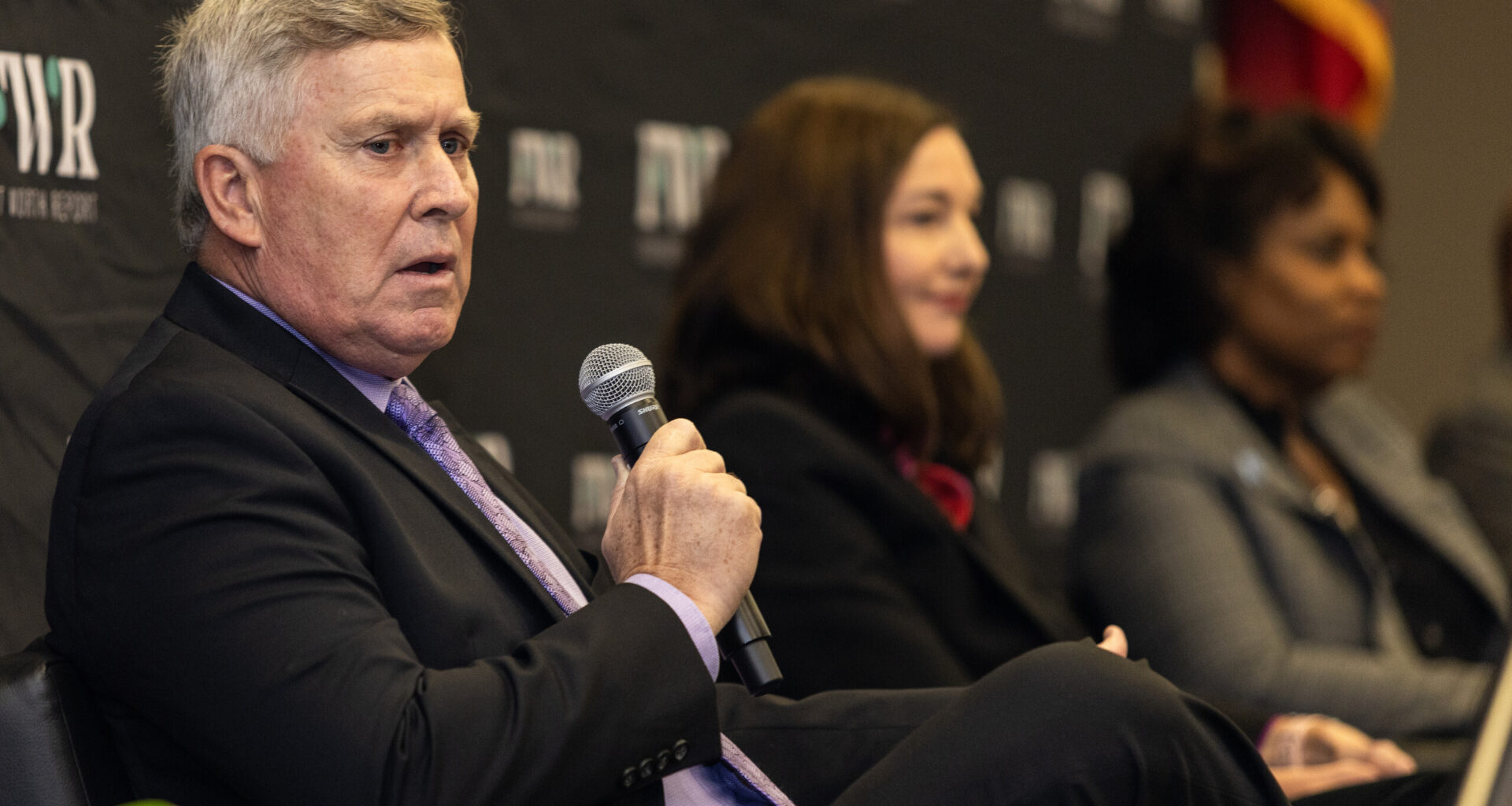
“If we can bring that aspect of what the community needs with industry, with government, with the citizenry in general, then we have the essence of putting together a hub of activity,” said Dr. Kirk Calhoun, president of UNT Health Fort Worth.
 Dr. Kirk Calhoun, president of UNT Health Fort Worth, speaks at a panel about medical innovation at Tarrant County College Trinity River Campus on Dec. 2, 2025. (Maria Crane | Fort Worth Report/CatchLight Local/Report for America)
UNT Health Fort Worth conducts about $110 million of medical research every year, and the goal is to reach $200 million annually, Calhoun said. UNT Health and TCU worked together to start a medical school, but that partnership ended in 2022.
Calhoun joined UNT Health in 2025 and emphasized the university would work with anyone to further its mission. He brought up the medical school partnership that ended and said, “Those kinds of ideas and so forth are good, but terribly difficult to accomplish.”
They’re difficult, he said, because of the difference in cultures between D.O. and M.D. schools. UNT founded a School of Osteopathic Medicine, which produces D.O. doctors, in 1970. TCU’s medical school produces doctors of medicine, or M.D.s
“But just because a culture is different does not mean you have any permanent enemies or friends, or you fail to work together,” Calhoun said, adding that he and Flynn had coffee three weeks earlier to discuss ways the two universities could work together.
Elyse Stolz Dickerson, CEO and co-founder of Fort Worth-based Eosera, said TechFW, initially created by local leaders in 1998 to be an incubator for medical technology, could help create a road map for uniting universities, hospitals and businesses.
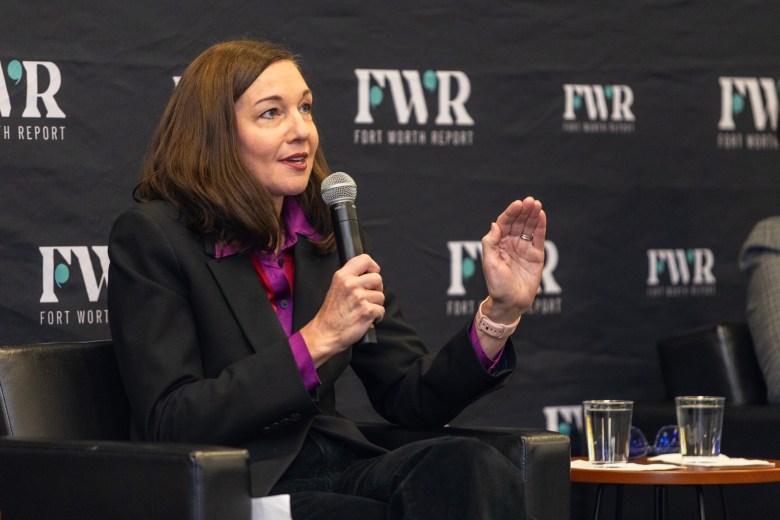 Elyse Stolz Dickerson, CEO and co-founder of Eosera, speaks at a panel about medical innovation at Tarrant County College Trinity River Campus on Dec. 2, 2025. (Maria Crane | Fort Worth Report/CatchLight Local/Report for America)
A leader with a vision for a medical innovation hub is needed, Flynn said.
“We haven’t put together a strategic plan that we all agree should be our marching orders with all of this,” he said.
A timely, but small road map with a set of achievable objectives is the first big obstacle, Flynn said.
He said he learned how difficult it was to get buy-in on a plan when he helped launch the University of Arizona College of Medicine in Phoenix, about 100 miles away from the main campus in Tucson. The community was splintered on innovative research, so the opportunity for a hub was lost, he said.
“The longer we wait, the more apt this city is to splinter” on those efforts, he cautioned.
Funding could be an issue since most Texans invest in real estate and oil and gas operations rather than in medical innovation, said Dickerson of Eosera, which makes ear care products for consumers.
“If we don’t incubate enough companies here, we won’t have any success,” she said.
Calhoun said a hub could answer critical questions about research and patient care.
“How do we improve quality? How do we control costs? How do we better access? Those are all critical issues, that if we can solve those problems here in Fort Worth, we have something that generates a benefit across the entire nation,” Calhoun said.
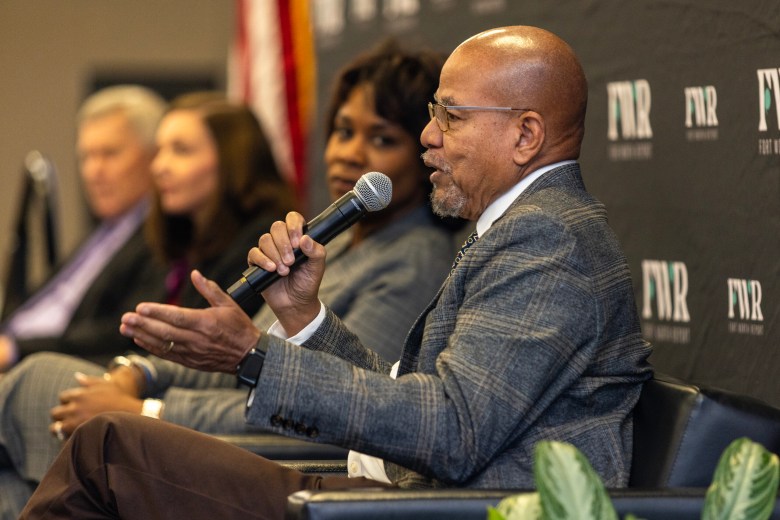
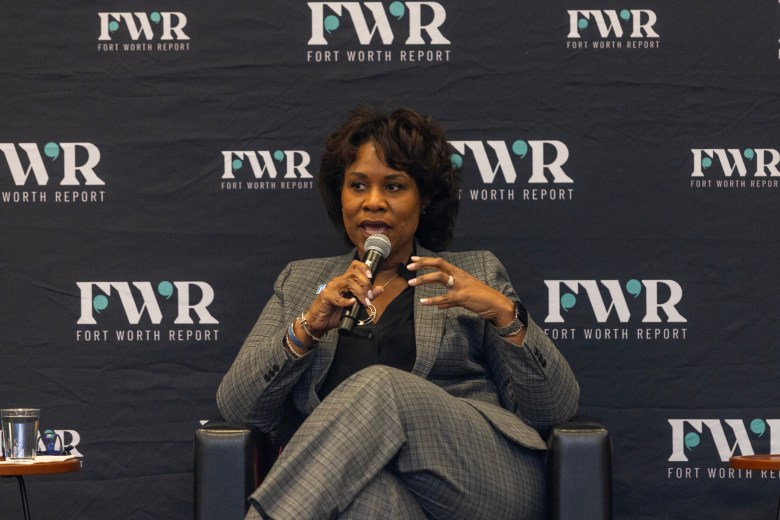 Dr. Tricia C. Elliott, senior vice president of academic and research affairs at JPS Health Network, speaks at a panel about medical innovation at Tarrant County College Trinity River Campus on Dec. 2, 2025. (Maria Crane | Fort Worth Report/CatchLight Local/Report for America)
Dr. Tricia C. Elliott, senior vice president of academic and research affairs for JPS Health Network, said she supports the idea of using research and making it practical and applicable for patient care. Medical research and trials often benefit JPS patients, she noted.
A focused medical effort, she said, could allow for collaborative projects.
“Each collaborative partner is able to actually have a very pointed impact on that actual health system or whatever it is we’re trying to accomplish,” she said.
A guided hub could shorten medical research into actual practice sooner, Elliott said.
“You’re really able to translate that research, translate that medical innovation into practice,” she said. “That’s what you do because everybody is at the table. Having that collaboration to be able to do that and shorten that time to be able to really make it effective for patients in our community is the ultimate goal.”
When Eosera was starting, Dickerson said, she rented lab space from UNT Health Fort Worth to develop her first ear wax solution and conducted clinical trials for the drops at JPS Health Network. TCU provided interns who had an opportunity to see a company’s beginnings, she said.
Health startups need time to grow or they will move to other cities that have more collaborative efforts in place with universities.
Flynn said he heard the word “competition” a lot when he arrived in Fort Worth a decade ago.
“I always found that kind of sad,” he said. “It was the wrong way to try to stand up and make this community grow. I would say that in probably the last four to five years, the word competition has turned into collaboration. I’m very sincere about this. I think this is now the beginning — the crystal, the nidus — of us being able to build an actual medical innovation hub.”
Until that flip, the hospitals and schools were all acting as independent actors competing rather than leveraging each others’ offerings, he said.
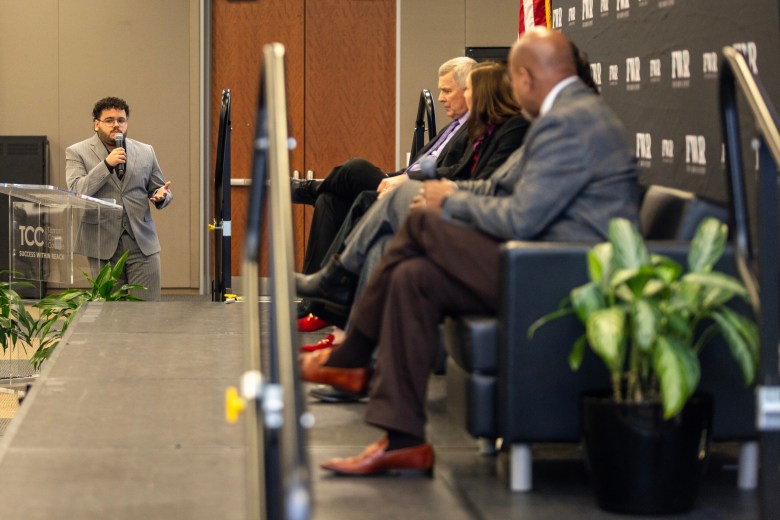 Health reporter Ismael M. Belkoura moderates a panel on medical innovation at Tarrant County College Trinity River Campus on Dec. 2, 2025. (Maria Crane | Fort Worth Report/CatchLight Local/Report for America)
Dickerson said teamwork is important for medical institutions and businesses so competition doesn’t hamper innovation.
“You have to be competitive to succeed,” she said. But, she added, that it’s important to keep one eye on the greater good.
“I am better if Fort Worth is better,” Dickerson said. “I am better if more talent wants to stay in Fort Worth when they graduate and work for me. I am better if our institutions are training workforce development.”
JPS could use innovative technologies and practices, including artificial intelligence, to improve care and make the patient experience even better, Elliott added.
Tracking those results, she said, could lead to better outcomes with maternal health and chronic diseases. That could also aid in economic development and talent retention and attraction, she said.
Flynn said Fort Worth is the last big city in the nation at a point “to paint its own picture” — an opportunity to develop a significant medical hub.
“It’s going to take 20 or 30 years to see some major fruits of this. … If we don’t start today, it’s never going to happen.”
Eric E. Garcia is a senior business reporter at the Fort Worth Report. Contact him at eric.garcia@fortworthreport.org.
News decisions are made independently of our board members and financial supporters. Read more about our editorial independence policy here.
Related
Fort Worth Report is certified by the Journalism Trust Initiative for adhering to standards for ethical journalism.
Republish This Story

Republishing is free for noncommercial entities. Commercial entities are prohibited without a licensing agreement. Contact us for details.