
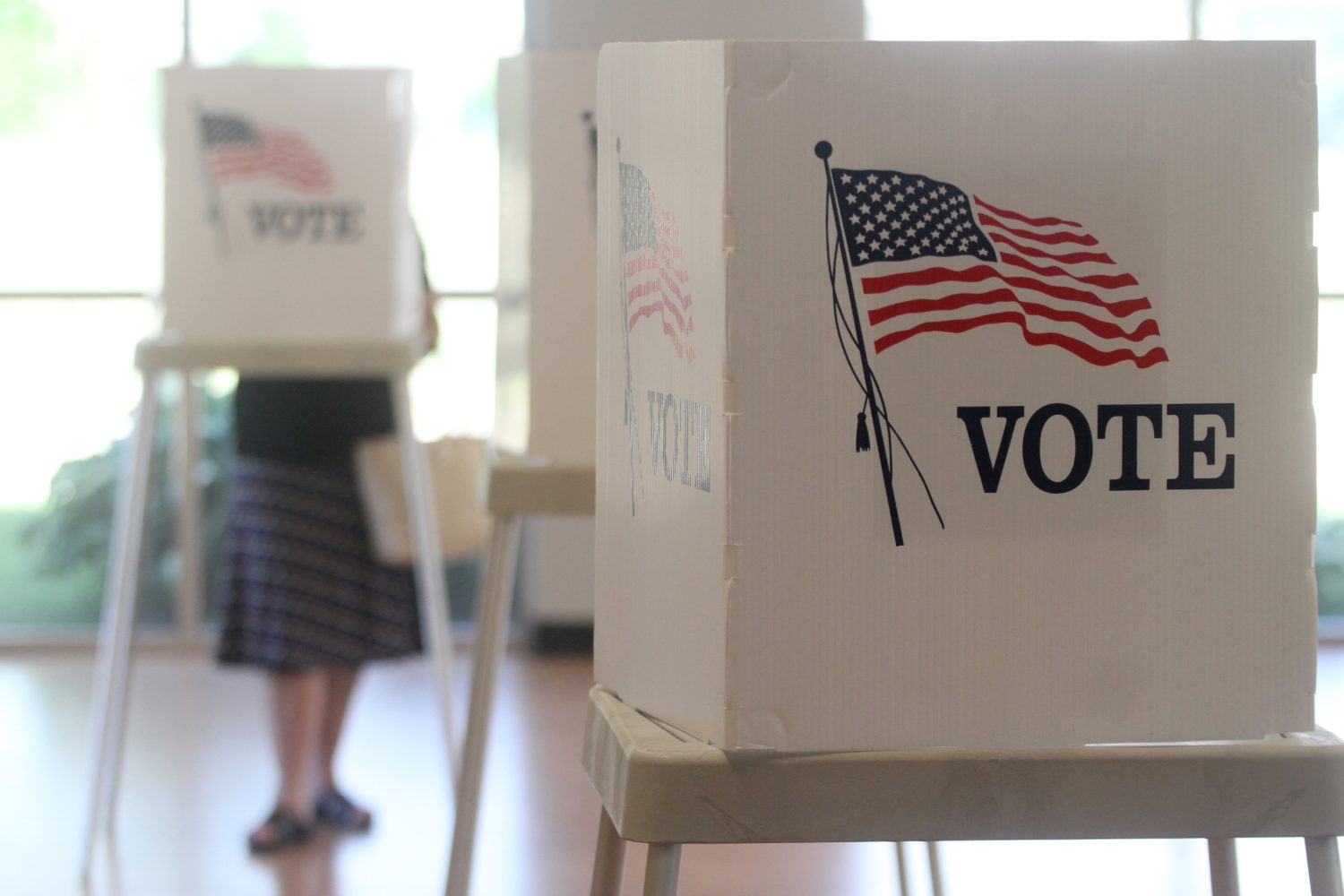
Voting booths stand ready for use in a Texas election.
Adobe Stock
President Donald Trump offered some misplaced kudos Tuesday morning, congratulating Dallas County for moving to paper ballots in next year’s primary elections. In reality, only the Dallas County Republican Party will make the move to paper ballots next March, but the decision could have implications for voters of all persuasions.
The push for paper ballots comes as skepticism towards voting machines has grown, but whether that skepticism is warranted can be debated. Ahead of the 2024 presidential election, Dallas County GOP Chair Allen West called for repeated testing of the county’s voting machines, claiming that the devices opened the county up to “grave risks,” including vote manipulation.
After three audits of the machines, even Attorney General Ken Paxton said he believed Dallas County’s equipment was suitable for the upcoming election. Still, West was not dissuaded from his belief that the county party needed to move towards paper ballots, a measure the group decided against in 2023 due to costs.
A county party committee voted in September to hand-count paper ballots next March. Pretty much every claim Trump made in his post requires a fact check, so that’s what we’re here to do.
This year, make your gift count –
Invest in local news that matters.
Our work is funded by readers like you who make voluntary gifts because they value our work and want to see it continue. Make a contribution today to help us reach our $30,000 goal!
“[Paper ballots are] more accurate, totally secure with watermark paper, FASTER, and only 9% of the cost,” Trump wrote on Truth Social. “All Republican Governors should mandatorily do this. Save Money and Freedom.”
Fact Checking Trump
Accuracy: Paper ballots have been a request of Republicans across the U.S. for years, with many party leaders making claims similar to West’s: machines mess up. However, according to multiple studies, hand counts, which paper ballots require, are prone to inaccuracy.
Rice University conducted a study that found that participants tasked with tracking the results of 120 ballots in two races accurately recorded the tabulations only 58% of the time. The average machine error rate sits around 0.5%.
Studies by MIT and voting experts have found that machines are more accurate than humans when it comes to tabulating votes. In 2022, Charles Stewart, Director of the MIT Election Data and Science Lab, wrote in the Washington Post that that’s because “computers — which ballot scanners rely on — are very good at tedious, repetitive tasks. Humans are bad at them.” The long hours worked by poll workers, often 12-hour days or longer, can also contribute to errors.
Additionally, Texas state law does not require an audit of ballots that are counted by hand, even if the results are found to be inaccurate.
Speed: Critics of paper ballots point to the logistical issues they pose when delivered in large numbers. In Gillespie County in 2024, it took 350 poll workers 24 hours to count all of the ballots submitted in the presidential race. Gillespie County’s population is 99% smaller than Dallas County’s. Due to the time required to count physical ballots, this practice is generally only employed in smaller jurisdictions.
Election results are required to be in within 24 hours of polls closing; otherwise, local officials could face investigations or charges.
Cost: Elections are cheaper when Democrats and Republicans agree to share polling places, but in the March election, the parties may not be sharing locations in Dallas County. If the Dallas County Republicans opt to host their own voting locations, Dallas Democrats would also find themselves pushed towards precinct voting centers instead of the citywide locations that have been operated in past elections.
West told the Texas Tribune that at least 360 voting locations would be needed to conduct a hand count, and those 360 locations would require nearly 2,200 poll workers. Labor costs for a 12-hour day would be at least $300,000, the party forecasts, and would likely rise rapidly as hand-counting ballots could stretch into the evening.
In 2023, the Dallas County Republican Party estimated it would need $1 million to count the 70,000 ballots cast in the 2024 primary, the Texas Tribune reports. The party is now attempting to raise $500,000 to help offset the costs, and state leaders have warned that they will not reimburse the party for the higher-than-average expenses.