
(TNND) — Researchers at Rice University’s Ken Kennedy Institute are working to leverage the power of artificial intelligence to give doctors new tools and improve health outcomes for patients.
There is no shortage of concerns over AI, a potentially transformative technology.
People are concerned about how AI will impact jobs, relationships, and youth mental health.
But Fritz Sedlazeck, a computational biologist at Rice University and Baylor College of Medicine, said he and his colleagues are working on exciting applications of AI that have the potential to save lives and propel medical breakthroughs.
“There are so many applications where AI is helping us to better understand the vast (amount) of data that is basically flooding and coming in from the medical sector, but also in the vast data amounts that we can sample from individuals,” Sedlazeck said.
AI can crunch massive amounts of data.
It can cross-reference numerous data points to help doctors diagnose someone more quickly and get them started sooner on treatment.
And it might give doctors the ability to offer improved or more tailored treatment options.
Just as ChatGPT can spit out wrong answers to simple questions, medical AI models aren’t flawless.
That’s why Sedlazeck said doctors will continue to shoulder the responsibility of treating their patients, regardless of how helpful their AI tools become.
“A clinician always has to be between the model, so to speak, and the patient to kind of vet these results,” he said. “But I think AI has been really instrumental and really great to prioritize certain outcomes or to highlight certain outcomes.”
Sedlazeck said one clear application of AI is to help doctors examine and interpret medical images, such as X-rays, CT scans, MRI, and ultrasound.
AI can be another set of eyes.
The technology, largely still in testing but getting closer to real-world clinical use, can help spot abnormalities in image data or other biometric data from patients.
AI can be used to develop new drugs.
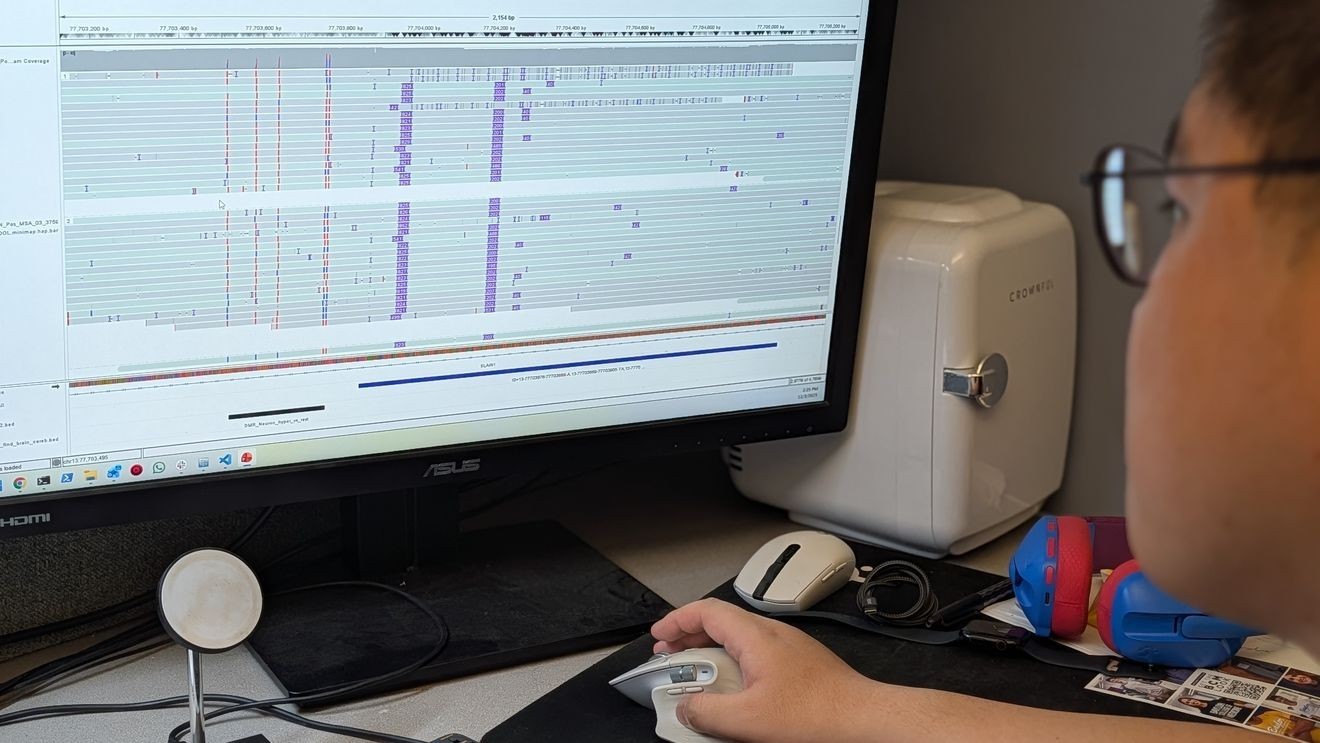
And it holds great potential in the field of genomics, which is the focus of Sedlazeck’s work.
“This is really important and interesting, because we can improve the interpretation or the diagnosis of rare-disease patients or cancer patients by identifying the genomic or genetic cause, or potential risk of progressing certain diseases, certain cancers, not just early on but also in treatment,” Sedlazeck said.
Our bodies are built of cells, and every cell carries inherited genetic information.
Some people are genetically predisposed to certain serious diseases, such as cancer or cardiovascular disease.
AI can help identify abnormalities in the genome, Sedlazeck said.
He said researchers hope to use AI to flag genetic risks, which could help doctors catch diseases earlier and treat patients more effectively.