

It was the summer of 1990 and Walter Moreau had just graduated from Baylor University with a degree in finance. For most people, the next step would be sending out applications for a job as an investment adviser, commercial banker, or accountant. Moreau didn’t want that.
“I wanted to do nonprofit work, not banking,” Moreau said. “And I got lucky, because my first job was at the United Way. They sent me to Skid Row in L.A. In the 1980s, a lot of the old flophouses, the residential hotels where you could rent a room, were being torn down. There was a movement by the SRO Housing Corporation of L.A., the Skid Row Housing Trust, and a group called the Los Angeles Men’s Project. They were buying up these old hotels and turning them into apartments for the homeless.”
Skid Row was, and is, 50 blocks just east of the skyscrapers in downtown Los Angeles. It has the largest concentration of homeless people in the nation. Moreau met Andy Raubeson, the leader of the SRO Housing Corporation. Raubeson was pioneering a new approach to homelessness called Housing First. In the Housing First model, homeless people are provided a place to live without first being required to quit drugs and alcohol. Once they’re settled, they’re surrounded with services to treat addiction and other health issues. They’re provided job opportunities and counseling.
The “SRO” in SRO Housing Corporation referred to single-room occupancy, a kind of housing that had been built on Skid Row in the early 1900s in the form of hotels which offered a single room with a bed to transient railroad and agricultural workers. At one time, there had been as many as 15,000 units of SRO housing on Skid Row. When Moreau arrived, half of it was gone and the rest was in bad shape. The SRO corporation was buying up the hotels, knocking them down, and replacing them. Sometimes they renovated them, adding skylights, tilework, and gardens.
“After they were renovated, they were really beautiful,” Moreau said. “They would try and preserve some of the lobby and entryway and mailboxes and front desk arrangements. And it was amazing to see the social services they provided. I met a lot of residents who had been on Skid Row for years, but now they had an apartment and were working and back on their feet.”
Raubeson took Moreau aside and explained the economics of the hotel acquisitions, the financing and tax credits. He’d written a book about it that he showed to Moreau. It lit up the finance part of Moreau’s brain. He saw it was something he could do. Today, Moreau leads Foundation Communities, the largest provider of affordable housing for families and formerly homeless people in Central Texas.
“So that experience really changed my life,” Moreau said. “What I saw in L.A. is that this model really works. It’s not that complicated. If you want to help somebody who’s on the street, really help them, it’s going to take providing a stable place to live and then addressing health issues.
“I came back and told my wife, ‘I know what I want to do. I want to go buy a hotel and serve people who are homeless.’”
The Homeless Industrial Complex
Austin has a fraught relationship with homelessness. The city’s residents have repeatedly approved bonds to provide tax money to address homelessness over the last 20 years. But the issue has also been at the heart of two backlashes against progressive policies: the vote to ban panhandling and camping in public places in 2021, and this November’s rejection of a proposed tax increase called Prop Q.
Prop Q was a request by city leaders that Austinites pay higher property taxes to fund a variety of social services. Had it been approved, it would have provided $30 million for a plan to address homelessness created by Austin’s Homeless Strategy Office. The plan would have funded what is called “the full homeless response continuum,” providing more long-term housing for the homeless, more temporary shelter, and much more money to help people on the verge of becoming homeless.
Mayor Kirk Watson and the Austin City Council voted 10-1 in August to put Prop Q on the ballot. Watson stressed that he supported the tax increase because of the homelessness plan. He spent significant political capital in public and behind the scenes to make the proposal happen.
Save Austin Now, the conservative political action committee which organized the effort to outlaw camping in 2021, began sending out mailers against Prop Q in September. A bitter campaign against the proposal rose up on social media.
The Prop Q opponents included personal injury attorney Adam Loewy and former County Judge Bill Aleshire, along with many people with anonymous handles, who denigrated the city’s homeless service providers as “grifters.” Several of the providers had contributed money to the Prop Q campaign, including Moreau’s nonprofit, Foundation Communities. The critics insinuated that the contributions amounted to self-dealing, though such donations are legal and common in politics. A homemade website created by a recent California transplant, Nate McGuire, captured the tone of the attack.
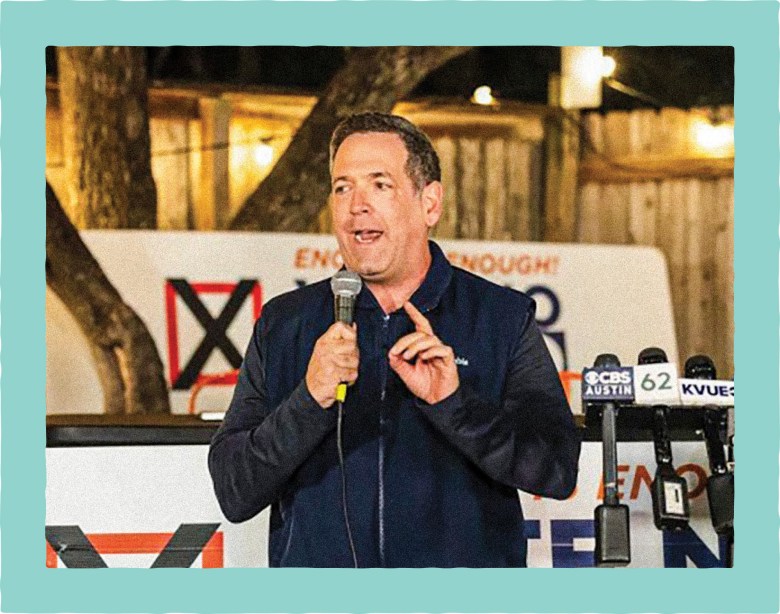 Adam Loewy speaks at an election night party after Prop Q’s defeat Credit: Brad Johnson / Courtesy of Adam Loewy
“Austin spends tens of millions each year on homelessness response, and most of that funding is outsourced to nonprofits through Social Services Contracts – creating a ‘shadow city council’ of organizations that shape priorities without being elected or directly accountable to voters,” a portion of the website, titled “Homeless NGO Complex,” read. The page named several of the shadowy entities – SAFE Alliance, which helps abused women and children; the Salvation Army, one of the nation’s best-known providers of shelter for homeless people; and Casa Marianella, a small group supporting immigrants and refugees.
In a post to X, Loewy reworded McGuire’s “Homeless NGO Complex,” writing that the city wanted “more money for the Homeless Industrial Complex.” This term was taken up by Prop Q opponents. They excoriated city leaders for making Austin “less safe and less clean,” a coded reference to the homeless. When Watson celebrated a report showing that the number of people becoming homeless in Austin had decreased for the first time in five years, McGuire posted photos of a disheveled, barefoot homeless person, writing, “Y’all are doing a stellar job.”
The attacks on the homeless probably had little to do with the outcome – Austinites seemed more concerned about housing affordability – but Prop Q was rejected by 63 percent of voters. Now, many of the city’s homeless services providers are working to save projects already in construction. Foundation Communities and Mobile Loaves & Fishes are worried about the financing for Burleson Studios, a joint project with tiny homes and a three-story apartment building slated to open next fall. The Other Ones Foundation may not be able to expand Esperanza Village, its own tiny-home compound. SAFE Alliance, Caritas, LifeWorks, Family Eldercare, and the Urban League have projects in the works they are concerned about.
“The immediate response is to triage the most critical projects and programs at risk of closing and see if there’s some funding to keep them going,” Moreau said. “We don’t want to go backwards. We don’t want to create harm.”
As they work to save their projects, homeless services providers and their supporters remain confused by the Prop Q insults, particularly being called grifters. “I think it’s truly unfortunate, especially because a lot of those folks who make those kind of comments and accusations have actually never set foot inside of a homeless shelter or a Foundation Communities property or an Integral Care health clinic,” David Gray, the leader of the Homeless Strategy Office, said. “They’ve never really seen the transformative work that’s going on there. But I would extend the hand and invite anybody who thinks that our nonprofit partners are grifters or beneficiaries of a homeless industrial complex to come in, walk with us, explore, tour, and see the good work.”
Moreau agrees. “Let’s go have coffee some morning at one of our supportive housing communities,” he said. “Or come to a supper club and meet our residents. Come see our work in action.”
31 Projects and Counting
Walter Moreau has worked at Foundation Communities for 31 years. The group is opening Norman Commons, its 31st affordable housing community, this month.
Norman Commons is located across from Norman-Sims Elementary School in East Austin. It will provide affordable apartments for 156 families, with 16 of them set aside for families at risk of homelessness. It will provide an afterschool program and a food pantry. It will offer free income tax preparation, health insurance enrollment, and other services to make life easier for its residents.
 Norman Commons, Foundation Communities’ newest affordable housing project Credit: John Anderson / Design by Zeke Barbaro
Moreau is a soft-spoken man of average height, with a voice reminiscent of the angel Clarence in It’s a Wonderful Life. His eyes brighten when he talks about his projects. He’s still talking about his 29th project, Balcones Terrace, which opened last summer. Balcones Terrace is one of Foundation Communities’ supportive housing projects, created specifically for people exiting homelessness. It’s a renovation of a Marriott hotel near the Arboretum, with 123 furnished single-room-occupancy apartments. It has on-site health care programs and counseling services, gathering spaces, and an area for dogs to play. Moreau talked about the community that has sprung up there.
“It’s always interesting in the first year to see how that community forms and comes together,” he said. “At Balcones, we have weekly supper clubs. There’s a karaoke group. We have a really amazing blues singer who usually performs. There’s a poetry group, a gardening club, a walking group. It’s really pretty cool.”
Moreau joined Foundation Communities in 1994. The group was begun four years earlier by friends who’d worked in UT’s very weird student-run co-ops of the 1970s and 80s – co-ops like the Ark, New Guild, and the 21st Street Co-op. Moreau met Foundation Communities’ first director, Francie Ferguson, while he was completing a master’s degree at the LBJ School of Public Affairs, a couple of years after returning from Skid Row.
“They had this vision in the Eighties that Austin ought to have not just student co-op housing but family co-op housing. I remember Francie describing it as, ‘We have nonprofit hospitals and we have nonprofit universities, and Austin ought to have a nonprofit affordable housing provider that grows over time and really maintains the properties for community use, so people don’t get priced out.’”
Foundation Communities opened its first property, the Sierra Ridge apartments on St. Elmo, the year it was formed. It still owns Sierra Ridge today. In fact, part of the group’s original vision was that it would never sell any of its properties, and it never has. The year after the group opened Sierra Ridge, it bought the Cherry Creek duplexes off Stassney Lane. The year after that, it developed the Buckingham Place duplexes, also in South Austin. For the next two decades, the group opened a new community every year.
These early projects were developed for low-income families rather than the chronically homeless. But in 2002, Foundation Communities opened Garden Terrace on William Cannon Drive, its first community created specifically for people exiting homelessness. It was a big shift.
“The models are different because they have different services,” Moreau said. “In the family properties, there’s more emphasis on afterschool programs for kids. Supportive housing is much more intensive. We have nurses, we have case management to help people with health challenges. But the core idea is the same: that housing should be a foundation, but it should be more than just a cheap apartment. We really believe in community-building. We want neighbors to get to know each other, to create social events.”
Moreau said that residents of the family housing and supportive housing communities follow the same rules as any other kind of renter. They have to pass background checks on their rental and criminal histories. They have to pay rent.
“We have some apartments at a very cheap rent, some at a middle rent, and some at a higher rent, all of it affordable,” Moreau said. “The housing is permanent insofar as there’s no deadline like in a program that comes to an end. But residents do have to pay their rent. It may be $550 a month, all bills paid, which is within reach if somebody is disabled or retired and their Social Security check is $1,100 or $1,200 a month.
“Twenty-five percent of our units for the chronically homeless are typically vouchered. We work with 12 different programs that help pay the rent. So for some residents, they may pay nothing or $50 a month. But it’s not free housing. People are still on the lease. They follow the rules. They have to pay their share of whatever the rent is.”
With the completion of the Parker Lane apartments in Southeast Austin and Balcones Terrace last year, Foundation Communities is now housing over 10,000 Austinites. One thousand of those were formerly homeless, making the group the largest provider of supportive housing in Central Texas.
“If you didn’t have Foundation Communities in this role, you would see two things happen, I believe,” David Gray said. “One is significantly more homelessness on our streets, because of the fewer housing opportunities. But you would also see more working poor who get trapped in an unending cycle of payday lending, the working poor who are paying $2,500 to $3,000 a month to stay in extended-stay motels across the city, more families sleeping in their car because they have no place to go with their kids.”
Cicero Institute
Nate McGuire’s likening of Austin’s homeless services providers to a “Homeless NGO Complex” echoes language used by a national think tank called the Cicero Institute, though McGuire told the Chronicle he’s never heard of the group. The Cicero Institute is headquartered in the heart of West Campus at Rio Grande and 22nd Street. It presents itself as a group of policy experts who value liberty and accountability. The group disparages unions and public education, and calls homelessness a “racket.” An article in last year’s In These Times summarizes its influence: “The Cicero Institute has helped transform homelessness policy from a niche fixation of a segment of Silicon Valley into a rallying cry in the culture war, bringing new levels of both visibility and cruelty to the issue.”
The Cicero Institute is harshly critical of Housing First and the kind of long-term support provided by Foundation Communities. “Permanent supportive housing doesn’t address homelessness – it creates demand for more homelessness and supports cronyism,” the group’s website reads. “Government-funded NGOs and activist groups exploit taxpayer dollars to push failed, ideological policies.” The group also insists that homeless services providers’ only goal should be to get people living on the street back to “self-sufficiency.”
The think tank was created by Joe Lonsdale, a confidante of Elon Musk, who, like Musk, is a tech worker who immigrated to Central Texas from the Bay Area in the early 2020s. Lonsdale is also a protégé of tech mogul Peter Thiel and a co-founder, with Thiel, of the defense contractor Palantir Technologies, which has been given close to a billion dollars by Donald Trump in the last year to create a digital profile on every American citizen for use by the Department of Homeland Security and the Pentagon. As the creator or co-creator of several other firms serving the government, Lonsdale’s net worth is estimated at $3.2 billion.
 Joe Lonsdale of the Cicero Institute Credit: Photo by Brian Ach / Getty Images for Tech Crunch / CC BY 2.0
One of the Cicero Institute’s main goals is to persuade states to change their laws governing involuntary commitment, so that homeless people suffering from mental illness or drug addiction can be seized against their will and forcibly medicated. On its website, the group recommends changing civil commitment laws “to extend treatment requirements for those most severely ill from months to years.” The group provides model legislation that state lawmakers can copy and paste.
Donald Trump’s policies on homelessness could be lifted from the Cicero Institute. In July, Trump issued an executive order calling for states to criminalize homelessness by adopting and enforcing camping bans. He ordered that federal money not be used on Housing First programs. And he ordered that states relax civil commitment laws so that homeless people may be locked up indefinitely, writing, “Shifting homeless individuals into long-term institutional settings … will restore public order.”
Plans to round up homeless people and force them to take medication are already underway in Utah. According to an October article in The New York Times, Utah’s Republican Gov. Spencer Cox has located 16 acres on the outskirts of Salt Lake City for use as a camp to house as many as 1,300 homeless people. Hundreds of them would be mentally ill and held against their will. “It is involuntary, OK?,” Randy Shumway of Utah’s Homeless Services Board told the Times. “You’re not coming in and out.”
We asked representatives of the Cicero Institute if it will work with Texas Republicans to relax civil commitment laws in the next legislative session in 2027. A spokesperson told us that as a nonprofit entity, the group is “education-focused” and does not lobby. We asked Gov. Greg Abbott if he would support a bill to loosen civil commitment laws. He did not respond. However, Abbott has used homelessness as a political cudgel before, sending state troopers to clear out homeless encampments in Austin in the weeks before the Prop Q vote. Attorney General Ken Paxton has also played politics with homelessness, writing in an October press release that Foundation Communities’ donation to the Prop Q campaign was “a sham, and it could be illegal.”
Though he has also been willing to politicize homelessness, Save Austin Now’s Matt Mackowiak does not offer a full-throated endorsement of involuntary commitment. When asked whether he supports holding and medicating people against their will, Mackowiak slipped around the question, saying that Save Austin Now has never commented on it before and that it’s an issue for the state to decide. But Mackowiak’s ally, Adam Loewy, was more willing to go on the record with his doubts about involuntary commitment, recalling a past in which addicts and the mentally ill were held in mental institutions and asylums.
“I don’t necessarily agree with it,” Loewy said. “The people that don’t want that help, to force them to do it, I think, is a very serious constitutional problem. If people want to go live in the woods and not work and just be homeless, I think that society can’t compel them to [do otherwise]. This has been an age-old thing where we used to have institutions and asylums. So I think what that argument is getting back to is an asylum theory. But I don’t necessarily support that.”
Unconditional Positive Regard
“There’s a term that social working people use called ‘unconditional positive regard,’” Sofia Barbato, director of supportive services for Foundation Communities, said. “It’s really just thinking the best of people. Trying to be patient and thinking the best of folks.”
Barbato and Moreau sat across from one another at a long table in the otherwise empty meeting room at Garden Terrace. Sunlight pushed through the windows at the end of the room, but where they sat it was only half-lit. Dozens of assembled jigsaw puzzles, 2 by 3 feet, 3 by 4 feet, hung on the walls.
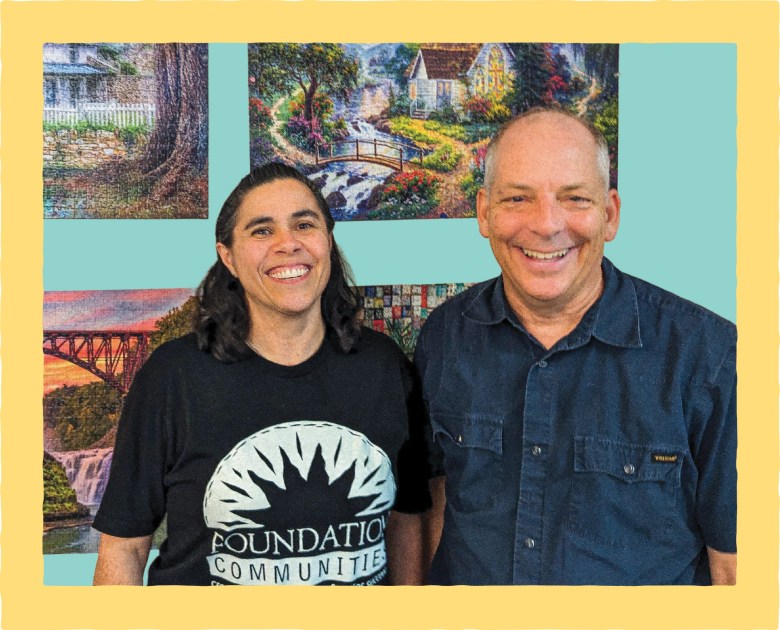 Sofia Barbato and Walter Moreau Credit: Brant Bingamon
Barbato was describing the groundedness it takes to stand beside someone who is suffering from mental illness. One in five Americans suffers from anxiety or depression, she said, but the homeless and formerly homeless have more debilitating illnesses, like schizophrenia. They may repeatedly sink into, and rise out of, psychosis. “It’s kind of just holding on and trying to have that relationship,” she said.
Barbato told us she began working at Garden Terrace 12 years ago, when she first became a case worker. Some of the facility’s 110 residents have lived there that entire time. Eight have lived there since the facility opened in 2003.
“So those relationships are really solid, and it’s nice, because then when folks have trouble again, we remember: ‘A couple years ago, what helped you in this situation? Is your sister still living in Roanoke? Let’s connect with her.’”
We asked Barbato what she likes about her job. She gestured to the puzzles on the walls. “So there’s these two residents who love doing puzzles together. And they are two of the most opposite people you would ever meet. But they both love puzzles, so they just do them together. And that’s a kind of bond. You know, it seems strange to think, ‘Oh, my reason to get up today is to finish this puzzle.’ But for some people, it really has just those connections.”
Moreau cut in gently: “Sofia, I’m not sure you answered the question.” Barbato paused. She started again.
“It really is about my faith tradition. I feel like we see God in other people. That is what I see here. And I feel like there’s no difference between me and the folks that live here. We have different jobs, and it has turned out maybe a little bit differently for me. But if I really think about it, I don’t feel like I’m here to help these folks. I feel like they have helped me – to know that you see the face of God in people.”
Foundation Communities’ Last Supportive Housing Project
The idea that homeless people, or formerly homeless people, or anyone, should be compelled to become self-sufficient is ridiculous to Moreau. He told us he’s 58 years old and doesn’t feel self-sufficient. He needs his wife and his friends and his church.
“We certainly want to help people get a job when they can,” Moreau said. “But the reality is, many people you encounter on the street, you wouldn’t offer them a job. That’s not true of everybody – you see some guys panhandling and washing windows, and they’re working, so you do respect that. But then you see other folks on the street who are actively psychotic. They’re talking to themselves, and need a lot of help. So it’s not just one answer.
“That’s the most frustrating thing that I’ve experienced in my career. Every few years, there’s some new prevailing opinion that ‘this is the answer to homelessness’ – you know, the silver bullet. And that’s wrong. It’s too complicated for one answer.”
Moreau’s friend, Alan Graham, founder and CEO of Mobile Loaves & Fishes, agrees. However, there is one principle that Graham, Moreau, and their peers believe is crucial to helping the chronically homeless – community. “We say that our model is built on the foundation of Housing First,” Graham said. “We also have a phrase: ‘Housing alone will never solve homelessness – but community will.’”
Graham’s reverence for community is reflected in the name of his tiny-home project in East Travis County, Community First! Village. Mobile Loaves & Fishes developed the project over several phases beginning in 2004. It is made up of dozens of tiny homes built around communal facilities – kitchens and dining halls, restrooms and laundries. The design provides residents a mix of privacy and community. Four hundred formerly homeless people live in Community First! Village, making Mobile Loaves & Fishes the second-largest provider of supportive housing in Central Texas. But the project is still expanding. Graham envisions it serving more than 1,900 people when it’s complete.
Graham has known Moreau for over 20 years. He calls him “the greatest affordable housing developer that I’ve ever seen around the country, and I’ve been to a lot of places.” He also calls him a “goober.”
“Not only are Walter and I good friends, our organizations are connected, and we leverage off of each other,” Graham said. “When we’re faced with different kinds of issues – it could be things like, ‘Here comes the great freeze’ – we’ll ask, ‘What are you guys doing? How are you guys dealing with those issues? How do you guys best deal with people that aren’t paying rent? What are you guys doing with the profound mental health issues that are happening?’”
Graham and Moreau recently entered into their first formal partnership, the creation of a supportive housing project in Southeast Austin that Graham calls Phase 4 and Moreau calls Burleson Studios. The project combines Community First! Village’s tiny-home model with Moreau’s apartments. Foundation Communities’ three-story structure is already in place on the property. It will offer 104 single-room-occupancy units. The project is expected to open next fall.
Moreau said Foundation Communities will keep building family properties but that Burleson Studios is the group’s last supportive housing project for now. The economics have gotten too hard.
“That’s our 10th supportive housing community, and then we’re not planning to do any more supportive housing for a long, long time. We’ve really reached our capacity as an organization. We have to sustain what we’ve got. We can’t build supportive housing and manage it wrong. Maybe in five or 10 years, the public funding environment will be different.”
10 NIMBY Battles
Moreau still has plenty of energy and still loves his work. That being said, he can imagine retiring when he turns 65. But first he wants to finish developing a project at the Mary Lee Foundation, behind the Saxon Pub. Foundation Communities also has entered into a partnership to build family housing next to the Town Lake YMCA. Both projects are set to break ground next year.
“I feel really lucky to have built a career here in Austin,” Moreau said. “I love live music. And Austin still feels like a small town a lot of times, when I run into people. I think that, overall, we are still a very caring community. I’ve been in 10 NIMBY battles, but we’ve always prevailed and found enough people in the community that support what we do.”
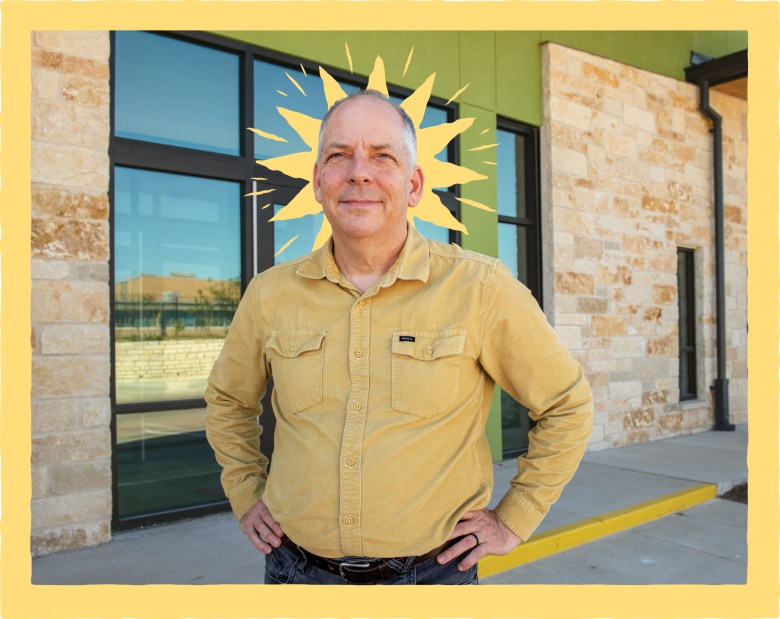 Credit: John Anderson / Design by Zeke Barbaro
Moreau’s “not-in-my-backyard” stories come from his supportive housing projects. In every one of them, residents fought to keep Foundation Communities out of their neighborhoods. Moreau told one of his favorite NIMBY stories.
“We bought the old Ramada Inn on Ben White. It’s now Skyline Terrace. And it was a bitter fight over zoning. And one of our opponents was a guy named Bob. He didn’t even live in the area, but he had some rental properties near the hotel. So he went down to City Hall and screamed and said, ‘This is drugs and crime! It’s gonna be horrible!’
“Five years later, we went to build Bluebonnet Studios just a mile away on South Lamar. At the neighborhood meeting, I saw Bob walk in and sit in the back of the room with his arms crossed. And I thought, ‘Oh shit, I’m gonna get another earful.’
“Towards the end of the meeting, he stood up and introduced himself. And he said, ‘I just really want to tell my neighbors that I fought and opposed Skyline Terrace five years ago, and I was wrong. Foundation Communities renovated that hotel, and they operated it really smoothly, and it’s been a great neighbor, and it really is helpful. And I feel so bad that I opposed it. And for all those reasons, I’m going to support Bluebonnet Studios.’
“It was one of those goosebump moments that – he’s converted. I come to find out later that what really made the difference is he goes to a Baptist church here in town, and was in a Bible study group with one of our residents at Skyline. The resident grew up in Austin, was addicted to drugs and alcohol, was on the street. A cousin scooped him off the street and took him to the Salvation Army men’s rehab center on South Congress, where he got sober. He stayed there two years. He was scared to leave because of relapse. But long story short, he eventually moved into Skyline Terrace and has done great. He’s still a resident.”
This article appears in December 5 • 2025.
A note to readers: Bold and uncensored, The Austin Chronicle has been Austin’s independent news source for over 40 years, expressing the community’s political and environmental concerns and supporting its active cultural scene. Now more than ever, we need your support to continue supplying Austin with independent, free press. If real news is important to you, please consider making a donation of $5, $10 or whatever you can afford, to help keep our journalism on stands.