
It was like a retirement party or a birthday party – even a wedding – but certainly not a funeral. From across town, artists, collectors, and gallerists came to pay homage to the matriarch of the Austin arts scene, Lora Reynolds, as she unveiled “Who made the grasshopper?,” her final exhibit at her eponymous gallery. Sharing stories from over the past 20 years, throwing around phrases like a “legendary show not to be missed,” Austin knew the closure of Lora Reynolds Gallery was the end of an era, deserving celebration in its fullest, final form.
Beginning her impressive career working at the top galleries of the art world, such as Anthony d’Offay and Matthew Marks, Reynolds brought her keen eye for enduring art to the South in 2005. Since then, the gallery has showcased works by titans of contemporary art, like Ellsworth Kelly and Ed Ruscha, and creators beloved by insiders, including Arlene Shechet, Karl Haendel, and the Haas Brothers. In doing so, the gallery became a space that championed mid-career and established artists worldwide, all at a Central Austin location on West Sixth. Forty-two of these artists were invited back for a final curtain call, and the result is spectacular.
“Who made the grasshopper?” fills the front, main, and back rooms, where many works reflect on a past life of the space – a previous exhibition, a relationship, a memory. As Colin Doyle, a partner of the gallery, led me through the venue, he relayed a personal story connected to almost every artwork, or the artists themselves.
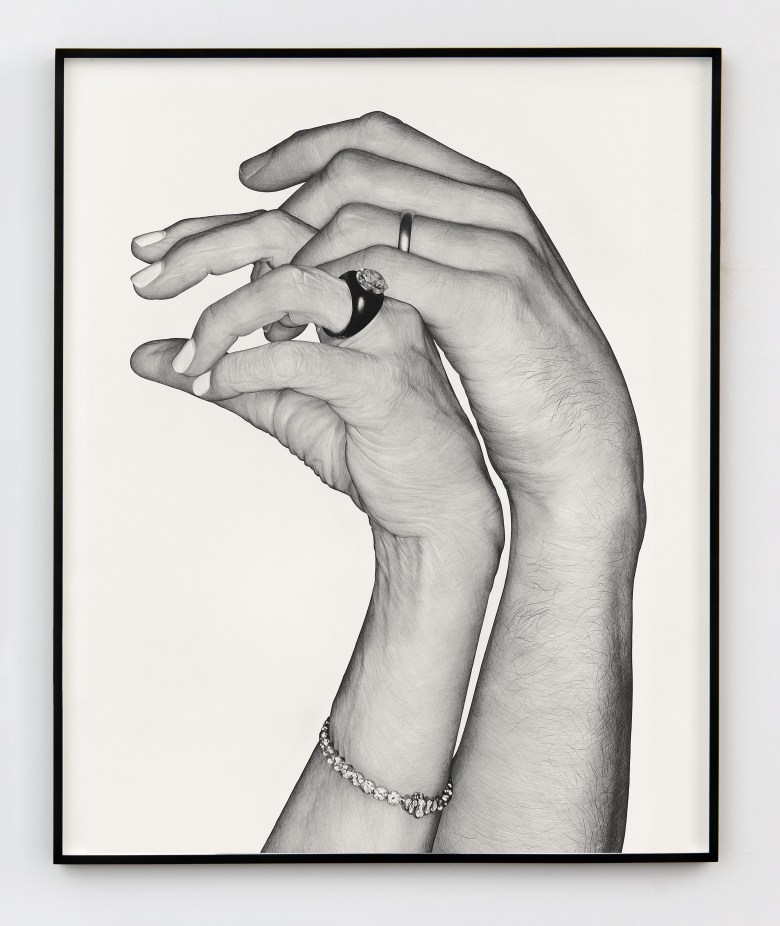 Karl Haendel’s Marriage Portrait (Lora and Colin) Credit: Lora Reynolds Gallery
Karl Haendel’s Marriage Portrait (Lora and Colin) had the most touching story of them all. Haendel’s enormous work on paper, featuring two ring-adorned hands laid atop one another, first meets your gaze as you step into the main space. Nothing is out of the ordinary except for the artist’s technical excellence, but as you step closer, each figure’s anatomy starts to fade. Manipulating Lora and Colin’s hands is the artist’s own interpretation of the two’s commitment to one another, and having been previously shown at the gallery, the portrait is not only a product of his and Reynolds’ longstanding friendship but also evidence that the gallery-artist relationship is one to be cherished.
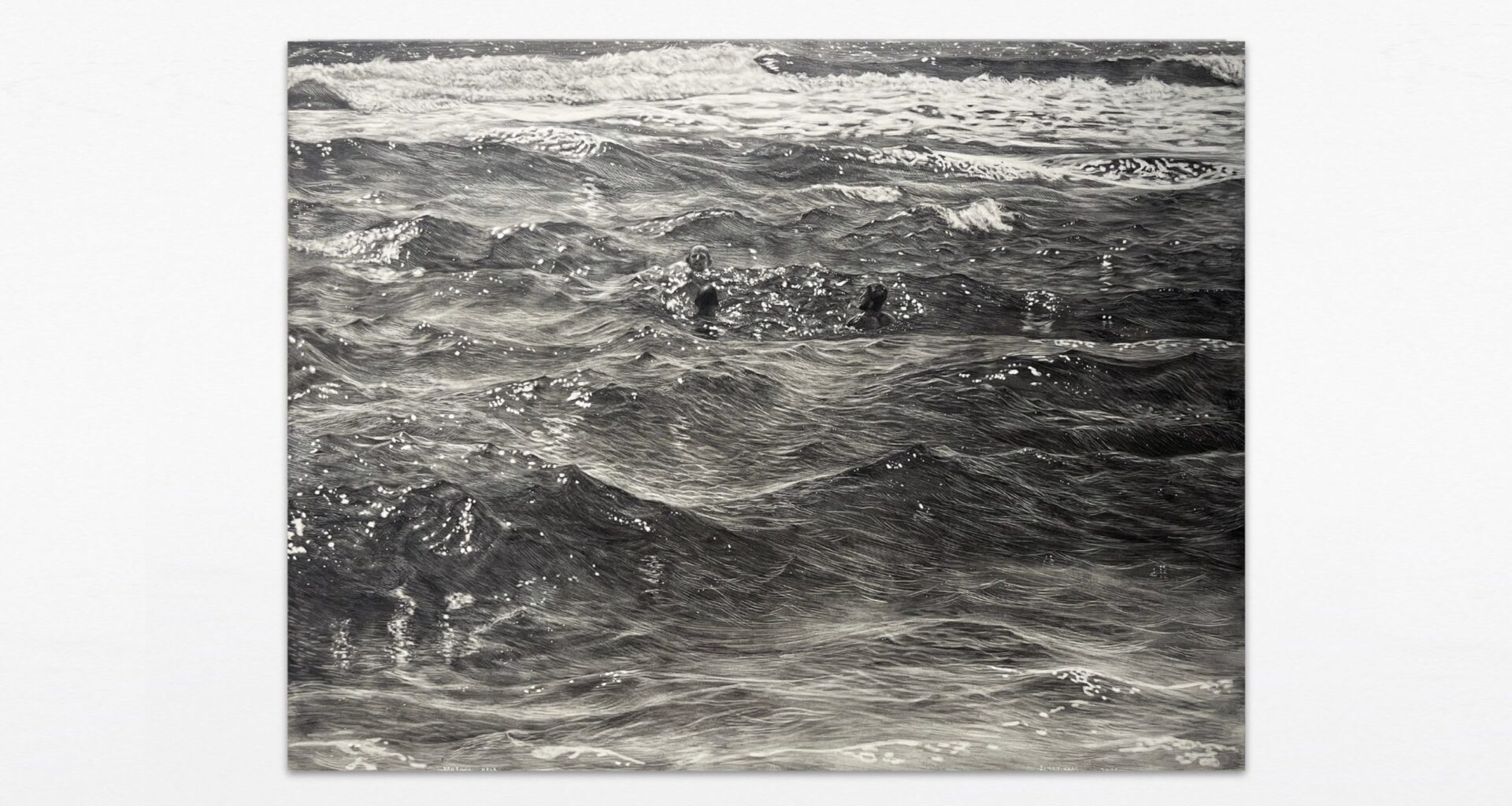
Two steps away from Haendel’s work on paper, you’ll find another black-and-white piece. Smaller in scale yet precise in execution, Simon Haas’ Nautilus Walk takes place on the historic Fire Island, where three male heads float in glistening waves. Queer friendship imbues the tender scene, a moment that feels deeply personal yet unequivocally universal.
I was surely impressed by the technicality of the work, but was taken aback when I realized it was completed by one-half of the Haas Brothers duo. Natives of Austin, the siblings are known for their biomorphic sculpture and furniture, which was recently featured at the Nasher and Cranbrook museums. Yet Simon’s work here couldn’t be further from the duo’s fantastical oeuvre; rather, this honest work on paper reckons with the artist’s queer identity, particularly poignant given that it’s been showcased right in his hometown. Here lies one of the many gifts of Lora Reynolds Gallery: The gallery reveals what otherwise might be left unseen and offers artists the space to flourish in their practice, both technically and personally.
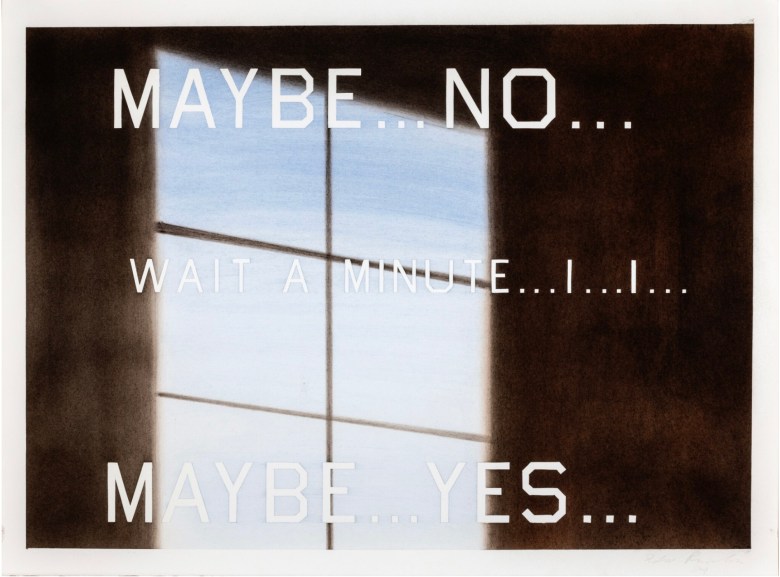 Ed Ruscha’s Maybe, Maybe Credit: Lora Reynolds Gallery
Beyond these two pieces, “Who made the grasshopper?” comprises Reynolds’ final curated selection of paintings, photographs, and sculptures from throughout her tenure. Similar to the Haendel and Haas, the works reveal Reynolds’ signature: a sense of mastery and a value for tiny systems, honed over the last two decades.
The closing of a gallery within an art ecosystem provokes a mental shift and leaves participants speculating: Is there a dip in the art market? Are personal events to blame? Financial? The simple answer for Reynolds: It’s just time. With her kids off to college and priorities shifting, the Lora Reynolds Gallery closes its doors when “Who made the grasshopper?” wraps in January, but the Mary Oliver poem that gives the show its name summarizes the beauty of an ending: “Doesn’t everything die at last, and too soon? Tell me, what is it you plan to do with your one wild and precious life?”
Who made the grasshopper?
Lora Reynolds Gallery
Through Jan. 24
This article appears in December 5 • 2025.
A note to readers: Bold and uncensored, The Austin Chronicle has been Austin’s independent news source for over 40 years, expressing the community’s political and environmental concerns and supporting its active cultural scene. Now more than ever, we need your support to continue supplying Austin with independent, free press. If real news is important to you, please consider making a donation of $5, $10 or whatever you can afford, to help keep our journalism on stands.